Donut Volume Calculator
Estimate donut ring volume, dough weight, proof expansion, batch dough, frying loss, and glaze coverage from the finished ring size, thickness, recipe style, and coating plan.
🍩Donut presets
Choose a real shaping scenario, then adjust the ring diameter, center hole, thickness, proof expansion, frying loss, glaze, and batch count.
📏Calculator inputs
Volume and batch breakdown
📊Dough density and proof reference
📏Ring size guide
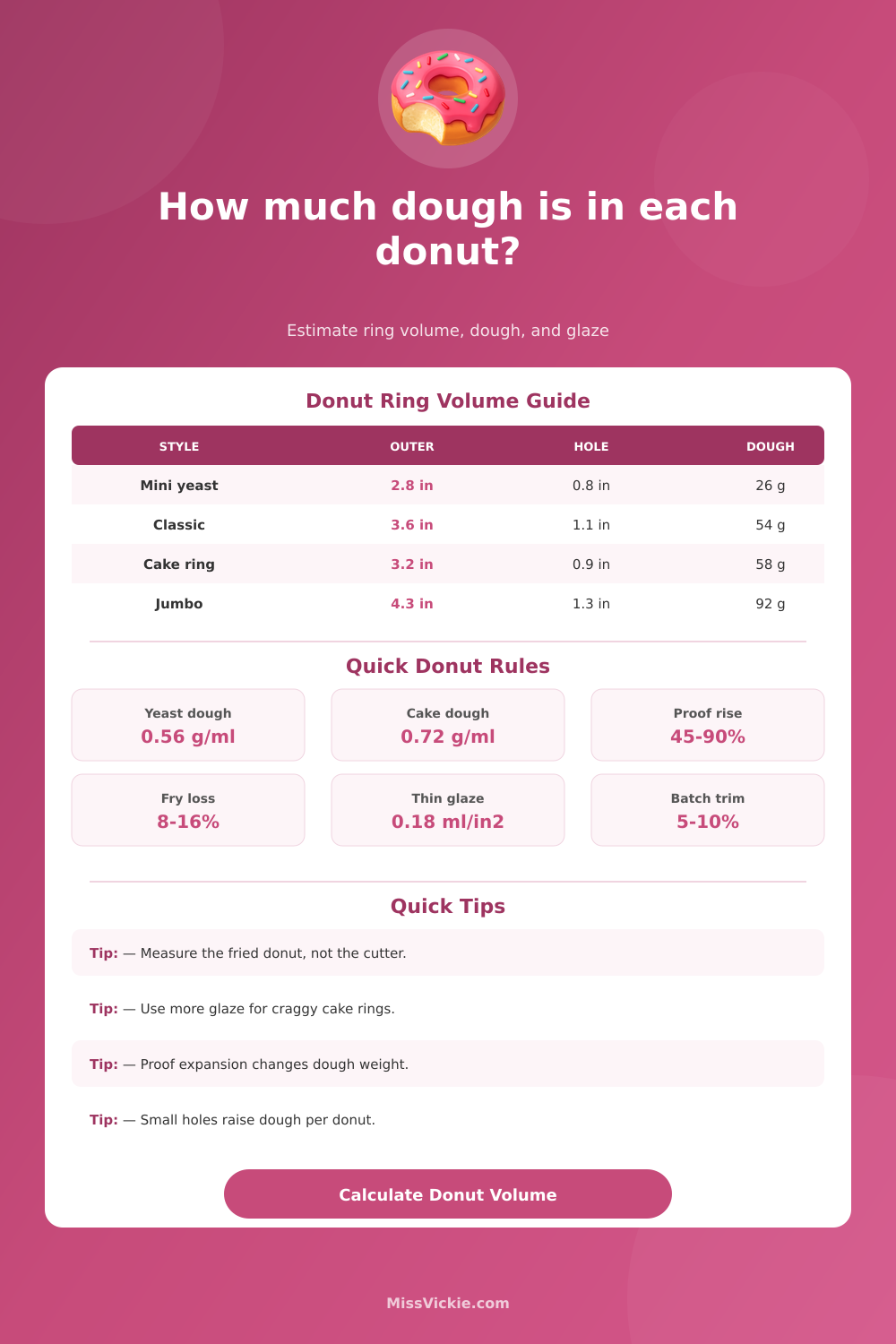
| Donut style | Outer diameter | Hole diameter | Thickness | Usual dough weight | Good use |
|---|---|---|---|---|---|
| Mini yeast ring | 2.6 to 3.0 in | 0.7 to 0.9 in | 0.75 to 0.9 in | 24 to 32 g | Platters, kids, tastings |
| Classic raised ring | 3.4 to 3.8 in | 1.0 to 1.2 in | 0.95 to 1.15 in | 48 to 62 g | Standard glazed donuts |
| Large bakery ring | 4.0 to 4.5 in | 1.2 to 1.5 in | 1.1 to 1.35 in | 78 to 105 g | Filled cases and premium toppings |
| Cake donut ring | 3.0 to 3.5 in | 0.8 to 1.1 in | 0.9 to 1.15 in | 52 to 72 g | Plain, chocolate, cider, sugar coat |
| Old fashioned ring | 3.1 to 3.7 in | 0.7 to 1.0 in | 1.0 to 1.3 in | 65 to 90 g | Cracked glaze and crunchy ridges |
| French cruller | 3.2 to 3.8 in | 1.0 to 1.4 in | 0.8 to 1.0 in | 32 to 48 g | Light choux rings and thin glaze |
The calculator lets the measured ring shape override these ranges. Use the table when you need a starting point for cutters or a batch sheet.
🍯Glaze coverage guide
Coating pickup by finish
| Finish | Pickup rate | Texture factor | Best estimate |
|---|---|---|---|
| Thin vanilla glaze | 0.18 ml per sq in | Low | Light shine, quick drip |
| Standard glaze | 0.24 ml per sq in | Medium | Classic raised donut coat |
| Thick icing glaze | 0.34 ml per sq in | High | Opaque top dip |
| Chocolate icing | 0.38 ml per sq in | High | Top-heavy bakery finish |
| Cinnamon sugar | 0.11 ml per sq in | Dry coat | Oil pickup plus sugar cling |
Batch planning checkpoints
| Batch | Donut size | Dough range | Glaze range |
|---|---|---|---|
| 12 minis | 2.8 in | 0.32 to 0.42 kg | 45 to 80 ml |
| 24 classic | 3.6 in | 1.25 to 1.55 kg | 170 to 260 ml |
| 36 cake rings | 3.3 in | 2.0 to 2.7 kg | 240 to 390 ml |
| 48 jumbo | 4.3 in | 4.2 to 5.3 kg | 520 to 820 ml |
| 72 mixed | varied | 4.0 to 6.0 kg | 650 to 1100 ml |
🧮Comparison grid
Large volume change means cutter size and proof time matter more than density alone.
Lower proof expansion and denser batter make the same ring size need more dough.
Cracks and ridges increase real surface area, so glaze pickup runs higher.
Steam expansion gives a high-volume ring with surprisingly low dough weight.
📝Volume tips
In order to scale a donut recipe, each donut must have a same amount of dough. The weight of the dough within each donut will determine if that donut contain light and airy qualities or if the donut is dense and greasy. Many people attempt to calculate the weight of the dough by measuring ingredients in cup.
Yet, cup measurements are not accurate measurements because the shape of the donut, the proof expansion of the dough, and the loss of moisture during the frying process can all change the weight of the dough within each donut. Thus, it is important for individuals to calculate the weight of the dough that will be used in each donut correctly in order to save time, reduce waste in the baking process, and to ensure that each batch of donuts have the same texture. The volume of a donut ring is defined by three specific measurement.
How to Calculate How Much Dough Each Donut Needs
These three measurements are the finished outer diameter of the donut, the size of the center hole in the donut, and the thickness of the donut ring after frying the donut. Each of these three measurements defines the volume of the donut once it is cooked. The volume can be used to find the amount of dough that was used for proof expansion, and the amount of dough that was used can be used to find the weight loss of the donut after frying.
Each of these three measurements can impact the amount of dough that is needed for the donut recipe; for instance, if the size of the center hole is smaller, the amount of dough that is required for the donut will increase because the smaller hole will make the donut ring more thicker. Dough density is a variable that will change according to the type of donut that is to be produced. For instance, dough that contains yeast will be a much lighter dough than cake donuts; cake donuts contain a much denser batter.
Thus, a cake donut will hold more weight than a donut that contains yeast. Additionally, old-fashioned donuts will also tend to be dense because the dough for those donuts is stiff enough to produce the ridges on the donut. Thus, you can adjust the density of the dough in the donut calculator to allow for changing between recipes and hydration levels.
Additionally, small changes in the density of the dough can lead to large changes in the amount of flour that is needed for a large batch of donuts. Lastly, proof expansion is the expansion of the dough between the time that the dough is cut and the time when the dough is fried. Proof expansion changes the size of the dough pieces.
Thus, if there is high proof expansion, the size of the pieces of dough will increase between cutting and frying the donuts; high proof expansion allows for smaller pieces of dough to be cut. Low proof expansion indicates that the size of the pieces will be similar between cutting the dough and frying the donuts. Although the volume of the finished donut ring may stay the same, the amount of dough you have to scale will change due to proof expansion changing.
Frying loss is the reduction in the weight of the dough when it is placed into hot oil. When dough is fried, between 8 and 16% of the weight of the dough are lost due to the moisture leaving the dough as steam and oil entering the dough. The longer the donut is fried or the more water content is present in the dough, the greater the frying loss.
Due to frying loss, the finished donut will weigh less than the raw dough. Accounting for frying loss is important because glaze will cover the finished donut, and the finished donut does not have the same weight as the raw dough. The surface area of the donut that will be covered in glaze is another factor to consider.
A donut ring that contains a large center hole contains less dough, yet it will have a wide surface area for the glaze to cover. Old-fashioned and cake donuts contain more surface area due to the texture of the donut. A texture factor can be used in the glaze calculator to account for the difference in texture between donut varieties.
The batch size require you to plan for extra dough. Extra dough is needed for dough scraps and re-rolls. A trim allowance for bench dough scraps and re-rolls prevents dough from running out during the production of donuts.
A trim allowance is an extra percentage of weight of dough that is added to the calculated weight of dough for a batch. As the batch size increases, the impact of factors like density and proof expansion has a greater impact on dough weight. A small percentage adjustment to dough weight is made for small batch sizes.
The same percentage adjustment to the same batch size will result in a large adjustment in the weight of dough needed. Kitchen conditions can change during the production of donuts. Changes in ambient temperature in the kitchen can change proof time.
The oil temperature can change during a long production run of donuts. The last donuts proofed on a tray may not have the same proof time as the first donuts proofed on that same tray. A glaze calculator provides a starting point for kitchen donut production.
Using the starting point as a baseline for donut production allows for dough adjustments according to changing kitchen conditions. Measure the finished donut rather than measuring the cutter to obtain the most accurate results. Cutters, proofing, and frying all change the dimensions of the donut.
Measuring the finished donut will provide more accurate results than measuring the cutter. By measuring the finished donut, you can determine the weight of dough that should be used in future batches of donuts to achieve the same results. Measuring the finished donut will help you to understand how your dough and equipment impact the finished donut results.