🥃 Distilling Calculator
Calculate spirit yield, ABV, cuts, and dilution for your home or craft distillery
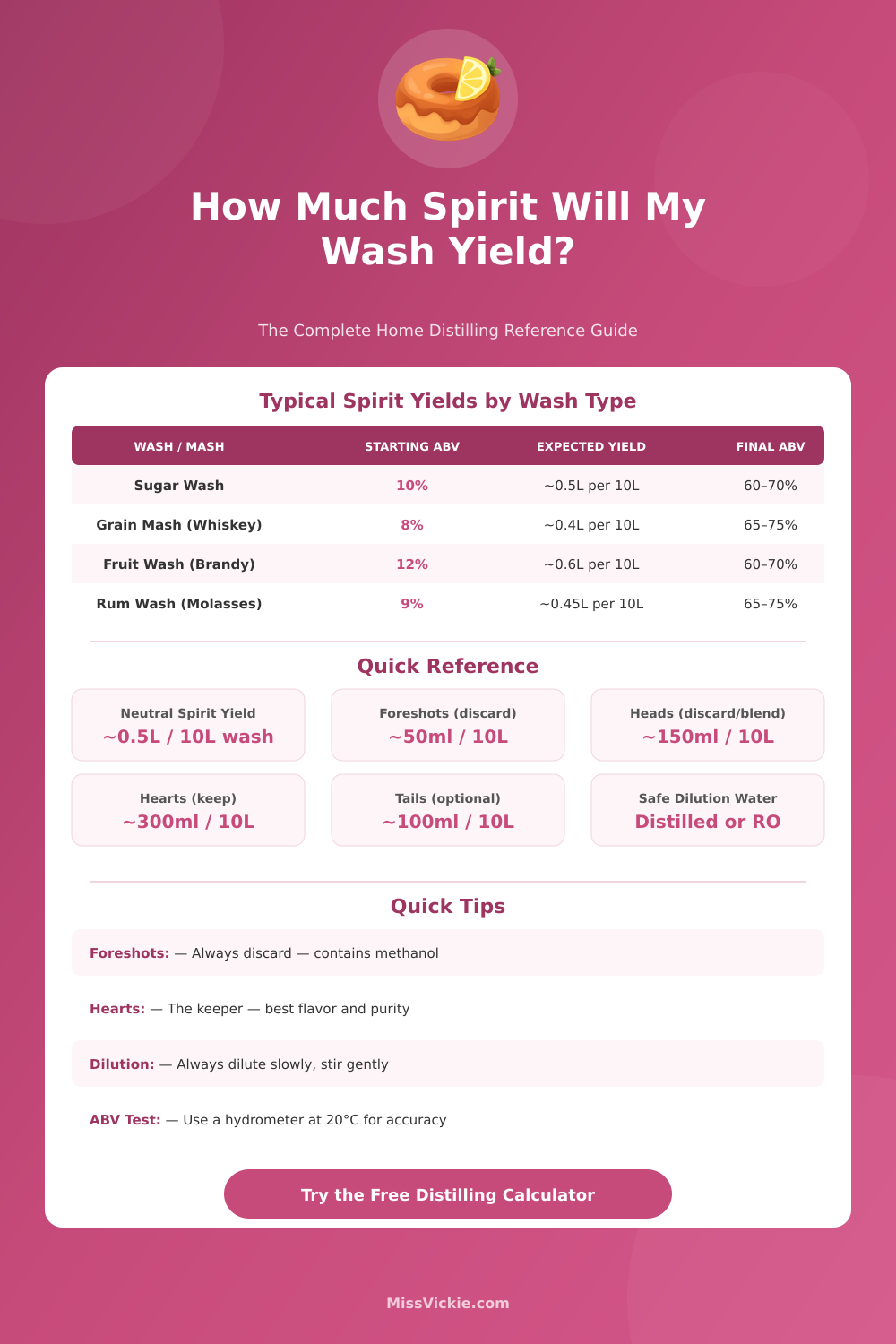
| Wash Type | Wash ABV | Still Efficiency | Pure Alcohol (L) | Spirit at 65% (L) | Bottles (700ml) |
|---|---|---|---|---|---|
| Sugar Wash | 10% | 75% | 0.75L | 1.15L | ~1.6 |
| Sugar Wash | 14% | 75% | 1.05L | 1.62L | ~2.3 |
| Grain Mash | 8% | 75% | 0.60L | 0.92L | ~1.3 |
| Fruit Wash | 12% | 75% | 0.90L | 1.38L | ~2.0 |
| Rum Wash | 9% | 75% | 0.68L | 1.04L | ~1.5 |
| Any Wash (column) | 10% | 90% | 0.90L | 1.38L | ~2.0 |
| Cut Fraction | % of Total Run | ABV Range | Action | Notes |
|---|---|---|---|---|
| Foreshots | ~5% | 85%+ | Always Discard | Contains methanol, acetone |
| Heads | ~15% | 75–85% | Discard or blend back | Harsh, solvent notes |
| Hearts | ~60% | 60–75% | Keep — primary product | Clean, best flavor |
| Tails | ~20% | 40–60% | Re-run or discard | Fusel oils, heavier flavor |
| Starting ABV | Target ABV | Water per 1L Spirit | Final Volume |
|---|---|---|---|
| 70% | 40% | 750ml | 1.75L |
| 65% | 40% | 625ml | 1.63L |
| 75% | 40% | 875ml | 1.88L |
| 80% | 40% | 1,000ml | 2.00L |
| 70% | 43% | 628ml | 1.63L |
| 70% | 37.5% | 867ml | 1.87L |
| ABV (%) | US Proof | UK Proof | Typical Spirit |
|---|---|---|---|
| 37.5% | 75 | 65.6° | Minimum EU spirit |
| 40% | 80 | 70° | Standard whiskey / vodka |
| 43% | 86 | 75.3° | Premium rum / gin |
| 46% | 92 | 80.5° | Cask-strength lite |
| 57% | 114 | 99.75° | Navy strength gin |
| 63% | 126 | 110.3° | Cask-strength whiskey |
At the heart of distilling simply separate liquids by boiling and condensation One can ultimately receive almost pure substances or something in between. When dealing with spirits, the main target is alcohol together with those flavors and aromatic elements, that make it interesting. Here you work with weak base as wine or beer, or you take already strong and strengthen it yet.
For turn grains or potatoes into spirits, you warm them in water to create mash. Later add enzymes, that smash starches into sugars, that fermentation can use. First you give grains time to get ground, later cook them, heat alters starches into fermentabel sugars.
How Spirits Are Made
When yeast enters the mix, it acts on those sugars and produce alcohol. At the end of fermentation you have basic beer, that then pass to the next stage.
The real distilling happen in stills, that come in many forms and shapes. Every type leaves its own mark in the taste and alcoholic strength. There is fractional, simple, steam and vacuum distilling, each operates a bit different and give different results.
Whiskey spirits start from grains, that is fermented in mash and later distilled, without the bitterness typical for beer. Fermentation requires time and good gear. Scotland is famous because of single malt whiskeys, and that name is protected, strict rules define what qualifies.
They use pot stills for distilling, that is less fast and efficient than modern column, but they preserve more flavor nuances intact.
Rum is born from fermented juice of cane sugar, molasses, yeast and water mixed together. Some distillers add white sugar, brown sugar, cane syrup or dehydrated cane sugars. Advantage of molasses is, that it costs less and do not require cooking before fermentation.
Because of that it answers for basics.
From wine you distill brandy simply passing it through still. Additional distillation give neutral spirit, that serves base for gin and alike. But here matters what went in: bad ingredients give bad results, so good quality originally ensures everything later.
Producers of bourbon have custom recycle part of used grain solids, called backset, in the next fermentation. They mix around 25 percent, and that is legally required for bourbon, it belongs to the sour mashing. That provides nutrients for fermentation and deepen the taste of the mash.
About service standard is 1,5 ounces of 80-proof spirit.