🕶 Distilling Yield Calculator
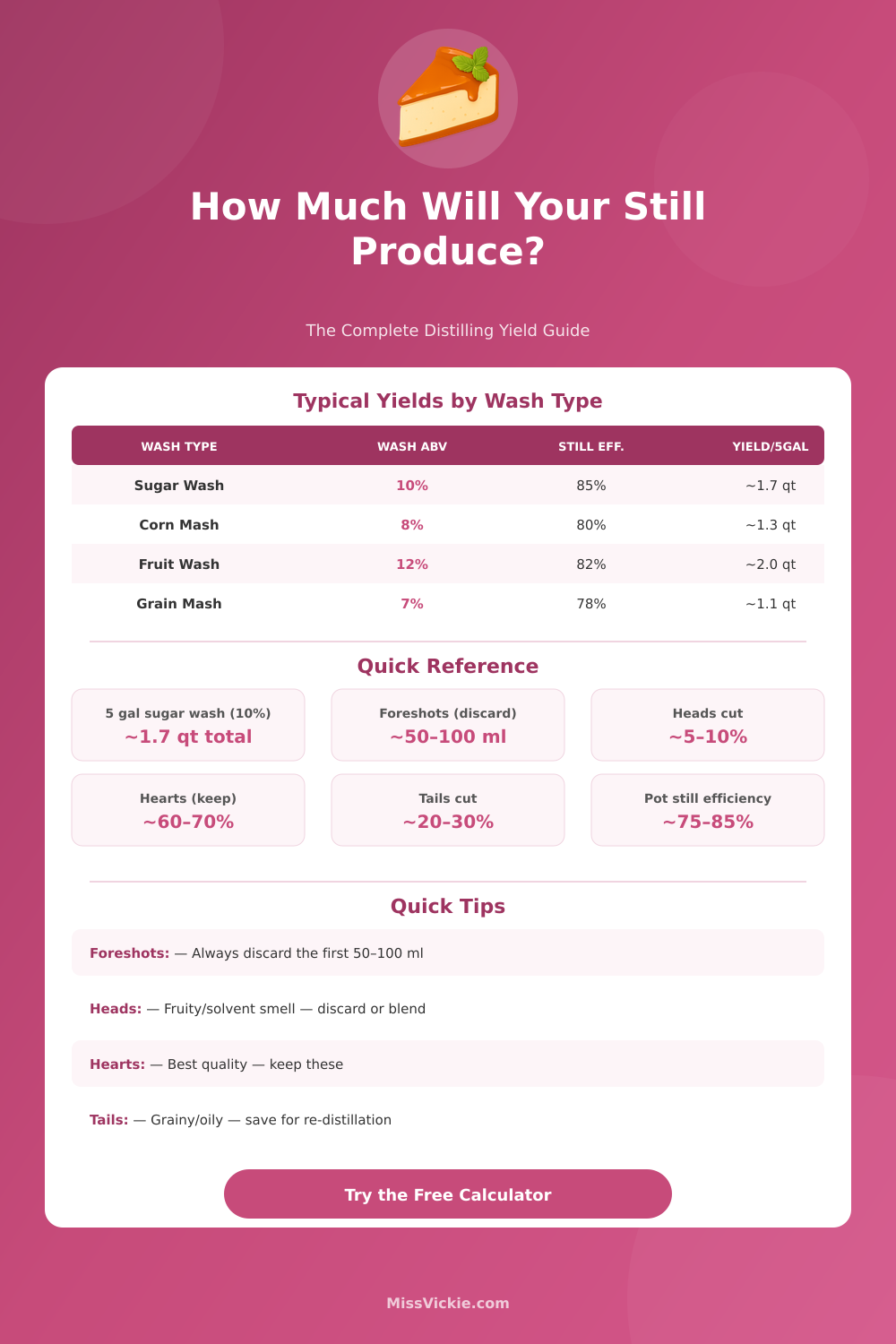
Estimate your total distillate output, cuts breakdown, and final proof from any wash or mash
| Wash Volume | Pure Alcohol | Total Distillate (60 proof) | Hearts Only (65%) |
|---|---|---|---|
| 1 gallon (3.8 L) | 0.34 qt (0.32 L) | 0.68 qt (0.64 L) | 0.44 qt (0.42 L) |
| 5 gallons (19 L) | 1.70 qt (1.61 L) | 3.40 qt (3.21 L) | 2.21 qt (2.09 L) |
| 10 gallons (38 L) | 3.40 qt (3.21 L) | 6.80 qt (6.43 L) | 4.42 qt (4.18 L) |
| 15 gallons (57 L) | 5.10 qt (4.82 L) | 10.2 qt (9.64 L) | 6.63 qt (6.27 L) |
| 20 gallons (76 L) | 6.80 qt (6.43 L) | 13.6 qt (12.9 L) | 8.84 qt (8.36 L) |
| Wash ABV | Pure Alcohol | Total Distillate | Hearts Cut |
|---|---|---|---|
| 6% | 1.02 qt (0.97 L) | 2.04 qt (1.93 L) | 1.33 qt (1.25 L) |
| 8% | 1.36 qt (1.29 L) | 2.72 qt (2.57 L) | 1.77 qt (1.67 L) |
| 10% | 1.70 qt (1.61 L) | 3.40 qt (3.21 L) | 2.21 qt (2.09 L) |
| 12% | 2.04 qt (1.93 L) | 4.08 qt (3.86 L) | 2.65 qt (2.51 L) |
| 14% | 2.38 qt (2.25 L) | 4.76 qt (4.50 L) | 3.09 qt (2.93 L) |
| 16% | 2.72 qt (2.57 L) | 5.44 qt (5.14 L) | 3.54 qt (3.34 L) |
| Proof (US) | ABV % | Common Name | Notes |
|---|---|---|---|
| 80 proof | 40% | Standard Spirit | Legal minimum for whiskey/vodka |
| 90 proof | 45% | High-Proof | Many bourbons and ryes |
| 100 proof | 50% | Bottled-in-Bond | US legal standard for BiB |
| 120 proof | 60% | Cask Strength | Typical new distillate target |
| 140 proof | 70% | High Wine | Second distillation output |
| 160 proof | 80% | Light Whiskey Legal Max | US regulation max for whiskey |
| 190 proof | 95% | Neutral Spirit | Column / reflux still output |
At the core, distilling simply separates the parts of liquid by boiling and condensing the steam. With spirits it intends to extract alcohol and those flavor compounds through evaporation. Seems quite easy but under the surface happens a whole world of chemistry
Working with grains or potatoes, you heat the ingredients in water to create mash. Enzymes are added to the mix, because they break the starches so that fermentation can act. You remove the grain, cook it to convert starches to sugar, later mix with yeast that turns everything into alcohol.
How Spirits Are Made
After fermentation you have basic beer, ready for distilling into stronger spirit.
Distilling becomes excting here, where everything becomes truly interesting. Stills come in various forms and sizes, and each leaves its mark on the taste and strength of the final spirit. Whiskey from grains is basically only distilled beer without hops.
Arriving to fermentation stage requires time and right gear however. Rum usually ferments from juice of cane sugar with molasses, yeast and water. Distillers occasionally vary…
Using white sugar, brown cane sugar, cane syrup or dehydrated cane sugar instead.
Wine turned into brandy is a good entry for many folks. Cheap wine can pass through a still, but understand the rules and study before starting. Repeatedly distilling it becomes neutral spirit, from that you prepare gin.
The most important cause? The quality of your coarse materials. Bad entry gives bad result.
Bourbon makers traditionally preserve around 25 percent of the used liquid from one batch and mix it in the next fermentation. That is compulsory for bourbon and called sour mash. The backset feeds fermentation and adds taste to the new mix.
Scottish single malts distill in pot stills, that is slower and less efficient than columns, but that slow mode preserves full taste.
Serving, standard dose of 80 proof spirit is 1.5 ounces. It matches approximately 12 ounces of 5 percent beer or 5 ounces of 12 percent wine. Molasses is cheap and does not require cooking before fermentation, hence rum appeals to newcomers.
Funny, folks commonly enter the hobby in unusual ways, for example wanting to do homemade bitters and realizing they require high proof alcohol to do it right.