Deep fry timing, air fryer heat, oil coating, basket load, and shake math
Deep Fryer to Air Fryer Converter
Convert deep fryer recipes for air fryer cooking with food-specific timing, temperature adjustment, weight or thickness changes, oil coating level, basket crowding, and shake intervals.
Load a common deep-fried food, then adjust the temperature, batch size, oil coating, basket load, and shake schedule for your air fryer.
Conversion Breakdown
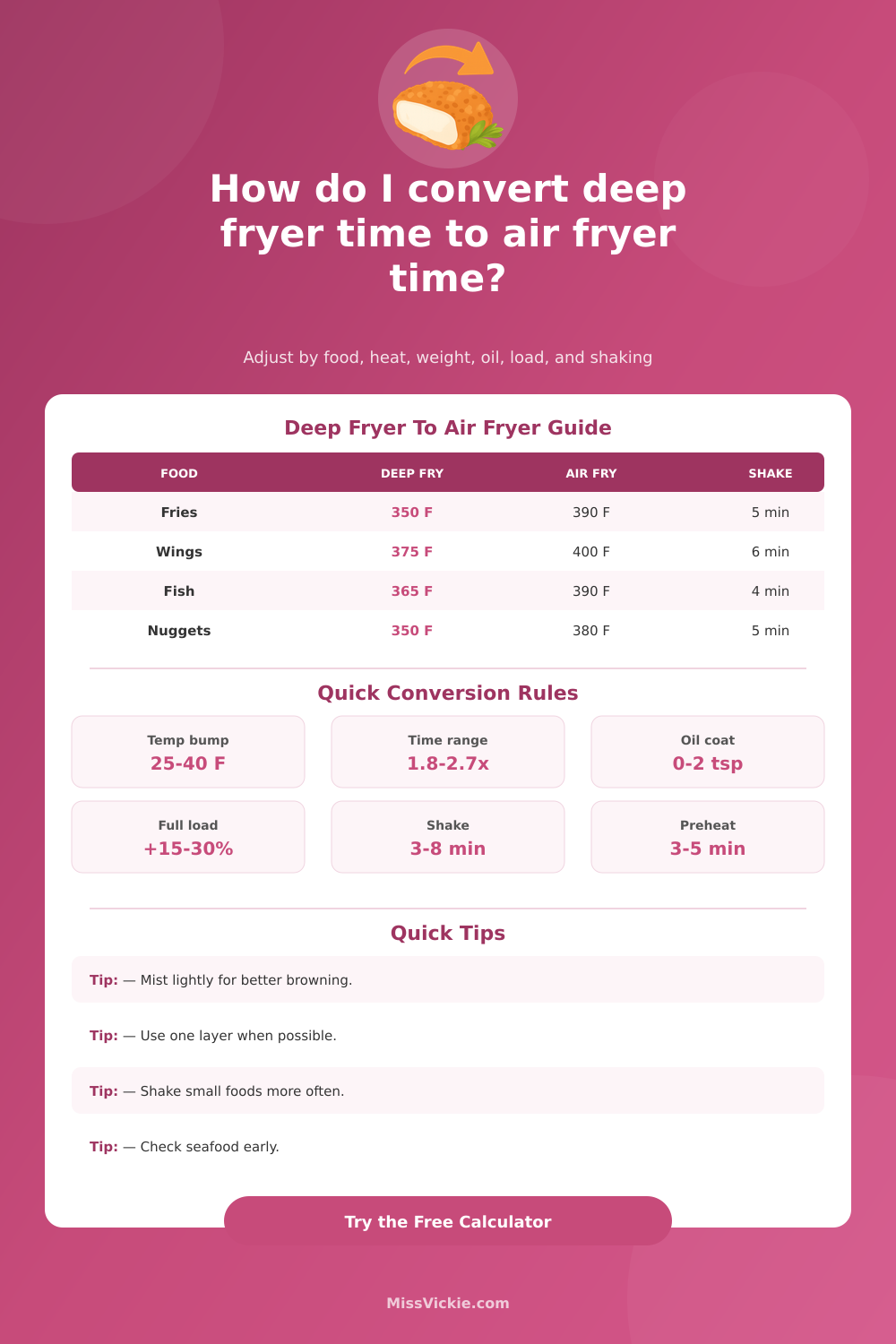
| Food Type | Deep Fry Baseline | Air Fry Baseline | Best Shake Plan | Notes |
|---|---|---|---|---|
| Frozen french fries | 350 F for 3-5 min | 390 F for 12-18 min | Every 5-6 min | Spread loose for airflow and finish extra crisp. |
| Fresh cut fries | 325 F then 375 F | 380-400 F for 16-24 min | Every 4-5 min | Soak, dry well, and oil lightly before cooking. |
| Chicken wings | 375 F for 8-10 min | 390-400 F for 18-26 min | Every 6-8 min | Use a thermometer and crisp skin at the end. |
| Breaded tenders | 350 F for 5-7 min | 380-400 F for 12-18 min | Turn halfway | Spray dry flour spots so crumbs brown evenly. |
| Fish fillets | 365 F for 3-5 min | 380-390 F for 9-14 min | Turn once | Check early because thin fillets dry quickly. |
| Onion rings | 375 F for 2-3 min | 375-390 F for 8-12 min | Every 4-5 min | Leave space around rings to protect the coating. |
| Adjustment | Light Batch | Normal Batch | Full Batch | Crowded Batch |
|---|---|---|---|---|
| Time change | Reduce 4-8% | Base time | Add 12-18% | Add 25-35% |
| Oil coating | 0.25-0.5 tsp | 0.5-1 tsp | 1-1.5 tsp | Cook in batches |
| Shake interval | 6-8 minutes | 5-6 minutes | 4-5 minutes | 3-4 minutes |
| Best use | Seafood, sticks | Fries, nuggets | Wings, tenders | Only sturdy foods |
| Piece Style | Typical Thickness | Timing Effect | Shake or Turn | Finish Cue |
|---|---|---|---|---|
| Thin fries and rings | 0.25-0.4 in | Fast browning | Shake often | Edges look dry and crisp. |
| Nuggets and shrimp | 0.5-0.8 in | Moderate timing | Shake or turn once | Coating is firm and hot inside. |
| Tenders and fillets | 0.75-1.25 in | Add 10-25% | Turn once gently | Check center temperature. |
| Wings and dense veg | 1-2 in | Add 20-35% | Shake twice or more | Skin or coating is deeply crisp. |
Air fryer estimates are planning numbers. For poultry, seafood, and thick pieces, confirm doneness with a food thermometer.
Oil surrounds food, so browning is rapid and moisture loss is lower.
Hot air needs more time, space between pieces, and occasional shaking.
A thin mist replaces immersion oil and helps crumbs or starch brown.
A single loose layer is the closest match to deep fryer crispness.
Deep frying and air frying is two different methods of cooking food. Therefore, when deep frying and air frying are performed with different methods of transferring heat to a food, the results will be different. Deep frying require cooking the food in hot oil so that each surface of the food are surrounded by hot oil at the same time.
Air frying requires that hot air move around the food that is to be cooked. Therefore, air frying takes longer than deep frying, requires more heat to reach the food, and requires more space for the hot air to move around the food. A deep fryer to air fryer converter is a tool that can help to bridge the gap between deep frying and air frying.
How to Convert Deep Frying to Air Frying
The deep fryer to air fryer converter will ask for the original deep-fry temperature of the food. This original deep-fry temperature informs the deep fryer to air fryer converter how much moisture is to be removed from the food during deep frying. To air fry the same food, you will have to raise the temperature by a modest amount.
This additional heat work to compensate for the fact that hot air transfers heat to the food at a slower rate then hot oil does. The suggested temperature will be in the low-to-mid range with the original deep fry temperature. Additionally, other inputs will determine the exact temperature that the food should be air-fried to.
The weight and thickness of the food to be cooked will factor into the deep fryer to air fryer converter. The weight and thickness of the food will impact how long it takes for the heat to reach the center of the food. For instance, thin pieces of food will cook to the desired doneness in a shorter period of time than thick piece of food.
For these reasons, the deep fryer to air fryer converter can ensure that you dont have to guess whether you need to add time to the beginning of the cooking process or whether you need to add time towards the end of the cooking process. Additionally, if you increase or decrease the recipe as per your need, the deep fryer to air fryer converter will factor in the evenness of the cooking of each piece of food. Oil coating is one of the most surprising factors that the deep fryer to air fryer converter will factor in to prepare your food for air frying.
Fat is continuously supplied to the food while deep frying; the same amount of fat are not supplied while air frying. Instead, you must rely on the hot air to supply the browning of the fat that is applied to the food. An insufficient amount of oil will produce food with a pale exterior while an excess of oil can cause the outside of the food to become soft; it will steam rather than properly cook.
The deep fryer to air fryer converter will provide an appropriate amount of oil so that you can decide whether the food should be lightly mist with oil or whether it should be lightly tossed in oil. Basket load and shake intervals are another set of factors that the deep fryer to air fryer converter will consider. Food that is cooked in the air fryer will naturaly have the opportunity to touch other pieces of food.
If the pieces of food to be cooked touch each other, they will block the air from fully cooking each piece of food. Food will brown differently depending on whether it remains in place for long periods of time. To counteract this, you should shake air fryers so that food is continually moved.
The deeper the load of food in the air fryer basket, the more frequently the basket should be shaken. The deep fryer to air fryer converter will account for the load of the food so that you dont have to wonder when or how often to shake the air fryer basket. Lastly, the starting temperature of the food and the desired finish of the food will be the last of the factors considered by the deep fryer to air fryer converter.
Food that is started at a frozen temperature will take more time to dry than food that is at room temperature. Additionally, food that is desired to have crispier edges will take more time to cook at the same temperature rather than higher temperatures that could cook the interior of the food to the desired doneness. These choices may seem small, but they will have an important impact on the outcome of air frying the food.
One of the advantages of air frying rather than deep frying is that you have more control over the cooking process. You can see the food while it is cooking and you can stop the cooking process at any time. This level of control is only effective if the time parameters is set appropriately.
The deep fryer to air fryer converter makes timing the cooking process reasonable by performing calculations based on the type of food, the weight of the food, and the cooking conditions that will be utilized while air frying. Despite the advantages of air fryers, there are some common mistakes that many people make when they are changing from deep fryers to air fryers. One of the most common is that people use the same time parameters for deep frying and air frying.
Additionally, another mistake that people make is that they use the highest setting on the air fryer. People make these mistakes because people tend to treat air fryers and deep fryers as the same appliance. However, deep fryers and air fryers are two different appliances with some similarities in their cooking processes.
One habit that can be developed with air fryers is to check the food towards the beginning of the cooking process and towards the end of the cooking process. A few minutes prior to the lower end of the time parameters for air frying the food, it is always helpful to inspect the color and texture of the food. If the food requires more time to brown, it can be placed back into the air fryer with the basket closed for an additional period of time.
If the food is browning to your liking, it can be removed from the air fryer. The deep fryer to air fryer converter will provide a starting point for cooking the food. However, it will not provide a schedule for when you should check in on the food.
Another habit that can be developed is to look into the air fryer basket at the halfway mark of the cooking process. This will provide information as to how the food is cooking in the air fryer basket. This will allow you to gain an understanding of your air fryers hot spots, the size of the food, and the movement of the food in the air fryer basket.
By checking the food while air frying, you will be able to gain an understanding of the quirks of your air fryer faster than if you read the manufacturers manual. Additionally, the deep fryer to air fryer converter will make it easier for you to cook food in smaller batches. Smaller batches will provide better texture to the food than larger batches of food.
After using the deep fryer to air fryer converter to air fry food several times, the suggested times for air frying and the amount of oil to use will become second nature to you. Your intuition will allow you to understand whether the food should be lightly coated in oil and whether it should be added to the air fryer basket as a loose layer of food. These are the primary factors in air frying food.
Other factors, such as time and oil amount, will act as fine adjustments to the cooking process. The deep fryer to air fryer converter will help you to understand these elements of cooking food so that you dont have to use trial and error to perfect the air frying process. While the goal is not to replicate the experience of deep frying, the results of air frying will be close enough to deep frying that the trade-offs are worth it.
Additionally, air frying reduces the amount of oil that is used in the cooking process, therefore reducing the amount of mess in the kitchen. It also reduces the risk of cooking in an unsafe manner by removing the need for a pot of hot fat on the stove.