Deep fryer oil volume, safe fill line, basket load, and smoke point check
Oil in a Deep Fryer Calculator
Estimate how much oil to add before frying by combining pot or fryer dimensions, basket clearance, food displacement, safe headspace, hot oil expansion, oil type, and batch load.
Start with a familiar setup, then adjust the inside measurements, basket size, food weight, fill line, headspace, and oil type for your own fryer.
Oil Volume Breakdown
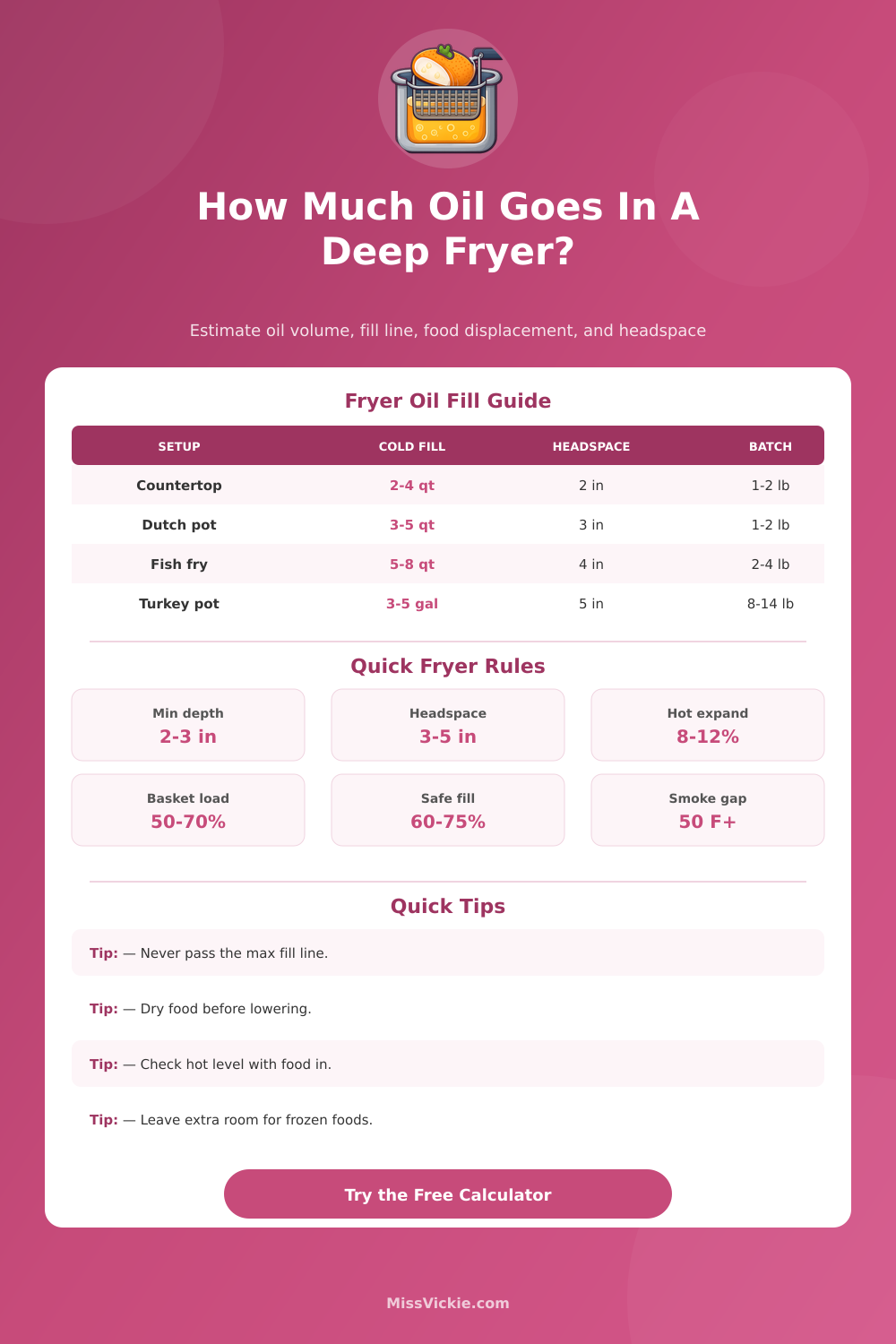
| Fryer setup | Typical cold oil | Useful oil depth | Headspace target | Best batch load |
|---|---|---|---|---|
| Small countertop fryer | 1.5 to 3 qt / 1.4 to 2.8 L | 2 to 3 in / 5 to 8 cm | built-in max line | 0.5 to 1.5 lb / 225 to 680 g |
| Dutch oven or heavy pot | 3 to 5 qt / 2.8 to 4.7 L | 3 to 4 in / 8 to 10 cm | 3 in / 8 cm or more | 1 to 2 lb / 450 to 900 g |
| Outdoor fish fry pot | 5 to 8 qt / 4.7 to 7.6 L | 4 to 5 in / 10 to 13 cm | 4 in / 10 cm or more | 2 to 4 lb / 0.9 to 1.8 kg |
| Turkey fryer pot | 3 to 5 gal / 11 to 19 L | enough to cover bird | 5 in / 13 cm or more | water-displacement test first |
| Food type | Estimated displacement | Basket load guidance | Oil depth note | Boil-up risk |
|---|---|---|---|---|
| Fries and potato wedges | 0.26 cup/lb / 0.54 L/kg | 50 to 65 percent | needs room to move | medium if damp |
| Chicken pieces or wings | 0.31 cup/lb / 0.64 L/kg | 50 to 60 percent | cover thickest piece | medium-high |
| Fish fillets | 0.33 cup/lb / 0.69 L/kg | 45 to 60 percent | shallow baskets work | medium |
| Donuts and fritters | 0.23 cup/lb / 0.48 L/kg | 40 to 55 percent | leave rise and flip room | low-medium |
| Frozen mixed snacks | 0.28 cup/lb / 0.58 L/kg | 40 to 55 percent | use extra headspace | high if icy |
| Oil type | Approx smoke point | Common fryer range | Best use | Margin note |
|---|---|---|---|---|
| Peanut oil | 450 F / 232 C | 325 to 375 F | fries, chicken, fish | strong high-heat margin |
| Canola oil | 400 F / 204 C | 325 to 365 F | general frying | watch at high temp |
| Vegetable oil blend | 400 F / 204 C | 325 to 365 F | everyday frying | check label if reused |
| Sunflower oil | 440 F / 227 C | 325 to 375 F | clean flavor frying | good high-heat option |
| Lard | 370 F / 188 C | 315 to 350 F | traditional frying | limited high-temp margin |
Round, tapered, and rectangular vessels are converted to liters or quarts from inside measurements.
The calculator subtracts expected food and basket displacement from the safe hot fill limit.
Moist or frozen food increases the recommended empty space above the hot oil level.
Smoke point margin is flagged when the selected oil is too close to the frying temperature.
This calculator estimates volume and fill safety. Always follow your fryer's manual, never leave hot oil unattended, and do not fry wet, icy, or partially frozen large foods.
In order to determine the amount of oil that is required to be poured into a deep fryer, it is first necessary to understand the physical factors that relates to and affect the levels of oil that will be present within the fryer. Factors to consider include the shape of the fryer vessels, the depth of the oil, the size of the fryer basket, the weight of the food to be fried, the moisture content of that food, and the type of oil to be used within the fryer. Each of these factors can impact the oil level within the fryer, and failure to account for each of these factors can lead to the oil level within the fryer being either too low to fully cover the food that is to be fried, or too high of a level to prevent the oil from potential overflowing onto the burner or countertop that the fryer is positioned at.
One of the physical factors related to the oil within a deep fryer is the expansion of the oil as it is heated. Deep fryer oils typicaly expands eight to twelve percent in relation to the amount of oil that is in the fryer when the oil is at room temperature. The expansion of the oil is not visible until the food that is added to the fryer causes the oil level to rise with the displacement of oil by the food.
How much oil to put in a deep fryer
A calculator can help to account for the amount of oil that is required to be added to the fryer. Each calculator account for the dimensions of the fryer, the weight of the food, and the moisture content of the food. Furthermore, the calculator accounts for the fact that the moisture within the food can quickly evaporate into steam when the food is added to the fryer, which increase the level of oil that is visible.
The shape of the fryer vessel is another physical factor in that the shape of the fryer will impact the amount of oil that the fryer can contain. Round deep fryers that has straight sides will contain different amounts of oil than deep fryers that are tapered or rectangular in their shape. Deep fryer calculators account for these differences in shape; deep fryers with more rounded shapes will contain different amounts of oil within them than those that are of a different shape.
Another factor related to oil level is the fryer basket that is used to deep fry the food. Deep fryers typically contains baskets upon which the food to be fried is placed. When the fry basket with the food is placed into the fryer, the basket and the food will displace some of the oil that is within the fryer.
The amount of oil that must be within the fryer to prevent boiling over the fry basket is dependent upon the size of the fry basket. Deep fryer oil volume calculators account for the volume of the fry basket; the calculator calculates the amount of oil to account for the volume of the fry basket when the basket is placed into the fryer. The type of food that is to be deepfried will also impact the level of oil within the fryer.
Deep fryer calculations take into account the type of food that the fryer will fry. Different types of food will contain different amounts of moisture, and foods that contains high levels of moisture will create more disturbance within the oil than foods that do not contain as much moisture. Therefore, deep fryer oil volume calculators account for the type of food that will be fried.
Foods that contain high amounts of moisture will require more space within the fryer than foods that contains less moisture. Another factor related to oil within a fryer is the smoke point of the oil. Each type of oil has a smoke point; the smoke point is the temperature at which the oil begins to break down within the fryer.
The smoke point must be higher than the temperature that is target for the frying of the food. If the smoke point is too close to the target frying temperature, the oil may smoke or develop an off-flavor before the food is cooked. Deep fryer oil volume calculators will account for the smoke point of the oil that is to be used by the fryer; it will indicate if the smoke point is too close to the frying temperature, and either suggest a different oil or a lower frying temperature.
Many people make mistakes when adding oil to there deep fryer. For example, many people add oil until it reaches a line upon the fryer that indicates the amount of oil that is to be used. They do not account for the expansion of the oil when it is heated, or the amount of oil that is displaced by the fry basket that contains the food.
Furthermore, many people add food that still contains ice to the oil within the fryer, which can cause the oil to boil over the fryer vessel due to the ice melting. Others simply do not account for the volume of oil that is occupied by the fry basket. However, each of these mistake can be avoided by taking the time to measure the dimensions of the fryer, and using the calculator that accounts for each of these factors.
By taking these steps, deep fryers will have consistency in the amount of oil that is required. By knowing the cold fill amount of oil that should be used, the fryers will have the correct amount of headspace within the fryer after it is heated, and the food has been added. Thus, each fryer will work efficiently, and the oil will not boil over the food basket or the fryer vessel itself.
While the numbers will change depending on the type of fryer or the type of food that is to be fried, the physical factors related to oil within a fryer are constant.