Deep Fry Whole Chicken Time Calculator
Estimate deep frying time for one whole chicken using bird weight, cavity dryness, oil temperature, fryer pot size, oil displacement, brine or injection, chilled state, rest time, carryover, and 165°F breast / 175°F thigh targets.
🐔Whole Chicken Fry Presets
Choose a real whole-chicken setup, then adjust the bird weight, dryness, oil temperature, pot geometry, oil fill depth, brine, injection, start temperature, crispness, and rest time. This calculator is for a single whole chicken, not turkey, Cornish hen, or separate chicken parts.
⚖Bird, Oil, and Fryer Setup
Your Whole Chicken Fry Plan
Use an instant-read thermometer to confirm the center before serving.
Timing Breakdown
Pot and Safety Breakdown
📌Whole Chicken Fry Reference Cards
Common range for 3 to 5 lb whole chickens near 350°F.
Keep extra rim space after displacement, foam, and bubbling.
Breast must reach 165°F; thighs are better around 175°F.
Rest on a rack, uncovered, before carving the whole bird.
🔥Time and Temperature Table
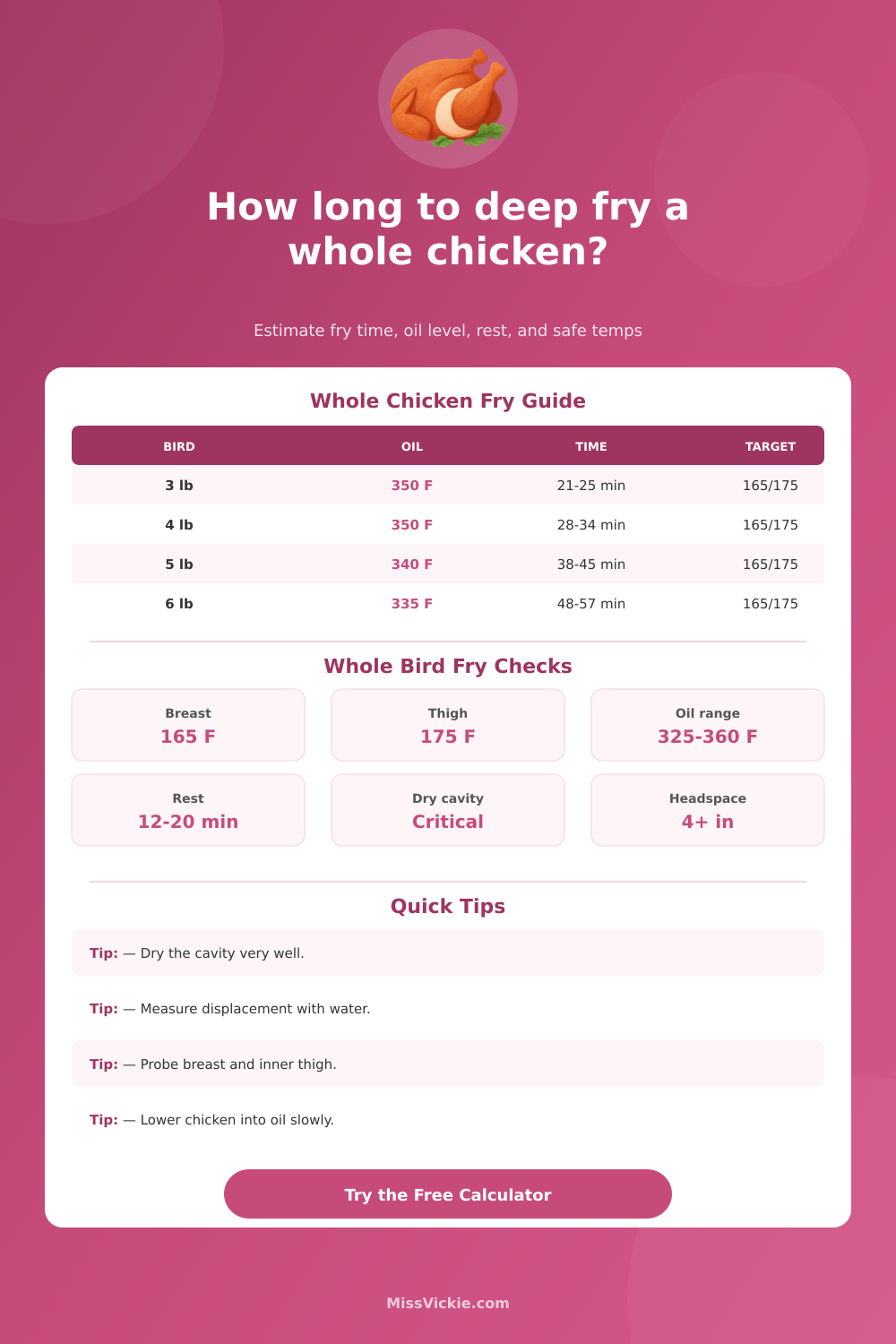
| Whole chicken size | Oil range | Estimated oil time | Use this as a check |
|---|---|---|---|
| 3 lb small whole chicken | 345 to 355°F | 21 to 27 minutes | Probe breast at 160°F pull only if thigh is close to 170°F. |
| 4 lb fryer or broiler | 340 to 355°F | 29 to 36 minutes | The breast often finishes before the thigh; check both locations. |
| 5 lb roasting chicken | 335 to 350°F | 38 to 46 minutes | Use a slightly lower oil temp so the crust does not overdarken. |
| 6 lb large roaster | 325 to 340°F | 48 to 58 minutes | Watch oil color and center temp; this is not the same timing as turkey. |
Time estimates are planning numbers. The final decision is always the measured internal temperature in the thickest breast and the inner thigh near the bone.
🛢Oil Displacement and Pot Safety Table
| Pot check | Good sign | Warning sign | Why it matters |
|---|---|---|---|
| Water displacement test | Oil line marked before heating | No test or guessed fill line | A whole chicken has a cavity and irregular shape, so displacement is not obvious by sight. |
| Headspace after bird | At least 4 inches below rim | Less than 3 inches below rim | Foam and bubbles rise quickly when moisture leaves the cavity and skin. |
| Chicken dryness | Cavity wiped and air dried | Wet cavity or pooling brine | Water converts to steam and can force oil up the sides. |
| Lowering method | Bird lowered slowly, heat managed | Chicken dropped into oil | Slow lowering lets bubbling settle and prevents a sudden boil-over. |
🧂Moisture, Brine, and Carryover Table
| Preparation | Time effect | Splatter effect | Best handling |
|---|---|---|---|
| Dry seasoned only | Baseline | Lowest when cavity is dry | Pat dry, season, and keep uncovered briefly before frying. |
| Dry brined | Add about 2 percent | Low to moderate | Brush off wet spots and air dry skin before oil contact. |
| Wet brined | Add about 6 percent | Moderate to high | Drain thoroughly, wipe the cavity, and rest uncovered on a rack. |
| Injected marinade | Add about 8 percent | High near punctures | Inject evenly, wipe leaks, and lower the chicken especially slowly. |
🌡Thermometer Target Table
| Probe location | Pull cue | Final target | Reading note |
|---|---|---|---|
| Thickest breast | 160 to 163°F if resting | 165°F minimum | Insert from the side and avoid touching bone or the cavity. |
| Inner thigh | 170 to 173°F if resting | 175°F preferred | Dark meat is more tender when it finishes higher than the breast. |
| Deep cavity side | Steam should be clear | No cold pockets | Use this as a secondary check, not a replacement for probe readings. |
| After rest | Recheck before carving | Breast 165°F+ | If any area is low, return to hot oil briefly or finish safely in an oven. |
🔍Whole Chicken vs Similar Frying Jobs
One cavity, mixed breast and thigh targets, moderate oil displacement.
Much smaller bird, faster center heating, often fried one or two at a time.
Separate legs, thighs, wings, or breasts cook by piece size, not whole-bird mass.
Far larger displacement and longer timing; use turkey-specific equipment and math.
💡Deep Frying Tips
When we drop a full chicken into the oil, we get nervous when the bubbles comes up too quickly. As soon as the oil begins its soft simmer, it explodes into foam party threatening to tip the rim out of your pot. It’s not just a disaster-in-waiting. It’s also a physics lesson pretending to be supper.
If asked what they do, most folks will admit to having a prayer in one hand and a stopwatch in the other when approaching this meal. Their fingers is crossed, hoping that following the rule of three minutes per pound might save them from tragedy. With your chicken’s weight entered and your oil’s temp dialed in, the rest are left up to a calculator. You won’t need to worry about doing the math yourself (which usually results in something either burnt or raw).
Why Fried Chicken Is Hard to Cook
The first thing that will affect all of this is water. Oil doesn’t like water. And when they gets together at three hundred and fifty degrees, the water turns to steam immediately. Then, it happens with a boom! The steam rushes up because it has nowhere else to go and puffs up the oil. So if you’re cooking a wet chicken (meaning its cavity was wet due to rinsing or brining), you might as well be cooking a bomb inside that bird.
Which is why I have a way on the calculator to adjust for whether your bird is relatively dry or not. Because a really dry bird can still be cooked to time. Wet one? Caution required. More turbulence. Longer cook time. Small detail, right? But it makes a difference.
There’s no hurrying the dry time. On the outside, you can pat that baby down easily enough. In the deep dark cavity? That takes time and a bit of patience. It also takes paper towels, which you should of just threw out anyway.
There’s yet another wrinkle: the weight of what you’re cooking compared to size of your gear. How do you know displacement? That’s not an intuitive thing. Yes, a 4lb chicken occupies some amount of volume; but it also displaces amount of oil equal to its mass (in water). So if you overfill your pot with oil and then throw in your chicken… where does the chicken go?
The chicken calculator requests the dimensions of your pot so that it knows how much “headspace” will be available once you add your chicken. The magic number here is 4 inches. Any less, and you risk boil-overs. More, and you’ll burn off extra oil. This slows down temperature recovery time when the chicken meet the flame. It also makes the process less efficient.
But which temperature target? That depends on where in the bird you’re measuring. One-hundred sixty-five degrees Fahrenheit is the magic number for safety in the breast, but if you pull it right there it’ll be dry as hell when rested. After you remove the bird from the oil, carryover cooking continue and will add an extra five or ten more degrees. At the same time, the thighs needs to reach almost one hundred seventy-five degrees to break down their connective tissue and make them tender.
Because we only get one thermometer reading from the center, this dual-target scenario make a standard thermometer not very useful. Ideally you’ll want to measure both the deepest spot in the thigh and thickest portion of the breast. One may be ready while the other’s not, which is a problem that can’t be solved just by adjusting your timer.
And then there’s the wrinkle of brining. This adds flavor and moisture to your food. However, it takes longer because the meat need to heat up once all that water has cooked off. It also increases splattering as any remaining moisture on the meat needs to cook away. With dry brines, things is simpler, though you do need to be sure you have them pretty well dried. Either way, the timer adapts accordingly: No more counting by the minute; now you’ve got an actual window of time.
It factors in whether you’re using a lid or not, what kind of stovetop you’re using, and even speed with which you lower the bird into the hot oil. Slow is best; it allows the oil to settle. Drop too fast and you’ll create a shockwave.
Cooking isn’t something that a calculator can do better than our eyes. Steam escapes clearly from the joint between the body and leg. Skin color: It should be a nice rich gold, but not dark brown. Read your probe, but know what it’s telling you. And remember, those numbers aren’t a law; they’re a guide.
With careful attention to temperature, good headspace, and a thorough drying off of the bird beforehand, there goes the worry. A precisely crisp bird settled in the oil turns that early on-set nervousness into a confidence. Most of this is learning what exactly it is we’re measuring here, and making sure our rig accounts for the physics long before the very first bubble appears.