Outdoor turkey fryer planner
Deep Fry Turkey Time Calculator
Estimate deep-fried turkey time from turkey weight, oil temperature, thawed and dry status, brining or injection, fryer size, outdoor temperature, oil recovery, target internal temperature, rest time, and oil displacement safety.
Safety first: Deep fry only a fully thawed, unstuffed turkey with a dry surface. Use this as a timing and oil-fill planner, then verify the thickest breast and innermost thigh with a food thermometer.
Includes oil temp, recovery, weather, moisture, and target temperature.
Estimated oil temperature dip after the turkey is lowered.
Approximate oil rise from the bird; confirm with water first.
Estimated empty room above oil after the turkey goes in.
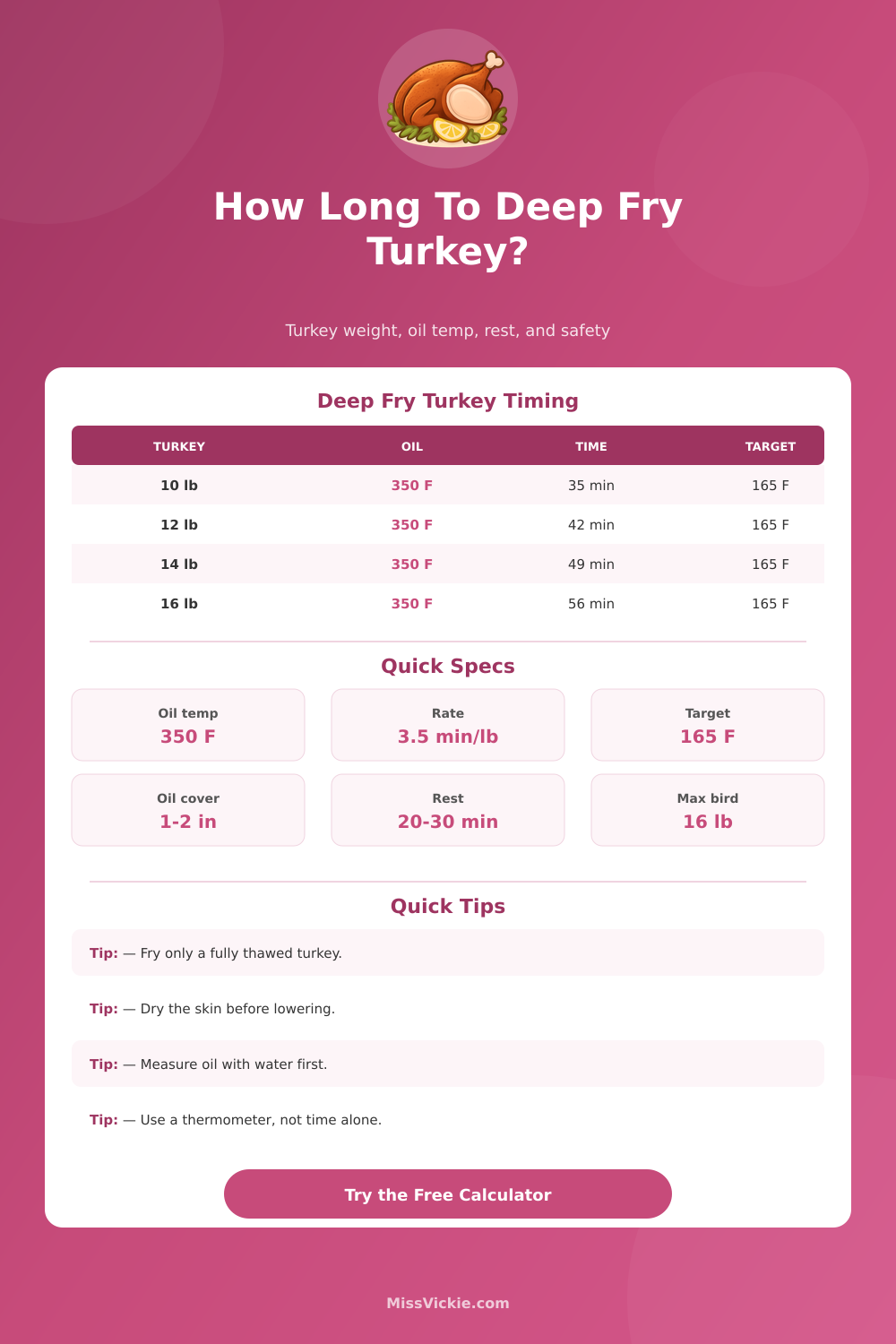
| Turkey Weight | Base Time at 350°F | Start Probing | Best Use |
|---|---|---|---|
| 8-10 lb / 3.6-4.5 kg | 28-35 minutes | About 22-27 minutes | Fastest and easiest range for many home turkey fryers. |
| 10-12 lb / 4.5-5.4 kg | 35-42 minutes | About 28-34 minutes | Classic fryer size with a manageable oil displacement profile. |
| 12-14 lb / 5.4-6.4 kg | 42-49 minutes | About 34-39 minutes | Good holiday range when the pot has plenty of capacity. |
| 14-16 lb / 6.4-7.3 kg | 49-56 minutes | About 39-45 minutes | Upper practical range for many outdoor rigs; check fryer manual. |
| Over 16 lb / 7.3 kg | Often not recommended | Use equipment guidance | Large birds raise spill risk and can cook unevenly; consider two smaller turkeys. |
A common planning rate is about 3.5 minutes per pound at 350°F, but thermometer readings decide doneness.
| Oil / Pot Check | Safer Planning Target | Calculator Impact | Why It Matters |
|---|---|---|---|
| Measured water displacement | Required before adding oil | Confirms the starting oil volume | Water shows the oil line after the bird is submerged, before heat is involved. |
| Oil covers turkey | About 1-2 in / 2.5-5 cm | Flags too little cover | Too little oil exposes parts of the turkey; too much raises overflow risk. |
| Empty headspace after lowering | At least 3-5 in / 8-13 cm | Compares pot room to oil plus displacement | Hot oil bubbles up when moisture flashes to steam. |
| Turkey displacement estimate | About 0.12 gal per lb | Estimates oil rise from turkey volume | The exact amount varies with shape, cavity size, rack, and pot geometry. |
| Burner off while lowering | Turn off flame briefly | Safety reminder only | If oil spills while the burner is lit, fire risk rises sharply. |
| Check Point | Minimum Target | Fryer Note | Where To Measure |
|---|---|---|---|
| Whole turkey | 165°F / 74°C | Rest after reaching the safe minimum. | Confirm both breast and innermost thigh. |
| Breast meat | 165°F / 74°C | Probe from the side into the thickest area. | Avoid the bone and avoid touching the fryer rack. |
| Thigh area | 165°F / 74°C | Often runs higher by the end of frying. | Innermost thigh, away from bone. |
| Stuffing | Do not stuff | Deep-fried whole turkey should be unstuffed. | Cook dressing separately if desired. |
| Oil | 350°F / 177°C | Let oil recover before judging timing. | Use a deep-fry thermometer clipped to the pot. |
References used for the safety baseline: FoodSafety.gov safe minimum internal temperature chart and USDA turkey-frying guidance.
Frying turkeys deep is quick… About 40 minutes for a 12-pounder, but it’s full of danger. If your pot’s too full and/or your turkey’s frozen, hot oil will leap out of control beyond the edge of the vessel. From wind conditions outside to dryness of its skin, you might not realize that small details matters.
By entering the thaw status, oil temperature and the turkey’s weight, calculator does the math for you. No more guesswork regarding displacement and recovery rate. Those inputs aren’t random; if bird is cold to the touch (icy interior), it’ll spew steam when you drop it in the oil. The calculator will refuse to provide an estimate of the timing and flag the issue. Ditto with a wet brine, there will be some surface moisture that also extends the time required for the oil to recover following the first plunge into the pot. The calculator accounts for that, tacking on a slight penalty to fry rate.
How the Calculator Helps You Fry Turkey Safely
Most people has issues with quantity of oil they use. This is part that trips up first-timers. The calculator requires number of gallons you intend to start with, as well as how much headspace (above the rim) you want between oil and lid. That’s because turkey itself occupies about a gallon and a half of space, plus you need some additional headroom to allow for initial bubbling in the first several minutes. When it calculates and alerts you that your oil line will be too high after lowering the bird into the pot, it tells you to decrease fill before lighting burner.
The calculator also factors in things like burner recovery and outdoor temperature which are far more important than many realize. Every time you open lid, cold air and wind rob your pot of heat. This increases estimated cooking time due to slower-recovery burners (or choosing a slow recovery setting) or cooler weather outside. It’s not about getting it perfect, but preventing that urge to yank the turkey out prematurely because the clock tell you it’s ready.
Another thing the calculator keeps in mind is rest time after frying. While resting, there’s still a carryover cook occurring, as well as juice redistributing, which prevent the breast from being carved up into dried-out slices. You should of generally rest it for 20-30 minutes (the calculator allows you to modify this depending on your desired timing for putting bird on the table).
And for my money, that’s realy what all these timers is good for: they make you think about the process ahead of time, when it doesn’t matter if the oil isn’t even hot yet. Before turkey goes anywhere near it, I’m measuring out how much water displacement I’ve got, drying off the turkey and figuring out where I’ll stick the thermometer probe. Once that’s done, the fryer portion becomes a calm exercise rather than a frantic scramble. Making the plan concrete means keeping meal relaxed.