Deep Fry to Air Fry Conversion Time Calculator
Convert a known deep-fry recipe into air-fryer temperature, cooking time, check timing, flip rhythm, spray notes, and doneness targets.
🍳 Recipe Conversion Presets
Pick a deep-fry recipe style, then adjust the oil time, food thickness, coating, basket load, fryer size, and target doneness.
⚖ Deep Fry Recipe Details
Air fryer conversion ready
Use the converted settings as a starting point, then check color and internal temperature near the early-check mark.
Conversion Breakdown
Timer Schedule
📌 Conversion Reference Points
🔥 Deep Fry Recipe Conversion Table
| Deep-Fried Food | Typical Oil Recipe | Air Fryer Start Point | Conversion Notes |
|---|---|---|---|
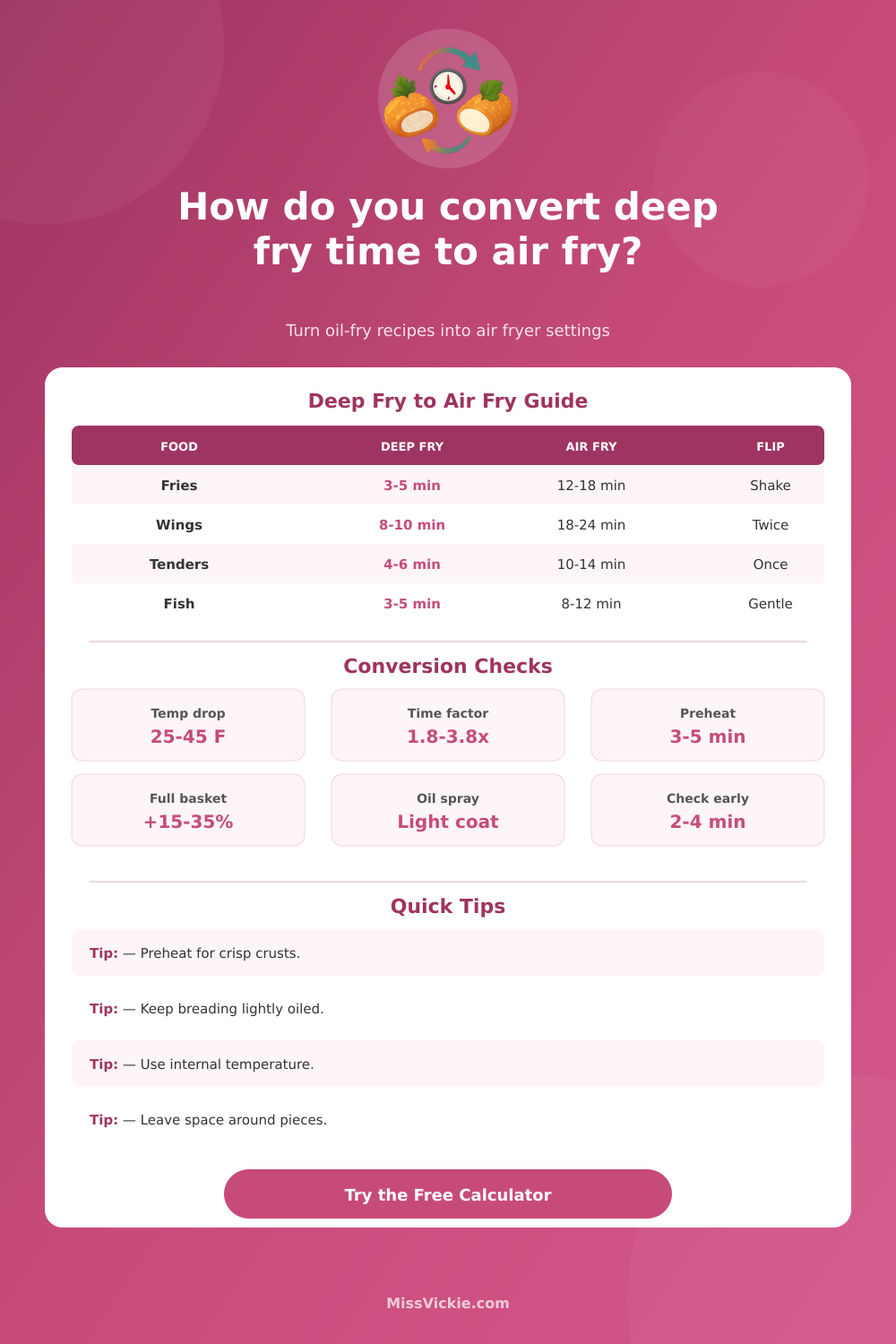
| Fresh french fries | 350 to 375°F, 3 to 5 min final fry | 380 to 400°F, 12 to 18 min | Shake twice; single layer browns more evenly. |
| Chicken wings | 350°F, 8 to 10 min | 375 to 400°F, 18 to 24 min | Cook to 165°F minimum; extra crisp may need longer. |
| Chicken tenders | 350°F, 4 to 6 min | 375 to 390°F, 10 to 14 min | Spray breading until no dry flour remains. |
| Fish fillets | 350 to 365°F, 3 to 5 min | 370 to 390°F, 8 to 12 min | Turn gently; fish should reach 145°F. |
| Shrimp | 350 to 375°F, 2 to 4 min | 375 to 400°F, 6 to 9 min | Check early because shrimp overcooks quickly. |
| Mozzarella sticks | 350°F, 1.5 to 3 min | 370 to 390°F, 5 to 8 min | Start frozen; stop when the first seam softens. |
| Onion rings | 365 to 375°F, 2 to 4 min | 375 to 400°F, 7 to 11 min | Wet batter needs parchment or a firmer coating. |
| Pork cutlets | 350°F, 5 to 8 min | 375 to 390°F, 12 to 18 min | Use 145°F plus rest as the final test. |
Air fryers vary by basket shape and fan strength. Treat the converted setting as the first test batch, then write down your final time for that exact appliance.
🧪 Factor Guide
| Input | Air Fryer Effect | When to Increase Time | When to Reduce Time |
|---|---|---|---|
| Thickness | Thicker centers need more time than oil recipes show. | Above 1 inch chicken, pork, potato wedges | Thin fish, shrimp, shoestring fries |
| Coating | Dry crumbs crisp faster than wet batter. | Wet batter, heavy breading, cheese-filled food | Bare, flour dredged, thin panko crust |
| Starting state | Frozen pieces lose time thawing before browning. | Frozen raw poultry, frozen thick fries | Thawed or already cooked food |
| Basket fullness | Crowding blocks hot air from surfaces. | Touching, crowded, piled baskets | Single layer with visible gaps |
| Wattage | Higher wattage browns more aggressively. | Under 1200 W or large oven-style trays | Over 1700 W compact baskets |
| Oil spray | Surface oil replaces some deep-fry browning. | No spray on crumbs or flour | Generous spray on thin coatings |
📋 Recipe Timing And Temperature Adjustments
| Deep-Fry Minutes | Oil Temperature | Air-Fryer Converted Temp | Thickness Cue | First Check |
|---|---|---|---|---|
| 1.5 to 3 min | 350 to 375°F | 370 to 400°F | Shrimp, cheese sticks, thin onion rings under 1/2 inch | 5 to 7 min; stop before seafood firms hard or cheese leaks. |
| 3 to 5 min | 350 to 375°F | 375 to 400°F | Fries, fish, vegetables, and small bites up to 3/4 inch | 7 to 10 min; shake once the coating looks set. |
| 4 to 6 min | 350 to 365°F | 375 to 390°F | Chicken tenders, nuggets, tofu cubes, or breaded strips | 9 to 12 min; use spray where flour still looks dry. |
| 6 to 10 min | 325 to 350°F | 375 to 400°F | Wings, pork cutlets, thick wedges, or bone-in pieces | 14 to 20 min; verify poultry or pork with a thermometer. |
| Recipe Factor | Setting | Time Adjustment | Flip Schedule | Conversion Note |
|---|---|---|---|---|
| Coating | Bare, flour, crumbs, wet batter, tempura, or cheese-filled | Bare: -5%; crumbs: +5%; wet batter: +15% to +20% | Flip after coating sets; turn fragile batter gently. | Air fryers need misted oil because the food is no longer submerged. |
| Frozen/fresh state | Fresh, thawed, frozen raw, frozen par-fried, or chilled cooked | Fresh: baseline; frozen: +15% to +25%; chilled cooked: -25% | Shake frozen fries twice; flip frozen breaded pieces once. | Frozen food spends early minutes driving off surface ice and moisture. |
| Wattage | Under 1200 W, 1200 to 1650 W, or over 1700 W | Low wattage: +6% to +12%; high wattage: -3% to -6% | Check high-wattage baskets 1 to 2 min early. | Compact high-wattage models brown faster than oven-style trays. |
| Basket load | Single layer, touching, crowded, or stacked | Touching: +10%; crowded: +20%; stacked: split batch | Single layer: once; crowded: twice or every 4 min. | Airflow matters more than recipe weight when converting from oil. |
| Flip schedule | None, once, twice, frequent shake, or gentle turn | No direct time change, but poor turning causes pale patches. | Once at halfway; twice at one-third and two-thirds. | Use the calculator schedule as a reminder, then cook to doneness. |
🌡 Doneness Targets
Use an instant-read thermometer in the thickest piece.
Fish should be opaque, flaky, and hot in the center.
Rest cutlets or chops after cooking for best texture.
Use this for cooked leftovers and chilled cooked foods.
💡 Conversion Notes
When attempting to re-create something that’s traditionally fried in oil by using an air fryer, you always wonder: Won’t it take me thirty minutes instead of just three minutes on high? That doesn’t seem fair! But then again, isn’t it cheating? No, because its a difference of physics, and if you think about airflow instead of time, you can sometimes get exactly the same result.
So, when you input your own variables, the calculator do the math for you. You don’t have to guess how much more heat it will take to cook something with a thick coating or how much longer it will need you to wait in patience.
How an Air Fryer Works
Most folks think that all they’re doing with an air fryer is reducing their deep-frying temperature, and that result in burnt coatings and dry meat. Why? Because air is mostly empty space, and hot air has to do more work to transfer its energy. It circulates around the food rather than surrounding it completeley like oil does.
The air fryer process also take more attention; a crowded basket or wet batter can block convection currents. The thickness is realy important to the way it converts. So if I have a really thin piece of fish it’ll cook through before the outside gets browned. But if I’ve got a thick piece of pork chop, I need to be at a low temperature for much longer. And the tool knows that because heat penetrate more slowly into an object when there’s air around it versus oil.
It knows about wattage too. A large appliance like an oven might struggle to get crispy on bottom layer. A small one, high wattage, will go super fast. Wattage matter, and if you don’t account for that, then you’re essentially not using the tool correctly: You’re just cooking blindly.
Another important thing to consider is the type of coating. Wet batter behaves different than when it is not suspended in oil. High heat causes instant sealing when deep frying, whereas air fryers requires a bit longer (and perhaps a few more flips) to crisp. The calculator increases cook duration for wet coatings and flags more flips. Dry crumbs brown quickly but burn easily towards the end of the cooking process. This explains why the output isn’t just one end-to-end number, but a set of checkpoints along the way.
Also take into account what’s going into your machine: frozen foods has a lot of thermal mass in their ice-crystal form. They will spend the initial few minutes just getting rid of that moisture. As they dry out on top, they will start to brown, but not before then. Food from fridge or food that has already been defrosted doesn’t waste any time; it begins crisping right away, saving perhaps 20% or even more of the overall cooking time.
This is compounded if your food is packed in a full basket, where pieces shade one another and block hot air flow. Piling things creates steam instead of crispness. That’s defeating the appliance purpose.
The doneness targets replace color hints here, as well. Depending on the shape of your air fryer’s basket, and which way the air circulates through the device, items browns inconsistently. Something may appear to be crisp and dark on top but still pale underneath. For pork and poultry in particular, this can be problematic because it becomes a matter of both taste and safety. It’s helpful that the tool recommends checking internal temperatures at certain points to make sure you’re taking something out just before it gets dry (but not too soon). It transforms a blind guesswork exercise into one that’s more organized.
A good conversion acknowledges what your gizmo isn’t able to do, while still getting close to it in a way that nobody will mind: Submerged frying has texture; there’s no way to exactly duplicate it, but close enough is fine. For a really crusty exterior, preheat, but be aware that misting with oil will also help the heat reach dried-out coatings without significantly increasing fat content. Each appliance is a little different, so check sooner rather than later; you should of dont assume the timer knows better. The estimated time is just a guide, not a guarantee.
It’s not so much a recipe as it is an exercise in controlling heat transfer; once you grasp what happens and why, you won’t feel like the numbers are arbitrary. You’ll begin to get them, and stop doubting your batches. The science backs you up, and when you let the air do its job, you can trust the process.