Deep Fry Sausage Time Calculator
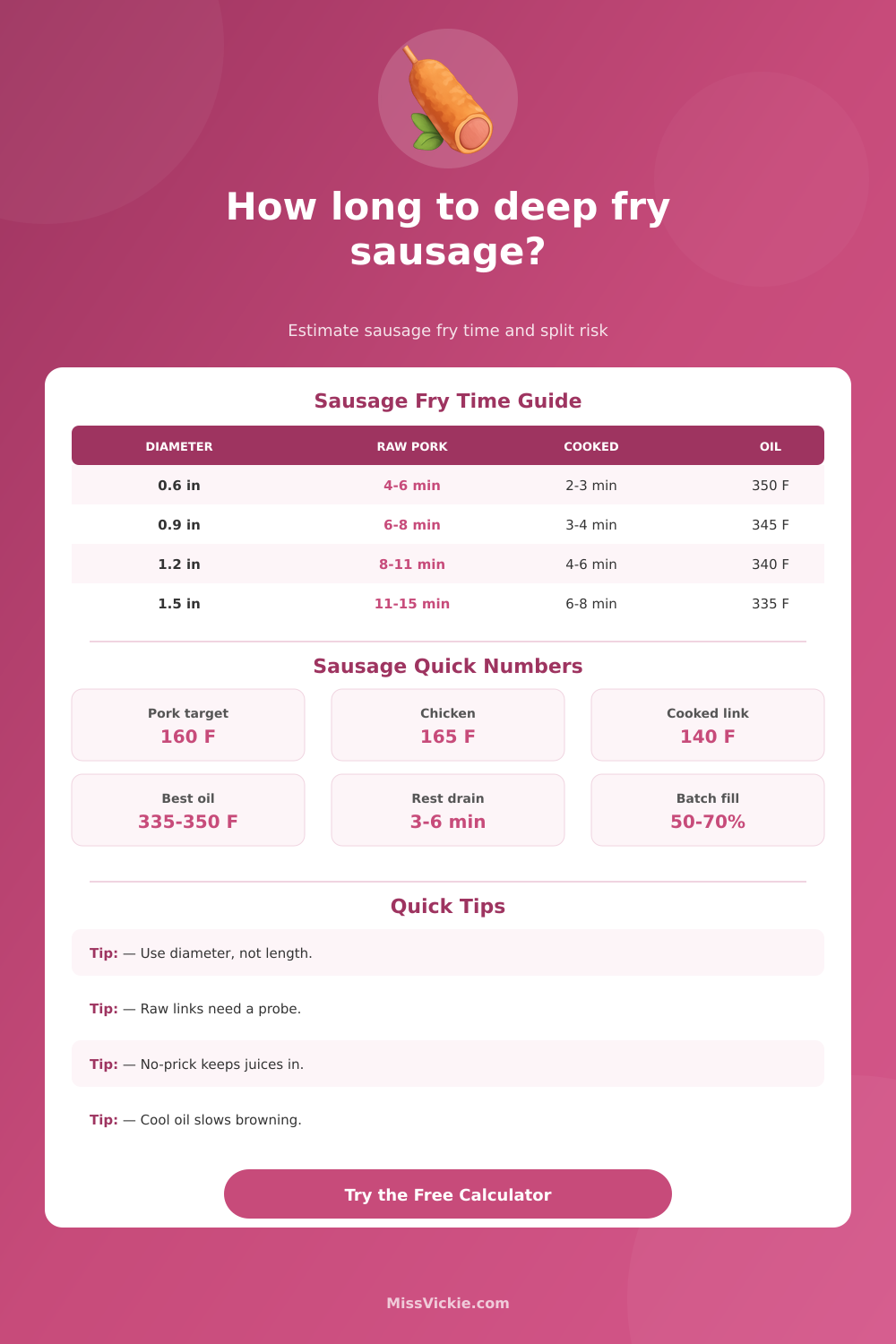
Estimate deep-fried sausage timing from link diameter, raw or fully cooked status, pork, chicken, beef, or mixed meat, casing type, oil temperature, target internal temperature, pricking choice, batch size, browning target, and rest or drain time.
Choose a realistic link style, then adjust diameter, casing, oil temperature, target doneness, batch size, and split-risk choices. Raw sausage must be checked with a thermometer.
Sausage Fry Plan
Adjust the inputs to estimate timing.
Timing Breakdown
Doneness And Split Notes
| Link Diameter | Raw Fresh Sausage | Fully Cooked Sausage | Best Oil Range | First Probe |
|---|---|---|---|---|
| Small 0.5 to 0.7 in | 4 to 6 minutes | 2 to 3 minutes | 350 to 360°F | 3 minutes |
| Medium 0.8 to 1.0 in | 6 to 8 minutes | 3 to 4 minutes | 340 to 350°F | 5 minutes |
| Large 1.1 to 1.3 in | 8 to 11 minutes | 4 to 6 minutes | 335 to 345°F | 7 minutes |
| Extra large 1.4 to 1.7 in | 11 to 15 minutes | 6 to 8 minutes | 325 to 340°F | 9 minutes |
| Meat Or Status | Typical Target | Carryover | Best Use | Doneness Note |
|---|---|---|---|---|
| Raw pork sausage | 160°F | 2 to 5°F | Fresh brats and Italian links | Ground pork should be cooked through. |
| Raw chicken or turkey | 165°F | 2 to 4°F | Poultry sausage | Probe the center of the thickest link. |
| Raw beef or mixed | 160°F | 2 to 5°F | Beef, lamb, and mixed links | Fat content can speed browning. |
| Fully cooked smoked | 140 to 145°F | 1 to 3°F | Kielbasa, franks, smoked links | Focus on heating and casing color. |
| Casing Choice | Split Risk | Texture | Prick Advice | Oil Note |
|---|---|---|---|---|
| Natural casing | Moderate | Snappy bite | No prick unless overfilled | Use steady 335 to 350°F oil. |
| Collagen casing | Moderate high | Firm, even surface | Light prick can help | Avoid very dark browning. |
| Skinless link | Low | Soft exterior | No prick needed | Brown quickly and turn gently. |
| Thick smoked casing | Low moderate | Chewy snap | Usually no prick | Lower oil for large pieces. |
| Batch Load | Oil Drop | Recovery Pause | Timing Effect | Best Practice |
|---|---|---|---|---|
| Open single layer | 10 to 15°F | 1 to 2 minutes | Fastest and most even | Leave space around each link. |
| Normal 60% basket | 18 to 28°F | 3 to 4 minutes | Add a small buffer | Turn once the casing sets. |
| Tight 75% basket | 30 to 42°F | 5 to 6 minutes | Noticeably slower | Split into smaller batches. |
| Overloaded basket | 45°F or more | 7 to 10 minutes | Unreliable timing | Reduce load before frying. |
Need enough time for the center to reach the target internal temperature.
Main goal is reheating and casing color, so overfrying can dry them out.
Keeps fat inside but raises pressure when oil is hot or links are overfilled.
Vents pressure for fragile casings, though it can leak juices into the oil.
Food safety note: use a reliable thermometer for raw sausage. Ground pork, beef, lamb, and mixed sausage are commonly cooked to 160°F; poultry sausage to 165°F. Fully cooked products only need reheating, but package instructions still matter.
Sausages are also all about pressure. When they’re cooked deep, you has to deal with internal pressure within the sausage itself. If it’s not done correctly, when it hits the heat the sausage will start to pop. You know what I mean: you’ll hear the casings go pop-pop-pop and at that point it’s game over, because now it’s just a greasy pile and not any kind of crispy link.
No, this isn’t usualy a case of bad meat. This is a question of physics. You want to get in there and cook it through, but you don’t want to burn the outsides. And you can’t split open the skin either, that’s tricky business.
How to Cook Sausages Perfectly
What’s the timing on pulling the sausage out? Most people guess. Out they come after it’s turned brown. That assumes diameter is most important variable. It’s the dominant variable. Cooking time has nothing to do with length. The distance between the outside and center determines cooking time; that’s why width is relevant dimension.
If you’re using thick bratwurst they’ll burns while interior remains unsafe to eat. Treat thin breakfast links as such: cook too long, and they’ll be dry. Get geometry of the operation, and you’ll rethink your approach in the fryer.
It calculates it for you after you put in your measurements. No more eyeballing it. How far along is the meat? Fresh unsmoked sausages requires sufficient time to get the interior temperature to 160 degrees Fahrenheit. Smoked fully cooked links only need to be warmed and browned on the outside. Because of this, they do not stay in the hot oil as long. Cooking them identically will result in smoking the others while leaving the first ones raw.
There’s another wrinkle: casing type. Certain types (natural) are thinner, more porous, and more prone to tearing (if there’s too much steam buildup inside). Others (collagen) is thicker and have more consistency; they hold up to higher temperatures. To take this into account, the tool factors in the pricked/casings status, which lowers the risk assessment because pricking allows steam out and keeps it from splitting. Of course, that’s at the expense of juice running down in the oil. A question of moisture vs. Presentation. You can prick all your links (some do), or not prick them at all (others don’t want flavor lost); both succeed, though different than others.
In the real world, batch size is where you will have most trouble. It’s tempting to put ten links into the fryer together because it seems like a time-saver, but this plunges the oil temp by thirty degrees or more. That’s enough to reduce speed of cooking as well as cause the sausage to steam rather than fry. Look again at that reference table above, you’ll notice that crowding not only prolongs the time, but also creates greater variability in results. For large crowds, do multiple rounds with fewer links each; give the oil a chance to re-warm between batches.
Sausages continue to cook even after you take them off the heat. By pulling your sausage when it reads exactly 160 degrees internal temp, you run the risk of having it be over cooked before it gets served. So account for some additional residual heat by pulling it just shy of that number. You should of pulled it earlier. The same principle carries over to poultry sausages, but they do requires a higher target internal temperature.
Resting is equally important. Settling the casing by letting the links drain on a rack helps redistribute the juices and let it set up. If you serve right away, all the fats will run out and not stay inside the bite. If timed well, each link should be hot and juicy with just the right amount of crispiness. The calculator includes this downtime in your total schedule. This gives you an accurate roadmap of how long everything takes to be ready for your guests so you don’t have to panic.
Splitting casings is few and far between if you respect diameter, monitor oil temperature, and allow your meat to rest. The result? You get deep fried sausage that looks good, tastes good, and is everything you could want.