Deep Fry Chicken Thighs Time Calculator
Estimate chicken thigh frying time by thigh count, weight, bone, skin, breading thickness, oil temperature, starting temperature, batch crowding, double-fry rest, crispness target, and a 175°F dark-meat finish.
Choose a real thigh scenario, then adjust the exact weight, breading, oil temperature, batch size, and crispness. This calculator is for thighs, not legs, breasts, wings, or tenders.
Chicken thigh fry plan
Use a thermometer in the thickest thigh meat and finish dark meat at 175°F.
Timing Breakdown
Temperature And Yield
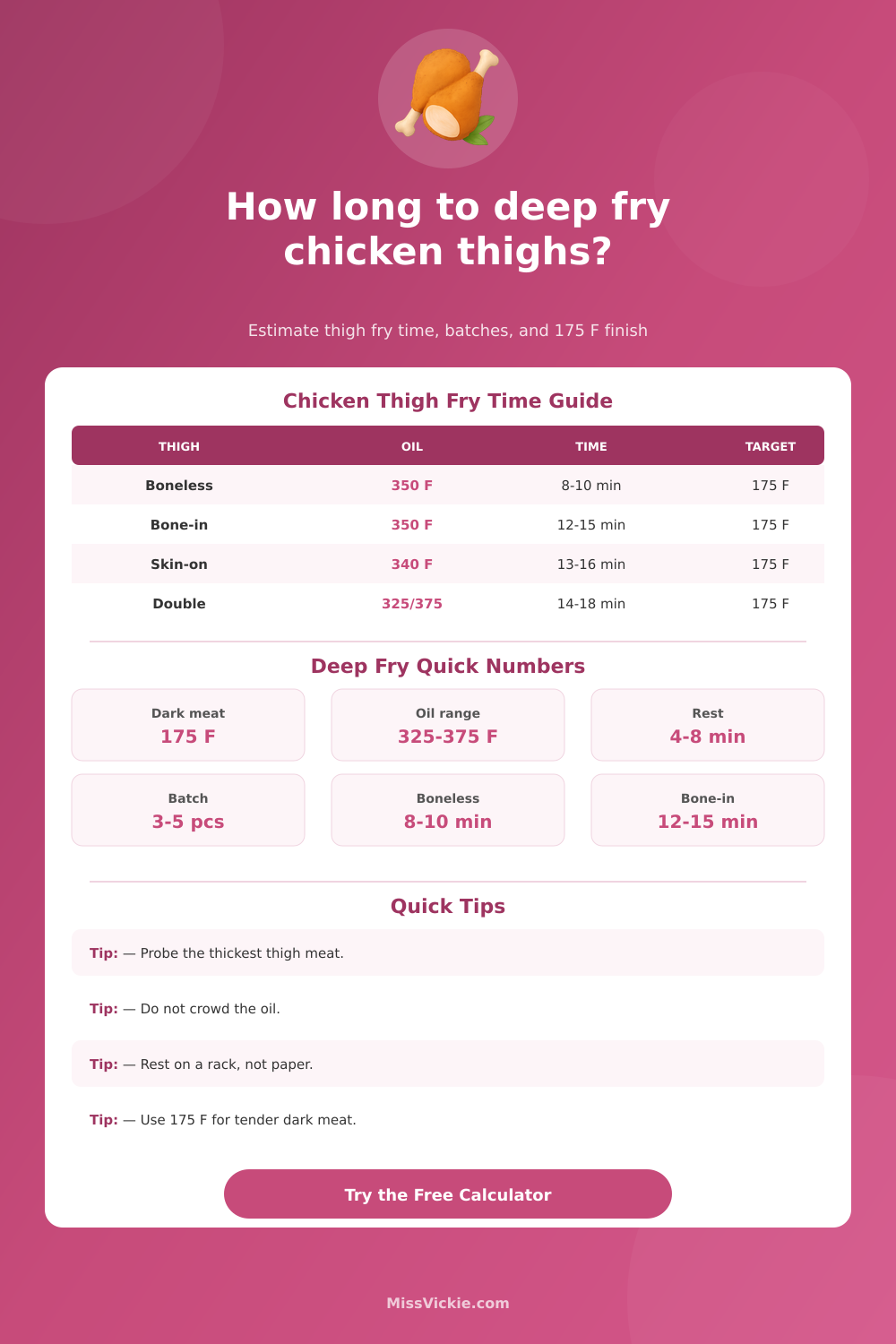
| Thigh style | Typical weight | 350°F single-fry range | Best cue |
|---|---|---|---|
| Boneless, skinless thigh | 4 to 6 oz / 115 to 170 g | 7 to 10 minutes | Fastest thigh cut, check early |
| Boneless, skin-on thigh | 5 to 7 oz / 140 to 200 g | 8 to 11 minutes | Skin needs time to render |
| Bone-in, skinless thigh | 6 to 8 oz / 170 to 225 g | 10 to 13 minutes | Probe beside the bone |
| Bone-in, skin-on thigh | 7 to 10 oz / 200 to 285 g | 12 to 16 minutes | Balance center temp and crust color |
| Large butcher-cut thigh | 10 to 13 oz / 285 to 370 g | 15 to 19 minutes | Reduce heat if crust darkens too soon |
| Oil temperature | Use for thighs | Timing effect | Watch for |
|---|---|---|---|
| 325°F / 163°C | First stage of double fry | Slower center cook | Pale crust, gentle bubbling |
| 340°F / 171°C | Large bone-in or thick crust | Moderate, safer for big thighs | Good color control |
| 350°F / 177°C | Standard thigh frying | Baseline calculator timing | Most reliable all-around point |
| 365°F / 185°C | Boneless or final crisp | Shorter finish | Crust browns fast |
| 375°F / 191°C | Second-fry crisp only | Fast crust setting | Not ideal for raw bone-in centers |
| Breading and batch factor | Calculator adjustment | Why it matters | Kitchen cue |
|---|---|---|---|
| Naked or unbreaded | Shortens time slightly | Oil contacts skin or meat directly | Surface browns faster |
| Standard flour dredge | Baseline | Common fried chicken coating | Steady bubbling, golden flour |
| Buttermilk crust | Adds time | Wet coating insulates the meat | Let excess drip before frying |
| Double-dredged crust | Adds more time | Thick crust delays center heat | Lower oil if browning too fast |
| Crowded batch | Adds time | Oil recovery drops after loading | Fewer thighs per batch fry cleaner |
| Preset scenario | Thigh structure | Oil plan | Expected result |
|---|---|---|---|
| Weeknight boneless | Boneless, skinless | 350°F single fry | Fastest dinner batch |
| Classic bone-in | Bone-in, skin-on | 340 to 350°F | Juicy center, rendered skin |
| Buttermilk crisp | Bone-in or boneless | 350°F, rack rest | Thicker crunchy crust |
| Double-fry crunch | Bone-in, skin-on | 325°F then 375°F | Best crust control |
| Party tray | Mixed thigh sizes | Small batches | More total elapsed time |
Food safety note: the model estimates time, but the final decision should come from an instant-read thermometer. For this calculator, dark-meat thighs are targeted at 175°F for a tender finish.
Dark meat with more connective tissue. It benefits from a higher finish than breast meat.
Legs have a different shape and more exposed bone, so they brown and cook differently.
White meat dries faster and should not use the same time curve as thighs.
Thin strips cook quickly. Thigh timing would overcook them before the crust is balanced.
Thermal control is essential when deep frying chicken thighs. Melt the fat underneath skin and crisp up starchy coating. Cook the dense dark meat and its connective tissue, but do not let the outside burn while inside remains raw.
How do you manage all of this? The information above will help you figure out roughly how long it should take based off size of your thighs, how thickly they are breaded, and what temperature your oil is at. Taking the guesswork out of frying can save your food from becoming a disaster in your kitchen. Instead, you can spend more time watching over what’s going on instead of guessing.
How to Deep Fry Chicken Thighs
What’s going on? A word on thighs vs. Breasts: Thighs = dark meat, which has a lot of collagen and fat in it. Darker meat can stand up better to higher internal temps before drying out. Breasts will dry very fast around 165 F. The calculator targets a finish closer to 175 F and sometimes as high as 180 F for thighs.
Why? Because at these higher temps, connective tissues breaks down into gelatin. Gelatin retains moisture; makes the meat tender and juicy. When bone-in thighs reach 165 F and you pull them out of the hot oil, they’re frequently chewy not juicy. That’s why the calculator shoots for 175 F finish time. It knows that thigh meats requires greater exposure to heat to get properly tender.
Timing involves breading too. Because of its thickness, the buttermilk crust insulates the meat, protecting it from direct contact with the heat. This contributes to better texture, but it also lengthens cooking time of the interior. Double-dredging your thighs won’t get the bone up to temperature quickly while the exterior has already turned golden brown. To compensate for this, the tool adjusts estimated time based on coating thickness.
For example: a floured, lightly dusted thigh is going to cook quicker than one that’s been battered and drenched; the crust provides a greater barrier between meat and oil. That’s why turning golden doesn’t necessarily mean it’s done. You might of have to reduce the temperature and continue frying until the interior finishes cooking without burning outer layer.
Most home cooks don’t think about batch size. Dropping some cold chicken into hot oil cools down the oil right away. Overcrowding the pot means that the oil can’t reheat quickly enough. Instead of frying in the oil, the thighs will boil in their own moisture. This results in uneven cooking and soggy breading.
Planning out your batches is what the calculator does for you by taking into account how many pieces can fit comfortabley in your pot. It assumes a normal recovery rate for a home fryer or Dutch oven. For a smaller skillet, it’ll take longer as the temperature remains lower throughout more of the process. Small batches ensures that the oil remains hot enough to produce those crisp crusts.
There’s also the issue of starting temperature. Chicken that you pulled directly from the fridge will be far cooler than thighs that you set out on the counter for half an hour. When the cold chicken enters the hot pot, it will depress the oil temperature more quickly. Additionally, it will increase overall cooking time due to the increased thermal mass that needs to absorbs heat. Allowing the chicken to warm up a bit before frying may help make the process easier.
However, as with everything related to food safety, be careful. Never deep fry frozen meat. The ice inside violently vaporizes into steam, which results in violent splatter. This is bad for both your health and the quality of your oil.
If your problem is achieving a crispy crust without overcooking the meat, consider double frying. Par-cook the interior at a low temperature and allow the thighs to rest on a wire rack. Finally, fry them briefly in hot oil so they crisp up on the outside. The calculator divides time into a two-part process. It provides a range for how long initial cooking should be and adds extra minutes for crisping up. Separating out these processes can produce better results different than attempting to achieve all outcomes within a single extended period of frying.
But then again, timing’s just a guideline. Each pot holds heat differently. Each stove is more or less powerful. Each brand of chicken is slightly larger or fatter then another. It all adds up to the fact that the numbers on this thing are estimates based on average conditions. They’ll put you in the right ballpark.
This means you won’t eat raw meat or burn dinner, but they’re no replacement for your senses. Look for deep golden color. Listen for vigorous bubbling: This means it’s actively frying. And always rely on the instant-read thermometer: Insert it into the center of the thickest part of the meat (away from any bones).
If all these indicators match up with estimated time, congratulations… You’ve done it. You’ve made the balance between data and instinct, between science and art… That separates great fried chicken from mere good fried chicken.