Danish Green Card Points Calculator
Estimate a Danish green card style score from education, field bonus, language skills, work experience, age, adaptability, occupation relevance, salary readiness, family factors, and settlement preparation.
Choose a sample profile to load realistic point assumptions, then adjust every field to match your own documents and plans.
Points Breakdown
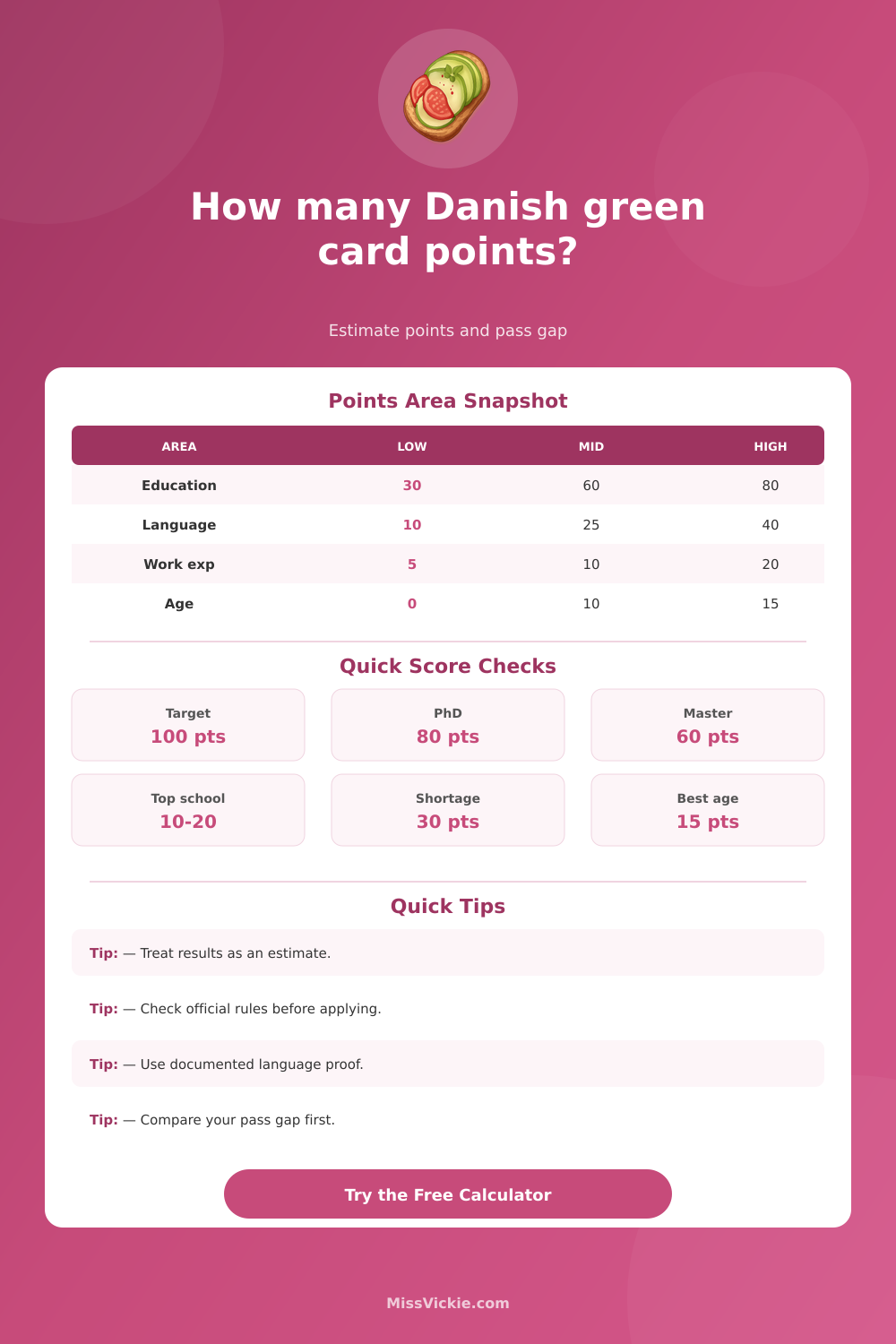
| Profile Area | Low Estimate | Middle Estimate | High Estimate | Calculator Use |
|---|---|---|---|---|
| Education level | Bachelor, 30 points | Master, 60 points | PhD, 80 points | Use the highest documented degree that can be compared to a Danish level. |
| University ranking | No bonus, 0 points | Top 400 or Top 200, 10 to 15 points | Top 100, 20 points | Use only if the ranking standard is clearly documented for your institution. |
| Shortage field | No shortage match, 0 points | Related field, 15 points | Direct shortage match, 30 points | Match the degree and job field rather than a broad industry label. |
| Field relevance strength | General degree, 0 points | Professional specialization, 7 points | Licensed high-need role, 10 points | This estimator adds nuance for occupation relevance beyond the basic shortage bonus. |
| Category | Lower Score | Solid Score | High Score | Documentation Reminder |
|---|---|---|---|---|
| Language skills | One workable language | Advanced English plus basic Danish | Advanced Danish or Nordic plus English | Use exam results, education language, or employer documentation where accepted. |
| Work experience | One year outside a shortage role | Three years in a related field | Five years as researcher or shortage specialist | Count recent, relevant, documented work rather than unrelated total career length. |
| Age band | 46 or older | 35 to 40 | 34 or younger | Age points are a profile factor only and cannot be improved by documents. |
| Adaptability | No Denmark or EU record | Short study, internship, or work placement | Completed study plus documented work | Prior lawful study or work history is stronger than a general travel history. |
| Planning Factor | Weak Signal | Moderate Signal | Strong Signal | Why It Matters |
|---|---|---|---|---|
| Salary readiness | No offer or salary evidence | Near Danish market level | Clearly above market level | Salary does not replace official criteria, but it helps estimate employability strength. |
| Occupation relevance | Limited employer demand | Clear employer demand | High-demand specialist role | Use real job postings, licensing requirements, and sector demand evidence. |
| Family support | No family plan | Documented family plan | Partner skills or income support | Family factors are scored here as settlement readiness, not as an official guarantee. |
| Settlement buffer | No budget buffer | Three to five months of savings | Six or more months of savings | Housing, savings, school, and city planning reduce practical relocation risk. |
The way it works is that Denmark has a points-based route for skilled workers, but it’s not a puzzle where one thing gets all the points. It are a puzzle where your education, work experience, Danish skills, and practical skills is weighed together. Most people think that having a good degree should of make them the big winner. But that’s not what the system rewards, it rewards (roughly equally) the ease with which you could come over and fit into the labor market here and livig as part of this society.
And that is why equation matters. In the long term, long-term fit count more than short-term credentials. A master’s is a solid entry in itself. The same qualification get additional points if it are from a university within an internationally recognised ranking band. It also gets more points if subject is in one of Denmark’s areas of shortage (the ‘field’).
How the Points System Works
Similarly, language scores adds value by themselves, but having documented Nordic/Danish skills show integration potential different than what can be offered through advanced English. You don’t have to speculate about which elements balance each other out, just plug them into the calculator above and let it do the maths for you.
There are also tradeoffs between work experience and age. Having a research background or recent relevant experience in an occupation with a shortage will increases scores much more than having a few random years of general experience. The age bands favors younger candidates while not penalizing mid career workers too much.
In the end though it’s the sum that counts, as you look at the number versus the target you identified. Is it close? Then it’s likely time to add another language cert or tighten up documentation. Is it far off? That’s where you’ll ask yourself some bigger questions about whether your work match your field or if you plan to relocate.
The intangibles (as opposed to degrees and salary), adaptability and settlement factors. Can be tempting to skip over as being too vague. But they’re weighted for exactly that reason: Because familiarity with Denmark and/or other parts of the EU lowers the perceived risk of failing to relocate when you get there. The same applies to savings buffers, having a housing plan documented, and having family in your corner. These thing aren’t substitutes for the official criteria. Rather, they tell us if a candidate is looking beyond the points score and the practical ways to make a move happen.
This is about salary readiness. Salary is one area that offers potential but doesn’t automatically mean a yes. If you have recieved an offer at or above average for the Danish market, it shows that the employer has already recognized some value in your profile. This can balances out weaknesses in other parts of the score if it is closer to the cut-off point.
I find that most common errors result from treating all inputs as equal. Applicants will overstuff the education fields, neglecting to fill in anything else (and then complain that it’s stuck at X). Other candidates ignore what part of the equation are off because they’re focused solely on the sum. Before adjusting their expectations, look through the reference tables on the page. These tables provides a range of realistic values per section. Are your documents currently positioned at the top, middle, or bottom?
What’s most helpful is this: Do the math twice. Once using conservative scores, what are you sure you qualify for? And then do it again with one category where you know with modest effort, you might get better marks. That second calculation will tell you if the distance left to go is a documentation issue or if it’s a sign there’s a deeper gap between your skills and Danes’ requirements. Honesty about what you do have versus what you think you might be able to claim down the road gets rewarded in the exercise.
In the end, however, the point system captures a combination of accomplishment and preparation. Even if your profile sounds good in writing, you must demonstrate that this time around the move will stick once they hand over the permit. That’s where crunching the numbers will force that discussion early; when it can still alter the result.