MissVickie kitchen conversions
Kitchen Measurement Converter
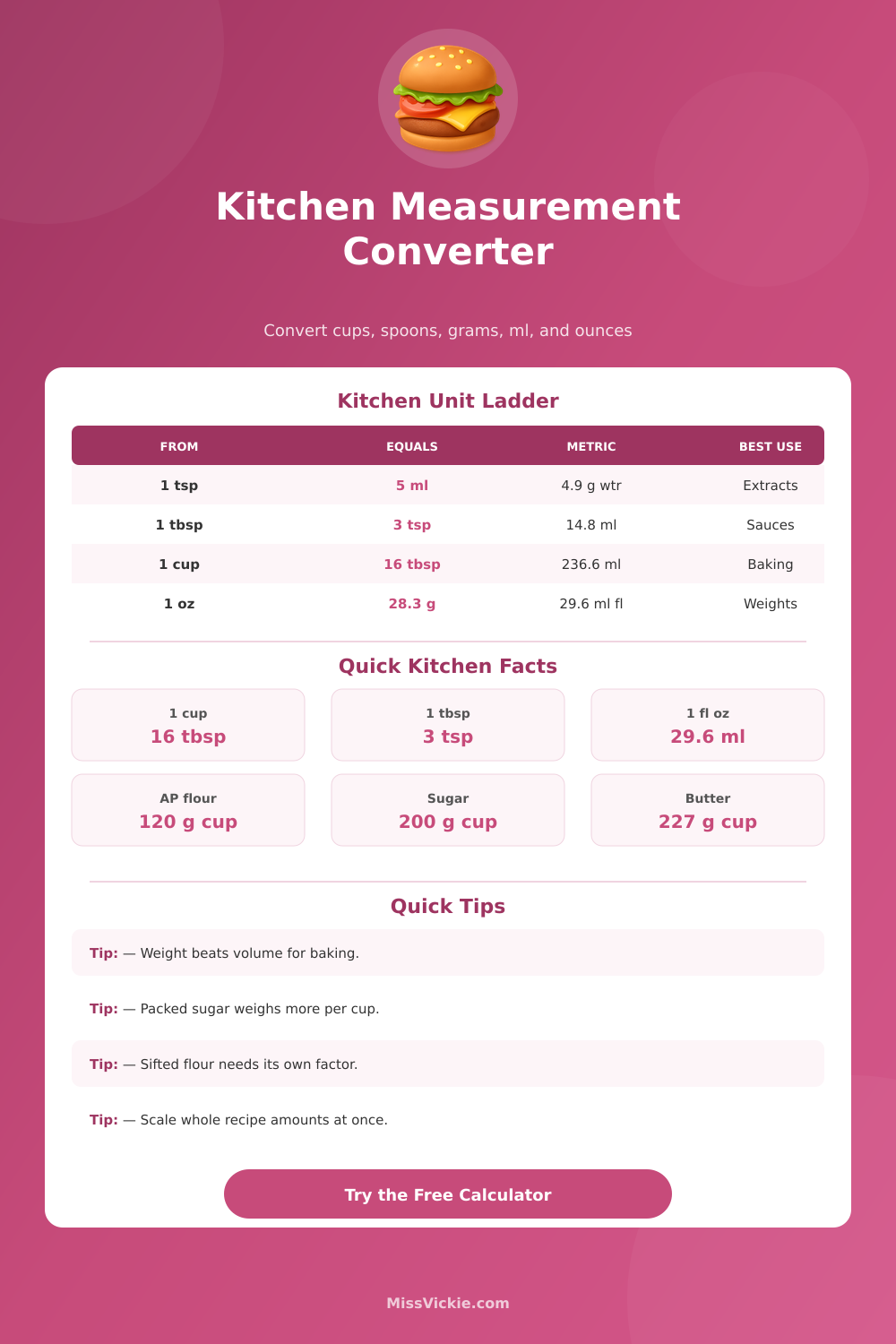
Convert cups, tablespoons, teaspoons, fluid ounces, milliliters, grams, kilograms, ounces, and pounds with ingredient-aware baking math, recipe scaling, and easy kitchen shorthand.
Dry ingredients need density and prep style, while liquids can convert directly. The calculator handles both and scales the amount for full recipe batches in one pass.
Best for dry goods when ingredients are leveled instead of packed.
Use grams for flour, cocoa, nuts, and sugar when repeatable baking matters.
Ideal for milk, water, stock, and oil because the surface line is easy to read.
Use for leaveners, spice blends, vanilla, and smaller sauce adjustments.
| Unit | Teaspoons | Tablespoons | Cups | Fluid ounces | Milliliters |
|---|---|---|---|---|---|
| 1 teaspoon | 1 | 0.33 | 0.02 | 0.17 | 4.93 |
| 1 tablespoon | 3 | 1 | 0.06 | 0.50 | 14.79 |
| 1 fluid ounce | 6 | 2 | 0.13 | 1 | 29.57 |
| 1 cup | 48 | 16 | 1 | 8 | 236.59 |
| 1 pint | 96 | 32 | 2 | 16 | 473.18 |
| 1 quart | 192 | 64 | 4 | 32 | 946.35 |
| Ingredient | Grams per cup | Ounces per cup | Style note | Best use |
|---|---|---|---|---|
| All-purpose flour | 120 g | 4.23 oz | Spooned and leveled | Cakes, cookies, quick breads |
| Bread flour | 127 g | 4.48 oz | Slightly denser grind | Yeast doughs and pizza |
| Cake flour | 114 g | 4.02 oz | Light texture, sift friendly | Layer cakes and muffins |
| Granulated sugar | 200 g | 7.05 oz | Level cup | Cookies and syrups |
| Brown sugar | 220 g | 7.76 oz | Packed firmly | Bars and sticky glazes |
| Powdered sugar | 120 g | 4.23 oz | Measured before sifting | Icings and dusting |
| Butter | 227 g | 8.00 oz | Solid cup equivalent | Baking and saute bases |
| Honey | 340 g | 12.00 oz | Heavy liquid | Glazes and soft breads |
| Whole milk | 245 g | 8.64 oz | Close to water, slightly richer | Custards and batters |
| Rolled oats | 90 g | 3.17 oz | Loose fill | Granola and oatmeal bakes |
| Kitchen amount | Tablespoons | Grams | Ounces | Useful note |
|---|---|---|---|---|
| 1 stick butter | 8 tbsp | 113 g | 4 oz | Half cup in US wrappers |
| 1/2 stick butter | 4 tbsp | 57 g | 2 oz | Quarter cup equivalent |
| 1 tablespoon butter | 1 tbsp | 14 g | 0.5 oz | Good for pan sauces |
| 1 teaspoon butter | 0.33 tbsp | 4.7 g | 0.17 oz | Useful for greasing pans |
| 1 tablespoon vanilla | 1 tbsp | 15 g | 0.5 oz | Equal to 3 teaspoons |
| 1 tablespoon baking powder | 1 tbsp | 12 g | 0.42 oz | Best measured level |
| Metric amount | Approx US amount | Nearest spoon mark | Good for |
|---|---|---|---|
| 5 ml | 1 tsp | 1 tsp | Extracts, spices |
| 15 ml | 1 tbsp | 1 tbsp | Dressings, vanilla |
| 60 ml | 1/4 cup | 4 tbsp | Small batter add-ins |
| 120 ml | 1/2 cup | 8 tbsp | Sauces and melted butter |
| 180 ml | 3/4 cup | 12 tbsp | Granola or oats |
| 240 ml | 1 cup | 16 tbsp | Milk, stock, flour reference |
| 500 ml | 2.11 cups | 2 cups plus 1 1/2 tbsp | Soups and braises |
| 1 liter | 4.23 cups | 4 cups plus 3 tbsp | Large pots and pitchers |
Light dry ingredient that changes most when scooped or sifted.
Heavy crystals stay consistent, so cup measures are fairly reliable.
Acts like a solid ingredient in baking but pours differently when melted.
Dense liquid that shows why direct volume-to-weight math matters.
Measuring ingredients by weight and measuring ingredients by volume are two different methods of measuring the same ingredient. However, these two methods produces different results due to the property of density. Density is the measurement of how much mass are contained within a specific volume.
The density of ingredients can affect how much that ingredient will weigh when measured by a measuring cup. For instance, if a cook scoops flour direct from the bag into the measuring cup, the flour will be compress and contain more mass than if the flour is spooned into the measuring cup. Similarly, if the flour is pack into the measuring cup, it will weigh more then if the flour is spooned into the measuring cup.
Measuring Ingredients: Weight vs Volume
Different ingredient have different densities. This means that one cup of one ingredient will not weigh the same as one cup of another ingredient. For instance, granulated sugar will have a consistant density so it can be measured by volume.
Brown sugar will have a high moisture content so it will need to be pack into the measuring cup to achieve the correct density of the ingredient. Liquids like milk have a density that is similar to water but due to the solids in milk, it will weigh slight more than water. Honey is a thick liquid so it will have a much higher density than water thus weigh much more than water.
The weight of ingredients is a more precise measurement than measuring by volume. If a cook use measuring tools to measure the weight of ingredients, such as a digital scale, the weight will remain the same each time the ingredient is measured. However, if measuring cups are used to measure the volume of the ingredient, the weight will change each time the ingredient is measured due to the different ways of measuring the ingredient.
Thus, using a digital scale to measure ingredients will result in more repeatable results in the kitchen but using measuring cups will result in inconsistency in the kitchen. To scale a recipe, each ingredient must be multiplied by the same number. However, this can be difficult to do with volume measurements.
For instance, if a cook is to double a recipe, the amount of flour will have to be doubled. However, if the volume measurements of flour are inconsistent, the recipe will result in an inconsistent amount of flour. To avoid this issue, using weight measurements for all ingredient will ensure that the recipe is scale correctly.
Butter is a solid ingredient that can be measured in stick. One stick of butter contains eight tablespoon or half of a cup of butter. However, if the butter is melt, the volume may slightly change so this change should of been accounted for if the recipe requires the butter to be melted.
There are many different kitchen tool that can be used to measure ingredients. A digital scale is the best tool for measuring dry ingredients like flour and sugar. This tool will measure the weight of the ingredient.
Additionally, liquid measuring cup are the best tool for measuring liquids like milk and water. The cups are made such that the sides of the cups allow the person in the kitchen to easily read the volume of the liquid. Measuring spoon are used to measure small amounts of ingredients like vanilla extract and salt.
These spoons should be filled to the level of the ingredient. Being able to convert between the metric system and the imperial system will help cook and bakers to follow different recipe. For instance, one tablespoon is equal to 15 milliliters but one quart is approximately equal to one liter.
Using metric measurements, it is possible to find the weight of the ingredient. For instance, 500 grams of flour can be measured to the nearest number of cups. Being able to understand these two system and density will help cooks and bakers to understand the difference between weight and volume measurements.
Thus, understanding these different concept will ensure that cooks and bakers are able to produce consistent result in the kitchen.