
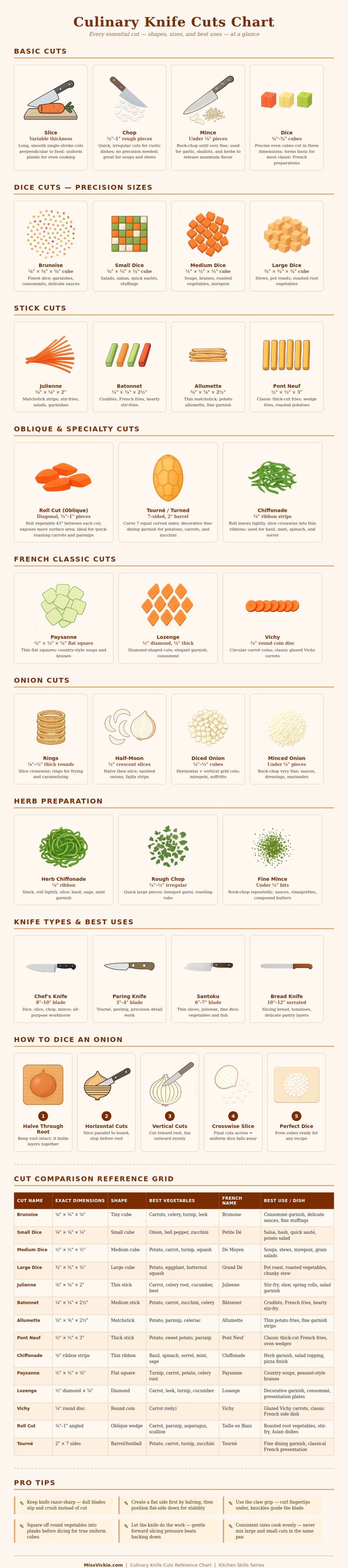
Uniformity in the cut of vegetables are important in the kitchen because uniform cuts will ensure that all piece of food will cook at the same rate. If food is cut into vary sizes, then some pieces of food will cook to quickly while other pieces will cook too slowly. The smaller pieces of food will cook quick and potentially become mushy while the large pieces will cook too slowly and remain hard to eat.
To avoid these issue, chefs must use precise cut to ensure that all pieces of food will cook to the same degree at the same time. Additionally, precise cuts will also ensure that the flavors are distributed even throughout the food because uniform cuts allow for even exposure of the food to flavoring agent. There are a variety of different cut for vegetables.
Why Even Vegetable Cuts Are Important
For instance, brunoise is an cut that allows for very small pieces of vegetables to be prepared for use as garnishes to add some color to a dish. A small dice is used as a larger version of the brunoise cut and is used for items such as salsa. A medium dice are used for recipes that require the vegetables to be cooked for a longer period of time, such as braises.
Large dice is used for recipes such as stews where the vegetables needs to be cooked for extended periods of time. Stick cuts focus on the length and thinness of the vegetables. For instance, julienne is a cut that produces long, thin matchsticks of vegetables and are used for stir-fry because they cook quickly.
Batonnet is thicker than julienne and is used for items like french fries. Allumette is thinner than julienne and is used for creating thin garnishes for food. Specialty cuts are only use for specific vegetables or culinary task.
For instance, an oblique cut is a roll cut where the cook rolls the vegetable between the cutting blades to produce angled piece of vegetables. This cut is often used on carrots. Another cut, chiffonade, is used for leafy vegetables.
With a chiffonade cut, the leaves is rolled into tight rolls before being sliced into long ribbons. This cut is used to avoid bruising the leaves and preserve the essential oils in the herbs. The types of tools you use will also impact the cuts of vegetables.
For instance, chef’s knives is used for most vegetable tasks. Chef’s knives have blades that range from 8 to 10 inches in length. Paring knives are smaller than chef knives and are used for detailed task on food.
Santoku knives are also a specific type of knife that is used for slicing vegetables into very thin pieces. Regardless of the knife used to cut vegetables, it is important to ensure that the knife are sharp. A dull knife can be dangerous because it can cause the knife to slip on the vegetables.
Additionally, a dull knife will crush the cell of the vegetables rather than cutting through the cells of the vegetables. There are a variety of techniques that can be used to master knife skill. For instance, one technique is the claw grip where the food is held in the hand and the fingers is tucked away from the blade to allow for the knuckles to guide the knife.
A stable cutting board is also important to master knife skills. A stable cutting board can be created by flattening one side of a vegetable. By using these technique to master knife skills, chefs will be able to produce uniform cuts of vegetables which will ensure that the vegetables cook evenly throughout the cooking process.