Croissant Layer Calculator
Estimate croissant butter layers, dough layers, turn count, trim loss, sheet thickness, proof expansion, croissant yield, and the honeycomb target for your lamination plan.
Choose a fold plan, then adjust the lock-in method, dough and butter weights, sheet size, cut size, trim loss, thickness, and proof expansion.
Croissant Lamination Breakdown
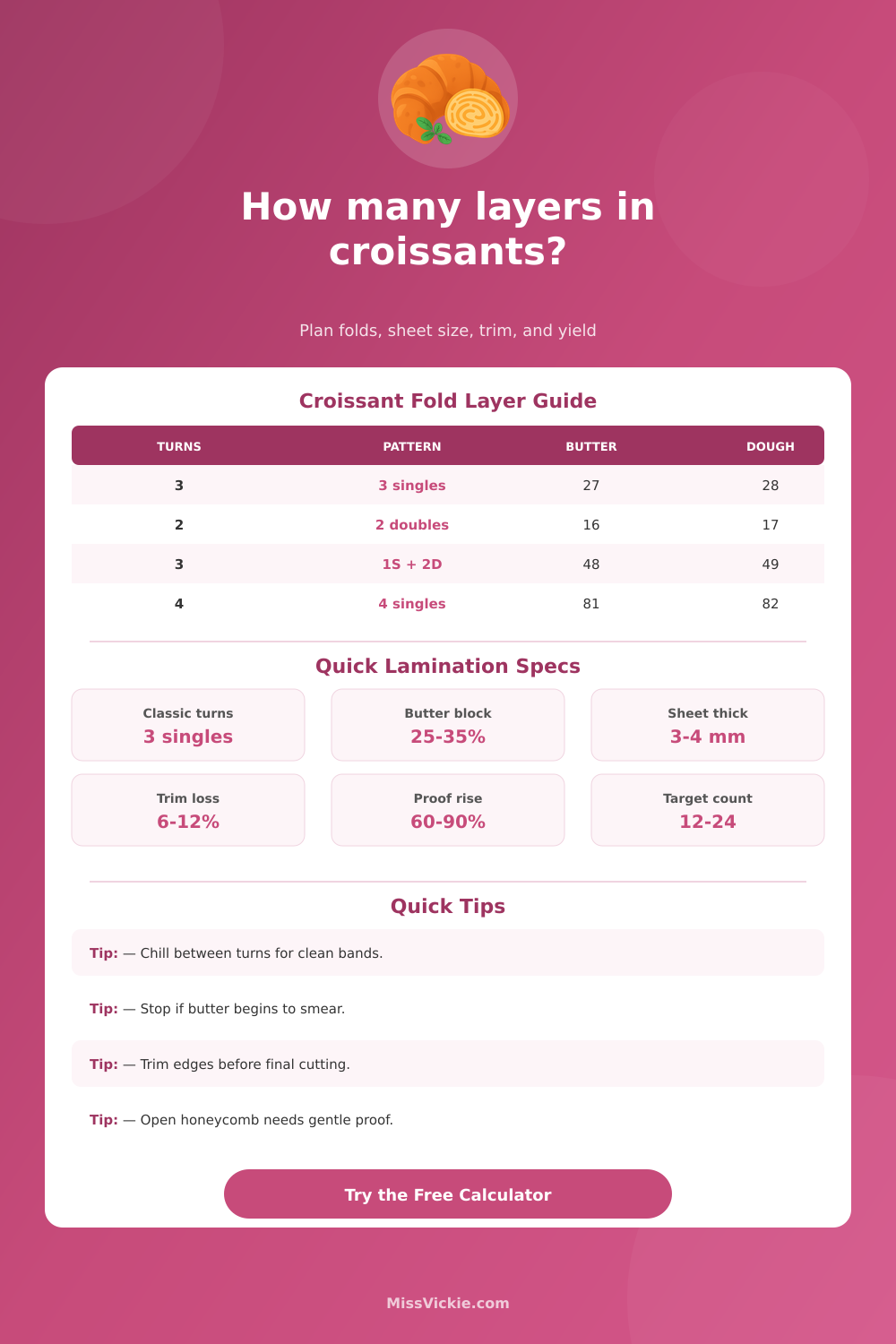
| Fold Pattern | Layer Math | Butter Layers | Dough Layers |
|---|---|---|---|
| Three single folds | 3 x 3 x 3 | 27 butter layers | 28 dough layers |
| Two double folds | 4 x 4 | 16 butter layers | 17 dough layers |
| One single plus two double folds | 3 x 4 x 4 | 48 butter layers | 49 dough layers |
| Four single folds | 3 x 3 x 3 x 3 | 81 butter layers | 82 dough layers |
| Two single plus one double fold | 3 x 3 x 4 | 36 butter layers | 37 dough layers |
Defined chambers, gentle handling, moderate layer count, and a full but not overlong proof.
Reliable bakery-style crumb with clean separation and enough structure for rolling.
Fine even crumb from extra folds, thinner layers, or firmer final sheeting.
Fewer bands, larger pockets, and a more handmade shape when layers are intentionally broad.
| Sheeting Target | Common Thickness | Best Use | Layer Effect |
|---|---|---|---|
| Mini croissants | 2.5 to 3 mm | Party trays and tight rolling | Very fine bands and a crisp shell |
| Classic croissants | 3 to 4 mm | Standard bakery crescent or straight shapes | Clear layers with room for honeycomb growth |
| Large croissants | 4 to 5 mm | Large triangles and bold open crumb | Wider layers that need careful proofing |
| Pain au chocolat slab | 3.5 to 4.5 mm | Rectangles instead of triangles | Similar layer count with fewer pointed trims |
| Test lamination | 5 mm or more | Practice rolling and visible layer checks | Coarser bands that reveal butter breaks |
| Batch Plan | Sheet Size | Triangle Size | Expected Count |
|---|---|---|---|
| Small home batch | 40 x 50 cm | 10 x 22 cm | 15 to 17 croissants after trim |
| Classic dozen | 35 x 50 cm | 11 x 25 cm | 11 to 12 larger croissants |
| Bakery tray | 50 x 70 cm | 10 x 26 cm | 24 to 25 standard croissants |
| Mini party sheet | 45 x 65 cm | 7 x 16 cm | 45 to 48 mini croissants |
| Practice batch | 30 x 45 cm | 9 x 20 cm | 12 to 13 compact croissants |
Making croissants depends upon building layers through lamination: yet almost all bakers simply guess the ratio of butter to dough, as well as how many turns will yield the right honeycomb structure. There are plenty of recipes out there, but problem isn’t with the recipes. It’s because they all make certain assumptions about your kitchen circumstances. Such as size of your sheets or your dough temperature, which don’t match their own.
The number of layers is as simple as multiplying. One single fold triples visible butter strata. Each single fold triples the visible butter strata. Two turns multiply by 4. First you make a base layer with the butter completely enclosed. Then the rest is just turning quickly, making very complex math problem simple. It’s all about keeping the dough even with the butter the whole time, so when you turn it doesn’t get too warm or to cold until next turn. Otherwise, if the butter start smearing, the layers melt into each other and you don’t get what you want.
Why This Calculator Helps You Bake Better Croissants
With all the numbers you put into it; the sheet size, the dough weight, the butter weight, your fold plan, calculator will do that math for you. So you has the math out of it and the practical decisions left for you to make.
The butter content matter a lot. Twenty-five to thirty-five percent butter (by weight in a finished dough) provides sufficient fat to separate the layers while maintaining enough elasticity to roll up into dough form. Anything lower than this will tighten the honeycomb but require additional twists to loosen it; anything higher will cause the layers to slip out of position when proofing, resulting in an unshapely croissant. With the tool, you are able to experiment with various percentages relative to your preferred honeycomb look so you see the trade-off before committing the dough.
The pre-cut thickness of the sheet is another factor in the result. A thinner sheet yields more delicate bands and crisps faster, perfect for small pastry that require a speedy bake. A thicker sheet holds wider bands, and unless you prefer a tight crumb over open spaces, it require longer and gentler proofing. The calculator estimates how thick your finished product will be based off your desired finished thickness, and the amount of expansion from proofing. It provides a concrete reference to use as a check against what you’ll see visually on the tray.
The number one thing bakers underestimate is trim loss. The more square-edged your dough, the easier it will be to see layers on the finished croissant. However, you are sacrificing usable space when you trim a piece off. This means there is less surface to cut triangles out of. A couple fewer pastries per sheet is difference between an 8 and a 14 percent loss. Knowing how much trim to factor into your end-count allows you to plan ahead: do you want cleaner-looking edges? Or a slightly larger yield? You should of planned for it.
But what’s really valuable about going through this exercise is you no longer treat each batch like an experiment. Instead, you gain clarity on what inputs do or don’t matter (i.e., what causes variation in output). This allows you to tweak things one variable at a time rather than guessing throughout your whole plan and you can recieve better results.