Royal icing stabilizer calculator
Cream of Tartar in Royal Icing Calculator
Estimate cream of tartar from powdered sugar weight, egg white or meringue powder base, flood versus outline consistency, humidity, drying time, and color bleeding risk.
🍪Quick royal icing scenarios
Load a realistic cookie decorating batch, then adjust sugar weight, base type, consistency, humidity, drying window, and colors below.
🧮Powdered sugar, base, and tartar inputs
Royal icing calculation breakdown
📏Fast royal icing tartar ratios
🥚Base type comparison
Classic royal icing base. Cream of tartar helps foam stability and edge strength.
Often slightly weaker foam. A modest tartar bump helps outline and detail icing.
Usually already stabilized. Add only a pinch unless your formula needs sharper piping.
Acid can support foam, but overdoing it may make flood icing taste sharper.
📋Cream of tartar by powdered sugar weight
| Powdered Sugar | Fresh Egg White Base | Meringue Powder Base | Best Consistency |
|---|---|---|---|
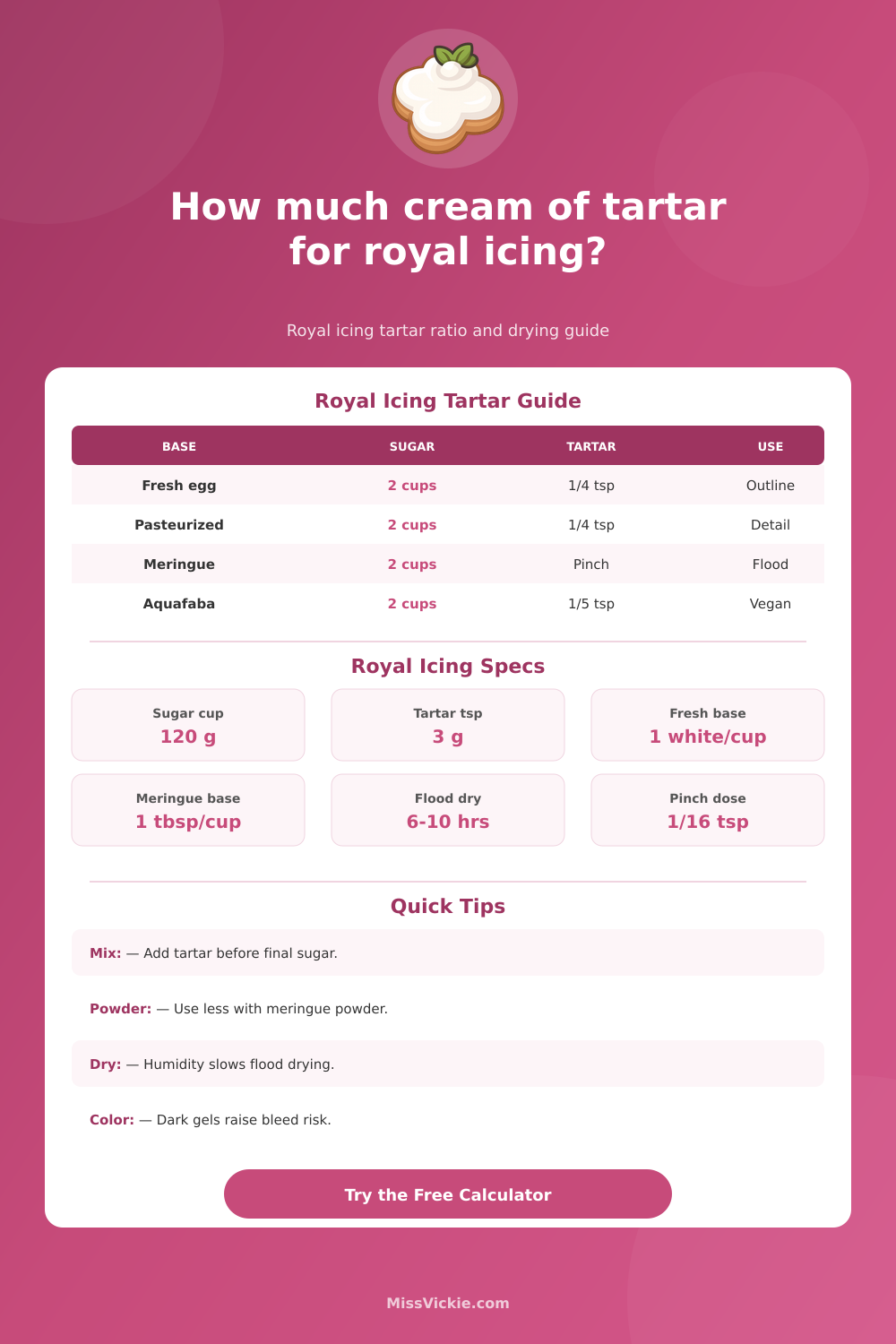
| 1 cup / 120 g | 1/8 tsp tartar | Small pinch | Small outline bag |
| 2 cups / 240 g | 1/4 tsp tartar | 1/16 tsp tartar | Outline plus flood |
| 4 cups / 480 g | 1/2 tsp tartar | 1/8 tsp tartar | Two dozen cookies |
| 6 cups / 720 g | 3/4 tsp tartar | 3/16 tsp tartar | Class or party batch |
| 8 cups / 960 g | 1 tsp tartar | 1/4 tsp tartar | Large decorating day |
💧Consistency, water, and drying reference
| Target | Typical Use | Water per 120 g Sugar | Drying Watchpoint |
|---|---|---|---|
| Stiff | Flowers, transfers, 3D detail | 8-12 ml | Can crust fast and feel brittle |
| Outline | Borders, lettering, dams | 12-16 ml | Edges should set before flood |
| Medium detail | Sections, dots, small fills | 15-19 ml | Watch for tip clogging |
| Flood | Base fill inside outline | 20-24 ml | Needs long uncovered drying |
| Wet-on-wet | Marbling, dots, drag designs | 23-27 ml | Highest color bleed risk |
🌧Humidity and color bleeding guide
| Condition | Drying Effect | Tartar Adjustment | Color Bleeding Note |
|---|---|---|---|
| Dry room under 40% | Sets faster | Use baseline or slightly less | Lower bleed risk, watch crusting |
| Normal room 40-55% | Predictable set | Use standard estimate | Best for layered details |
| Humid room 56-70% | Flood dries slowly | Small stability bump | Dry dark colors longer |
| Very humid over 70% | Surface stays tacky | Do not rely on tartar alone | High bleed risk with wet-on-wet |
🧁Practical royal icing notes
Cream of tartar is an ingredient that is use in royal icing, and it has a specific function within royal icing. Cream of tartar help to strengthen the foam that is made from egg whites that are used to make royal icing. Strong egg whites foam are necessary for royal icing to maintain its border and to maintain a smooth surface.
Without adequate strength in the egg white foam, the icing may collapse before the sugar can effectively lock the icing in place. Many baker use cream of tartar in making royal icing, but many do not realize that the amount of cream of tartar that is required change based off several different factor. The amount of cream of tartar that is needed is dependent upon the type of base that is used in the royal icing.
How Much Cream of Tartar to Use in Royal Icing
Royal icing that utilize fresh egg whites will require the addition of a measured amount of cream of tartar to strengthen the egg whites foam. Royal icing that uses meringue powder, however, will require less cream of tartar to be add, as meringue powder already contains the element necessary to strengthen the icing. Royal icing that uses pasteurized egg whites will have a strength that is somewhere in between those of fresh egg whites and meringue powder.
The amount of cream of tartar that is needed can therefore be adjust based upon the type of base that is used. Additionally, the type of consistency that is desired for the icing will impact the amount of cream of tartar that is used. Icing that is to be used for stiff piping will contain more cream of tartar than icing that is to be used for flooding, as flooding icing will be too sharp if the flooding icing contain the same amount of cream of tartar as the icing that is piped into decorative pattern.
Additional factor that will impact the amount of cream of tartar that is required for royal icing include the humidity in the room in which the icing will dry, the drying time for the icing, color choice for the icing, and the number of color that are to be used in the royal icing decorations. In dry rooms, royal icing will dry faster, indicating that less cream of tartar should be used. In humid environment, however, royal icing will dry slower, indicating that more cream of tartar should be used.
Additionally, the amount of time in which royal icing should dry can also impact the amount of cream of tartar that is used in the icing. If the icing need to dry within a short time frame, more cream of tartar will be needed to allow the icing to reach its stable state in that shorter amount of time. Finally, royal icing that include dark gel color will contain moisture.
This moisture can lead to the color of royal icing bleeding if the icing is too soft. Additionally, if royal icing decoration include many color of icing next to one another, the risk of bleeding will increase. Therefore, by entering factor as mentioned above, a user uses a calculator to determine the amount of cream of tartar that should be used in royal icing.
The calculator will provide the amount of cream of tartar that should be used, the estimated time in which the icing will dry, and the risk of the icing color bleeding. This information will allow the baker to make decisions regarding the royal icing decorating plan. In addition to the factor that are included in the cream of tartar calculator, there are a few additional variable that may impact the strength of the egg white foam.
For instance, if the bowl in which royal icing is mixed contain traces of butter, it will weaken the strength of the foam that is prepared from the egg whites. Additionally, if the royal icing contain any flavor that is based upon oil, it will also weaken the egg white foam. Finally, if flood icing is thinned too much to allow it to flood the cookies that are decorated with royal icing, that thinning will cancel out the effect of the cream of tartar that is used.
The information provided from the royal icing calculator should be used as a starting point to prepare royal icing. The cream of tartar amount is not to be treat as a rule. Instead, royal icing should be mixed and a small border of royal icing should be prepared on scrap paper to test the strength of the icing.
If the icing begin to soften before it dries, more cream of tartar should be added to royal icing batch to come. If the icing begin to crack, too much cream of tartar has been used for the amount of humidity in the icing and it’s required consistency. Thus, the goal of utilizing cream of tartar in royal icing is to create a decorating process that is both more predictable and reliable.