How Much Cream of Tartar per Egg White?
Calculate cream of tartar for egg whites by count or measured weight, then adjust for recipe use, foam target, sugar level, humidity, hold time, egg size, and measuring precision.
Start with a baking situation, then tune the white weight, foam target, sugar ratio, and kitchen conditions to fit your bowl.
Calculation Breakdown
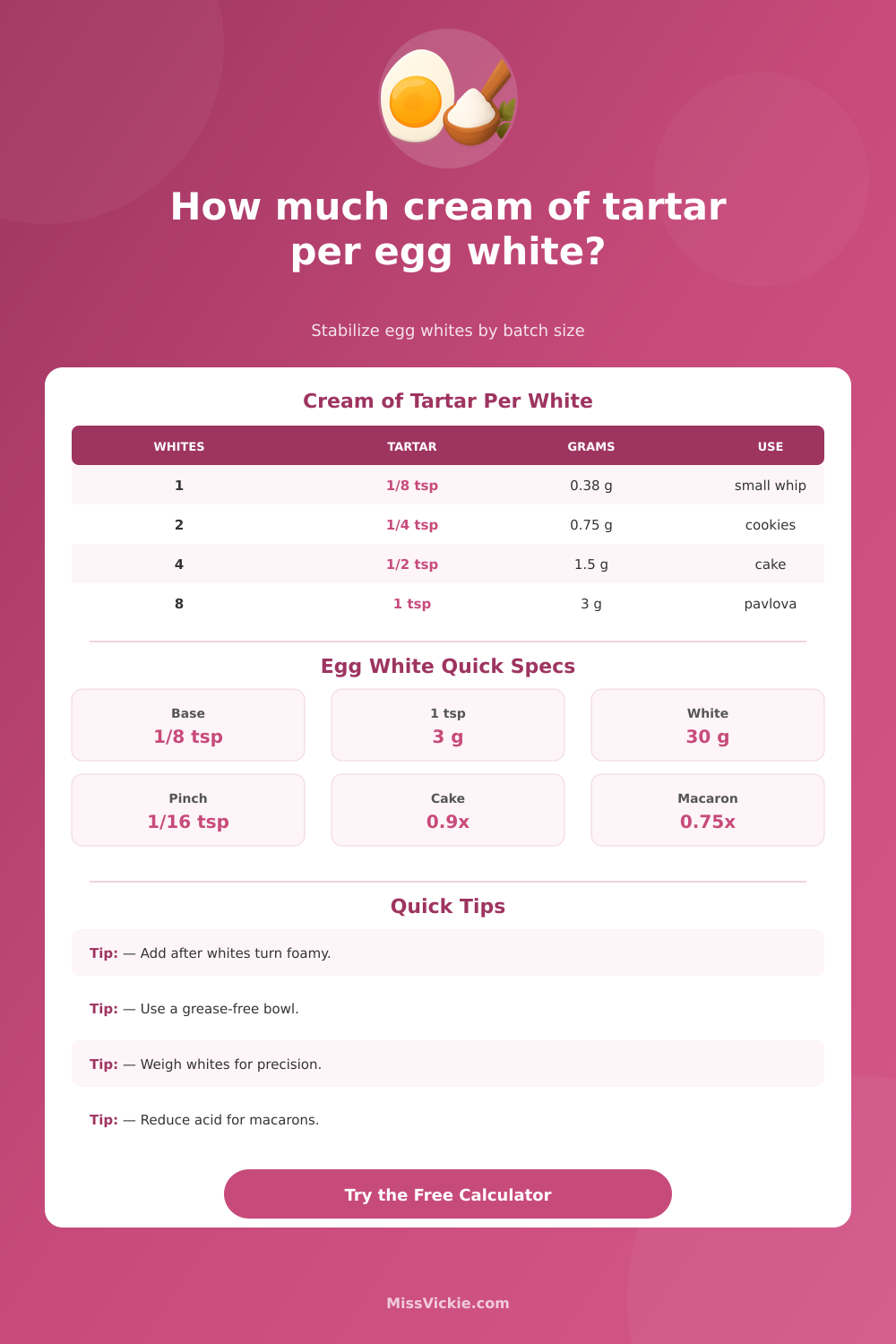
| Egg whites | Base cream of tartar | Approx grams | Common use |
|---|---|---|---|
| 1 large white | 1/8 teaspoon | 0.38 g | Small test whip, cocktail foam, light folding |
| 2 large whites | 1/4 teaspoon | 0.75 g | Small cookies, mini pie topping, practice meringue |
| 3 large whites | 3/8 teaspoon | 1.13 g | Macaron batch, small sponge cake, royal icing |
| 4 large whites | 1/2 teaspoon | 1.50 g | Angel food style batter or family pie topping |
| 6 large whites | 3/4 teaspoon | 2.25 g | Large cake, pavlova shell, party dessert base |
| 8 large whites | 1 teaspoon | 3.00 g | Large pavlova, sheet meringue, bakery batch |
| Recipe use | Factor | Why it changes | Practical note |
|---|---|---|---|
| Standard whipped whites | 1.00x | General stabilization | Good default for most home baking |
| French meringue | 1.05x | Sugar is added while whipping | Useful for cookies and pie topping |
| Angel food cake | 0.90x | Batter needs flexible foam | Too much acid can make foam tight |
| Macaron batter | 0.75x | Foam is folded down deliberately | Lower acid helps avoid dry, brittle shells |
| Souffle or folded batter | 0.85x | Lift matters more than stiffness | Use just enough acid for structure |
| Royal icing or glaze | 1.10x | Longer standing time | Useful when piping details |
| Swiss meringue method | 0.75x | Heat and sugar add stability | Add acid after warming if needed |
| Italian meringue method | 0.60x | Hot syrup stabilizes the foam | Often needs less cream of tartar |
| Measure | Large white equivalent | Cream of tartar baseline | Best for |
|---|---|---|---|
| 1 large white | About 30 g / 1.06 oz | 1/8 teaspoon | Fast home baking |
| 2 tablespoons whites | About 1 large white | 1/8 teaspoon | Carton whites or separated leftovers |
| 30 milliliters whites | About 1 large white | 1/8 teaspoon | Metric liquid measuring |
| 100 g whites | About 3.3 large whites | 0.42 teaspoon | Macarons and bakery formulas |
| 1 ounce whites | About 0.94 large white | 0.12 teaspoon | Small imperial scale batches |
| 1 cup whites | About 8 large whites | 1 teaspoon | Angel food cakes and large meringues |
| Condition | Factor range | What it means | Kitchen cue |
|---|---|---|---|
| Dry room, use now | 0.94x to 1.00x | Foam needs less insurance | Stop at glossy peaks |
| Normal room, short hold | 1.00x to 1.08x | Reliable everyday target | Add acid after frothy foam forms |
| Humid room, medium hold | 1.10x to 1.22x | Foam may weep sooner | Bake or pipe promptly |
| Rainy room, long hold | 1.25x to 1.40x | Maximum home-kitchen support | Avoid overbeating into grainy foam |
Dry acid with clean flavor and easy storage.
Use more liquid acid; flavor becomes noticeable.
Similar acidity support with a sharper aroma.
Possible for fresh eggs, but less stable.
Cream of tartar is an acidic powder that help to stabilize the egg whites that are beaten to incorporate air into the mixture. Cream of tartar can prevent egg whites from collapsing when beating the eggs. When you beat egg whites, the proteins in the egg whites will stretch to incorporate air into the mixture.
However, the structure of the egg whites are fragil. The cream of tartar will help to keep the proteins in the egg whites tight so they will remain stable. If there is too little cream of tartar in the egg whites, the egg whites will weep before they can set.
How to Use Cream of Tartar for Egg Whites
If there is too much cream of tartar in the egg whites, the flavor of the egg whites will be to sharply and the texture will become tight and dry. Many people use one eighth of a teaspoon of cream of tartar for every large egg white that they use in its recipe. This amount of cream of tartar ensures that the egg whites has a baseline level of acidity so that the proteins do not relax.
However, the amount of cream of tartar that is needed may change due to different variable in the recipe. For example, if the kitchen is dry, less cream of tartar is needed than if the kitchen is humid. The cream of tartar calculator will provide you with the amount of cream of tartar that is needed for your recipe, based off the information that you provide on the calculator.
You must provide information on how you measured the egg whites. For example, you can weigh the egg whites or you can use a count of the number of eggs that you used. The weight of carton eggs may not equal the weight of separated egg whites.
The calculator will also ask for the target peak of the egg whites, the amount of sugar that you will use in the recipe, and for how long the egg whites will sit before being heated in the oven. Each of these variables will affect the amount of cream of tartar that is needed in your recipe for the egg whites to remain stable. You must ensure that you add the cream of tartar at the correct time for it to work correctly with the egg whites.
You should add the cream of tartar once the egg whites have begun to foam but before the egg whites reach soft peak. If you add the cream of tartar too early, the egg whites may foam to a higher volume too soon. However, if you add the cream of tartar too late, parts of the egg whites may collapse.
The calculator will provide you with the total amount of cream of tartar to use. For recipes that use a large amount of egg whites, you can choose to add the cream of tartar in two or three separate addition. Sugar会影响 the amount of cream of tartar that is needed for the egg whites.
The higher the amount of sugar in the recipe, the less cream of tartar will be needed. This is because sugar will help the egg whites to foam. For example, pavlova recipes that contain a high amount of sugar will require less cream of tartar to be added to the egg whites than recipes that contain very little sugar, such as soufflés.
The amount of sugar in your recipe can be selected in the calculator to allow it to calculate the correct amount of cream of tartar. Humidity is another variable with its effect on the egg whites. Humidity can affect the amount of cream of tartar that is needed for the egg whites.
If the air is dry, the egg whites will hold their shape easy. However, if the air is humid, the egg whites will weep. Therefore, if the air is humid or it is rainy outside, the calculator will increase the amount of cream of tartar that is recommended.
This is to ensure that the proteins in the egg whites do not relax due to the humidity in the air. The amount of time that you allow the egg whites to sit after adding them will also affect the amount of cream of tartar. If you will be using the egg whites immediately, you will need less cream of tartar.
However, if the egg whites will be sitting for some time before being heated in the oven, you will need to add more cream of tartar so that they dont soften before being baked. Although cream of tartar can be substituted, adjustments will have to be made to the measurements. Lemon juice and white vinegar can be used as substitutes for cream of tartar.
However, since they are liquids, the volume of lemon juice and white vinegar that you use will be roughly three times the measurement of the amount of cream of tartar that will be used. The use of these substitutes will change the flavor of the egg whites and may also affect the stability of the egg whites. The calculator can be used to determine the amount of lemon juice and vinegar that can be used in place of cream of tartar for your recipe.
Common mistakes may be made when using cream of tartar. For instance, some people use the ratio of cream of tartar to egg whites without considering that it may need to be adjusted according to the amount of sugar in the recipe. People may measure the amount of cream of tartar by eye.
However, this is not the best way to ensure that the recipe turns out the way that you would like. Instead, it may lead to using too much cream of tartar. Additionally, people may use the same amount of cream of tartar for recipes that contain a low amount of sugar and a high amount of sugar.
However, this is a mistake because sugar has a direct effect on the stability of the egg whites. Finally, another mistake that can be made is to ignore the humidity in the air. If the air is humid, the egg whites will begin to weep.
Therefore, it is better to take into account the humidity in the air to ensure that the recipe succeeds. The cream of tartar calculator will help you to avoid these mistakes when preparing your recipe.