Cream of Tartar for Macarons Calculator
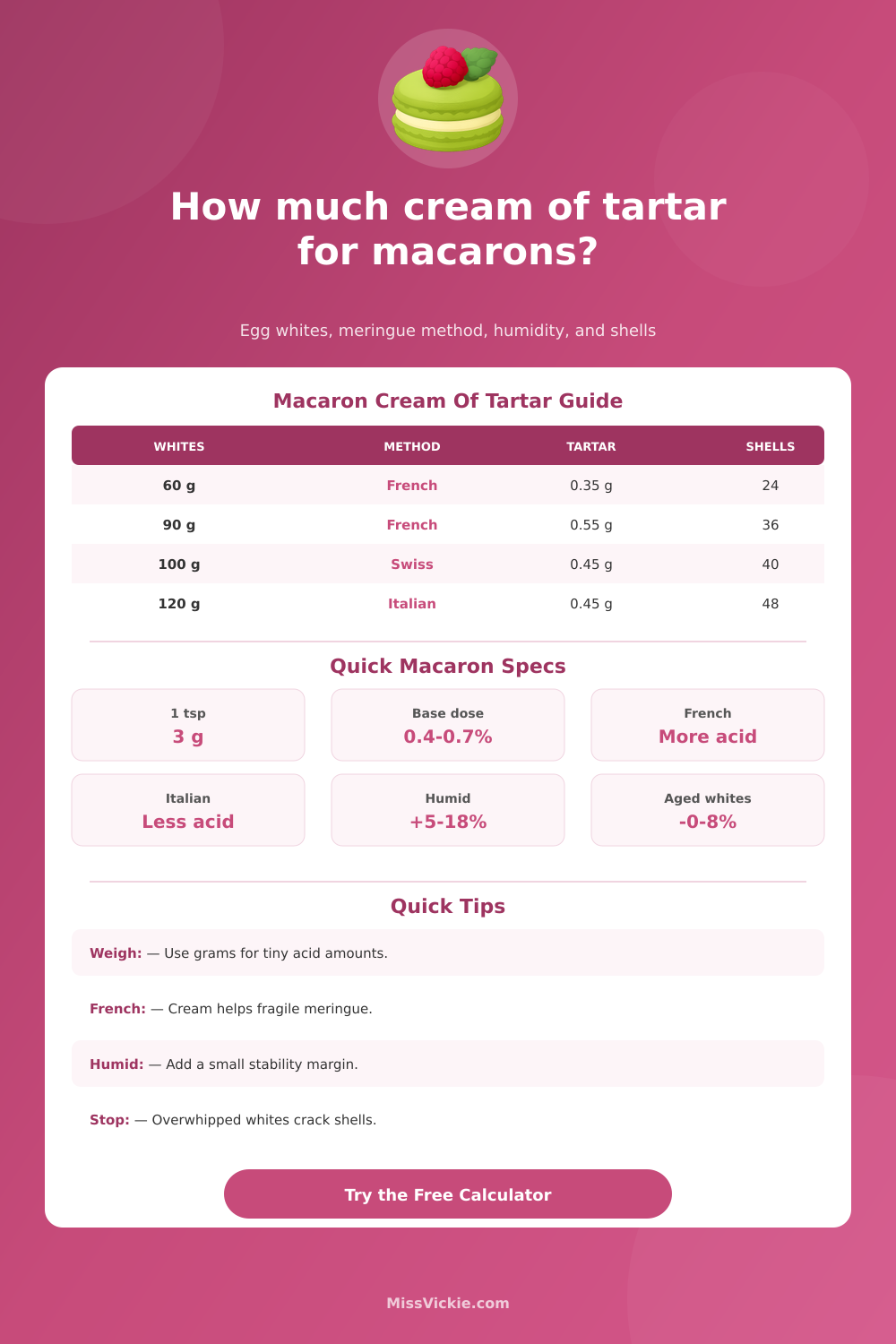
Estimate cream of tartar for macaron meringue from egg white grams, meringue method, sugar ratio, humidity, desired shell count, aged whites, acid strength, and overwhip risk.
Choose a starting point: each preset loads egg whites, meringue method, shell size, shell count, granulated sugar ratio, humidity, aging, and acid strength.
Macaron Batch Breakdown
| Situation | Base Cream Of Tartar | Adjustment | Macaron Cue |
|---|---|---|---|
| French meringue, normal humidity | 0.5 g to 0.6 g per 100 g whites | Best all-purpose starting range | Stop at firm, glossy peaks before the whites look chunky. |
| Swiss meringue, warmed sugar and whites | 0.4 g to 0.5 g per 100 g whites | Reduce slightly because heat dissolves sugar and tightens foam. | Cool slightly before adding color to avoid loose batter. |
| Italian meringue with hot syrup | 0.3 g to 0.45 g per 100 g whites | Use a light hand; syrup is the main stabilizer. | Whip until bowl is warm, not hot, and peaks hold softly. |
| Very humid kitchen | Add about 8% to 18% | Pair with longer shell drying and careful oven venting. | Shells should feel dry before baking, not sticky. |
| Aged whites, 2 to 3 days | Reduce about 4% to 8% | Older whites foam quickly and may overwhip sooner. | Use medium speed once foamy to keep bubbles fine. |
| High gel color or cocoa shells | Add about 3% to 8% | Color and dry flavor can weaken or thicken the batter. | Fold less aggressively once the batter starts flowing. |
| Shell Size | Batter Per Shell | 100 g Whites Yields | Best Use |
|---|---|---|---|
| Mini, 1.25 in / 3.2 cm | About 3.8 g before baking | 60 to 68 shells after normal piping loss | Tasting trays, petits fours, and high-count party boxes. |
| Small, 1.5 in / 3.8 cm | About 5.0 g before baking | 46 to 54 shells after normal piping loss | Gift boxes where smaller filled macarons are preferred. |
| Classic, 1.75 in / 4.5 cm | About 6.4 g before baking | 36 to 44 shells after normal piping loss | Standard bakery-size shells and most home templates. |
| Large, 2 in / 5 cm | About 8.0 g before baking | 28 to 34 shells after normal piping loss | Dessert table shells with generous filling. |
| Jumbo, 2.5 in / 6.4 cm | About 12.0 g before baking | 18 to 23 shells after normal piping loss | Ice cream sandwiches or single-serve plated desserts. |
| Acid Option | Strength Used Here | How To Dose | Macaron Concern |
|---|---|---|---|
| Fresh cream of tartar | 100% | Weigh powder or use a level measuring spoon. | Cleanest flavor and least added moisture. |
| Older cream of tartar | About 80% | Use a little more, then replace the jar if results are inconsistent. | Clumped powder can distribute unevenly in small batches. |
| Lemon juice | About 45% | Use drops, not spoonfuls, and subtract the liquid mentally from whites. | Can loosen meringue and add flavor if overused. |
| White vinegar | About 50% | Add to foamy whites before the sugar stream. | Can smell sharp before baking, though most aroma fades. |
Macarons relies upon the texture of a meringue. The amounts of acid that you adds to the meringue affect the texture of the meringue. While cream of tartar is an acid that prevent the egg white foam from collapsing too early in the preparation of the meringue, too much cream of tartar can make the macarons taste sharply or dry.
The amount of cream of tartar that you should add to the meringue are based off the batch size, the meringue method that will be used, and the humidity of the kitchen in which the macarons will be prepared. Many baker will attempt to use the same amount of cream of tartar with each batch of macarons. However, the same amount of cream of tartar may not work if the method for preparing the meringue are changed or if the humidity of the kitchen change.
How Much Cream of Tartar to Use for Macarons
For instance, if a baker change from using a French meringue to a Swiss meringue, the amount of cream of tartar required will change. Additionally, if the humidity in the kitchen is high, the meringue will be more fragilely, which may also impact the amount of cream of tartar that should be used. The calculator provide a specific weight for the cream of tartar because it takes into account the weight of the egg whites that will be used, the method for preparing the meringue, and the humidity level in the kitchen.
Additionally, the calculator also take into account the age of the egg whites that will be used and the amount of coloring that will be added to the meringue. As such, the calculator provides the amount of cream of tartar that you should weigh on a scale. The amount of cream of tartar that will be used may also change based upon the type of meringue that is to be prepared.
For instance, French meringue will require a higher amount of cream of tartar then Italian meringue. The sugar are added to the egg whites in its raw state in French meringue, which provides less stability to the egg white foam than other types of meringue. Italian meringue, on the other hand, use hot syrup to stabilize the egg whites, which reduce the need for cream of tartar.
The humidity of the kitchen can also change the amount of cream of tartar that should be use in the meringue. High humidity levels makes the meringue more fragile. Additionally, aged egg whites will whip faster than fresh egg whites, which may also impact the amount of cream of tartar that is needed in the preparation of the meringue.
The calculator can be used to plan the number of macaron shell that you wish to make. By entering the number of macaron shells that you wish to make, the diameter of the macaron shells, and the ratio of sugar to egg whites that you prefer, the calculator will indicate the number of grams of egg whites that will be need. Based upon the weight of the egg whites, the calculator can also determine the amount of cream of tartar that should be used.
This can prevent the mistake of using too much batter to make the shells or using too little batter to make the shells. Lemon juice and vinegar can be used as an alternative to cream of tartar. However, lemon juice and vinegar contains water.
The calculator will provide the amount of lemon juice or vinegar that will be needed, but it will also warn the baker that these ingredient may make the meringue behave in a wetter manner. Many bakers, however, prefer to use cream of tartar in place of lemon juice and vinegar because cream of tartar does not alter the texture of the meringue and does not contribute to the flavor of the macarons. The calculator also provide a risk reading for the meringue.
A high risk reading do not mean that the meringue will fail during the baking process. However, if the risk reading is high, care should be taken to ensure that the meringue is not overwhipped. If the meringue appears to be dry or clumpy, this means that the meringue has been overwhipped.
Overwhipped meringue can lead to macaron shells that contains hollow center. In these cases, the meringue should be stopped as soon as it begin to appear firm and glossy. While the amount of cream of tartar to be used is an important variable in the preparation of macarons, the amount of cream of tartar to be used does not replace the bakers technique in preparing the shells.
For example, the shells should still be dried until they feel matte to the touch, and the macaronage should still be perform until the macaron batter begin to ribbon off of the spatula. However, once you weigh the amount of cream of tartar on a gram scale, weighing the cream of tartar will become a routine part of the macaron baking process.