Cream of Tartar to Baking Powder Substitute Calculator
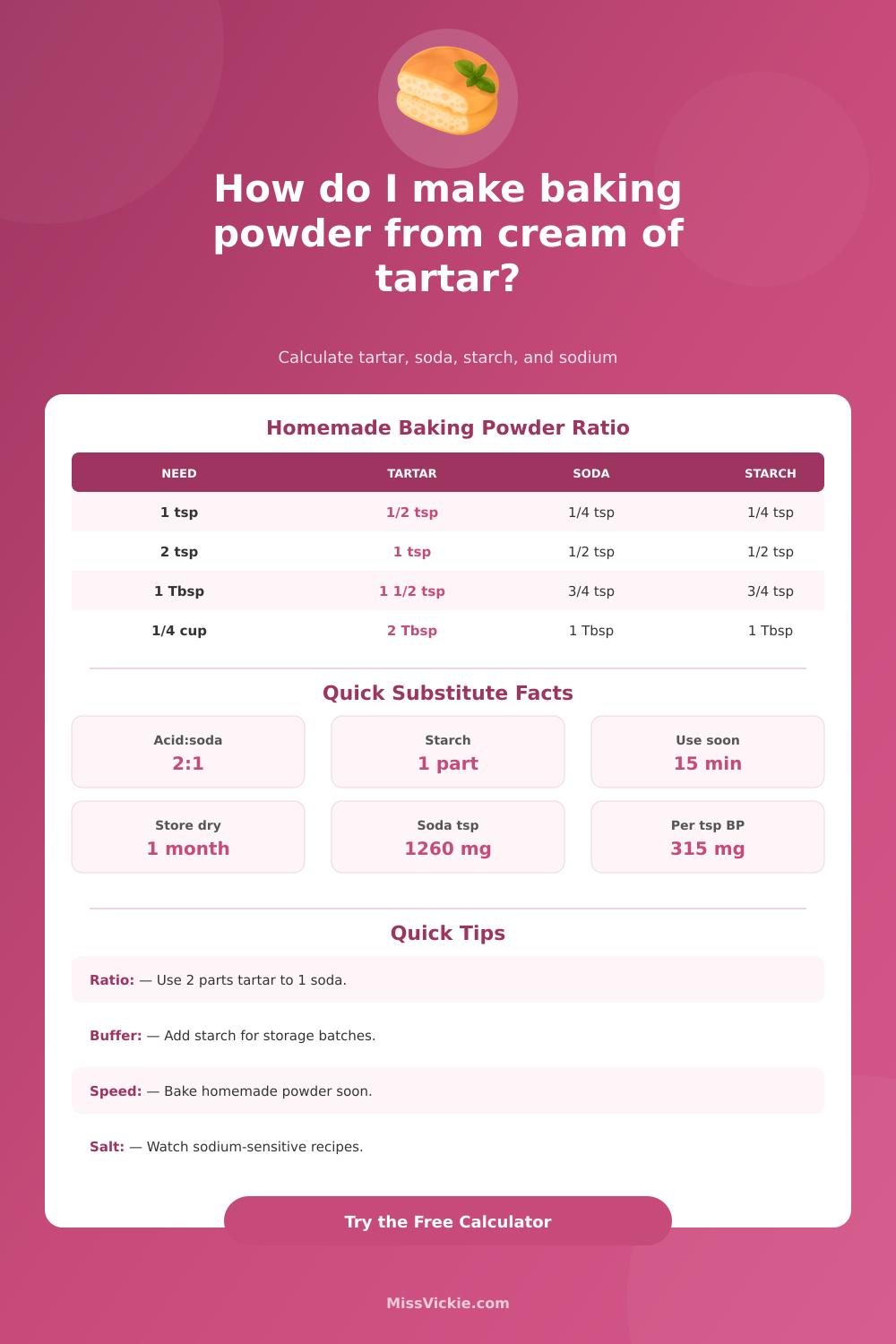
Make a baking powder substitute from cream of tartar, baking soda, and a cornstarch buffer while checking recipe type, storage plan, leavening urgency, batch scaling, and sodium impact.
Load a common baking powder need, then adjust the blend for immediate use, storage, recipe style, or sodium sensitivity.
Substitute Breakdown
| Baking Powder Needed | Cream of Tartar | Baking Soda | Cornstarch Buffer | Best Use |
|---|---|---|---|---|
| 1 tsp | 1/2 tsp | 1/4 tsp | 1/4 tsp | Most small recipe swaps |
| 2 tsp | 1 tsp | 1/2 tsp | 1/2 tsp | Muffins, pancakes, snack cakes |
| 1 Tbsp | 1 1/2 tsp | 3/4 tsp | 3/4 tsp | Quick breads and larger cakes |
| 1/4 cup | 2 Tbsp | 1 Tbsp | 1 Tbsp | Storage jar, kept dry and labeled |
| 1/2 cup | 1/4 cup | 2 Tbsp | 2 Tbsp | Prep batch for frequent baking |
| Recipe Type | Blend Behavior | Urgency | Sodium Note | Calculator Factor |
|---|---|---|---|---|
| Cakes | Needs even, gentle lift | Bake soon after mixing | Reduce added salt if sensitive | Slightly gentle |
| Muffins | Tolerates a standard 2:1 blend | Fill pans quickly | Moderate sodium per serving | Standard |
| Pancakes | Fast griddle reaction works well | Cook first batch soon | Salt can taste stronger | Small cushion |
| Biscuits | Lift depends on cold dough and oven spring | Cut and bake promptly | Salted butter adds pressure | Small cushion |
| Cookies | Leavening affects spread and browning | Chilling weakens homemade lift | Soda adds browning and sodium | Conservative |
Mix the active acid and soda into dry ingredients and bake quickly.
A small starch buffer helps slow clumping while the blend waits.
Use the full starch buffer, label it, and keep moisture away.
Homemade powder is not a perfect double-acting replacement.
| Scale | Baking Powder Target | Cream of Tartar | Baking Soda Sodium | Handling Note |
|---|---|---|---|---|
| Half batch | 0.5 tsp | 1/4 tsp | About 158 mg | Use measuring spoons carefully |
| Single batch | 1 tsp | 1/2 tsp | About 315 mg | Good emergency swap size |
| Double batch | 2 tsp | 1 tsp | About 630 mg | Whisk dry ingredients thoroughly |
| Jar prep | 1/4 cup | 2 Tbsp | About 7560 mg | Store airtight and use a dry spoon |
Baking powder are a leavening agent that many peoples use in baking. Baking powder creates a lift that cakes, muffins, and biscuits has. Instead of baking powder, people can use cream of tartar and baking soda.
When mixed together, cream of tartar and baking soda will create an acid-base reaction that will release the carbon dioxide gas that create lift in the baked goods. However, cream of tartar and baking soda will react as soon as the baking ingredients is mixed with liquids. Therefore, if cream of tartar and baking soda is to be substituted for baking powder, the reaction must be timed according.
How to Make and Use Homemade Baking Powder
The baking powder calculator will calculate how much cream of tartar and baking soda is required for the amount of baking powder required by the recipe. The amount of baking powder by the recipe will determine the amount of cream of tartar and baking soda required by the recipe. Additionally, the baking powder calculator will also calculate how much time will pass before baking the goods.
This is to account for the fact that the baking powder that is made at home will not have the same double acting protection as commercial baking powder. Commercial baking powder will contain two source of acid that will react with the base in baking powder. However, at home baking powder will only have one source of acid.
Therefore, homemade baking powder will begin to react the moment that it is mixed with the liquid in the recipe. Cream of tartar will be the acidic component in the mixture with baking soda. Baking soda will be the basic component in the mixture with cream of tartar.
The ratio for cream of tartar and baking soda is two parts cream of tartar to one part baking soda. However, the ratio can be manipulated depending on the recipe being create. For cakes, a gentler ratio of cream of tartar and baking soda will prevent the baked good from having a metallic taste.
For biscuits, using a stronger ratio will allow the biscuits to rise more quick. If the mixture is to be stored for a long period of time, adding a starch like cornstarch will help to keep the baking soda and cream of tartar dry. Baking soda contain sodium.
The baking soda sodium calculator will estimate the amount of sodium in each serving of the food product if the amount of salt used in the recipe is provided. Many people needs to manage their sodium intake. Therefore, knowing the amount of sodium will allow people to change the amount of salt in other components of the recipe.
The baking soda calculator will also display the amount of sodium in the recipe if the batch size are increased. In order to ensure that homemade baking powder remain effective, the storage of homemade baking powder is important. If homemade baking powder is made in large batch to be used over many weeks, cornstarch or arrowroot should be added to the baking powder to keep the baking soda and cream of tartar dry.
Homemade baking powder should be stored in a labeled container that contains homemade baking powder and used within one month of the batch being create. If needed for only one recipe, skipping the addition of starch are all that is required to make homemade baking powder. The type of recipe that will be created will play a big role in how homemade baking powder is used.
Pancake and waffle recipes use the standard ratio of cream of tartar to baking soda because pancakes and waffles cook quick on the griddle. Cake recipes use a gentler ratio of cream of tartar to baking soda. Additionally, cake recipes must be baked immediately after adding the liquid to the cake batter.
Biscuit recipes use the same ratio of cream of tartar to baking soda but should be baked quick because the biscuit dough should not be allowed to sit for long after the baking soda and cream of tartar are mixed into the biscuit dough. Finally, using the freshness selector on the baking soda or cream of tartar will ensure that the homemade baking powder maintain its ability to release the carbon dioxide gas that create lift in the baked goods.