Crawfish pounds, boil water, seasoning, soak, and add-ins
Crawfish Boil Seasoning Per Pound Calculator
Scale a backyard or party boil with dry seasoning per pound, liquid boil per gallon, salt strength, purge loss, potatoes, corn, sausage, batch size, and cooler finish time.
🦞Real Crawfish Boil Presets
Choose a starting point, then adjust your pot size, spice, soak, and add-ins.
⚙Boil Settings
Your Crawfish Boil Plan
Seasoning amounts will appear after calculation.
Full Breakdown
📊Batch Snapshot
🔥Seasoning Style Reference
| Boil Style | Dry Mix | Liquid Boil | Salt Target | Soak Range |
|---|---|---|---|---|
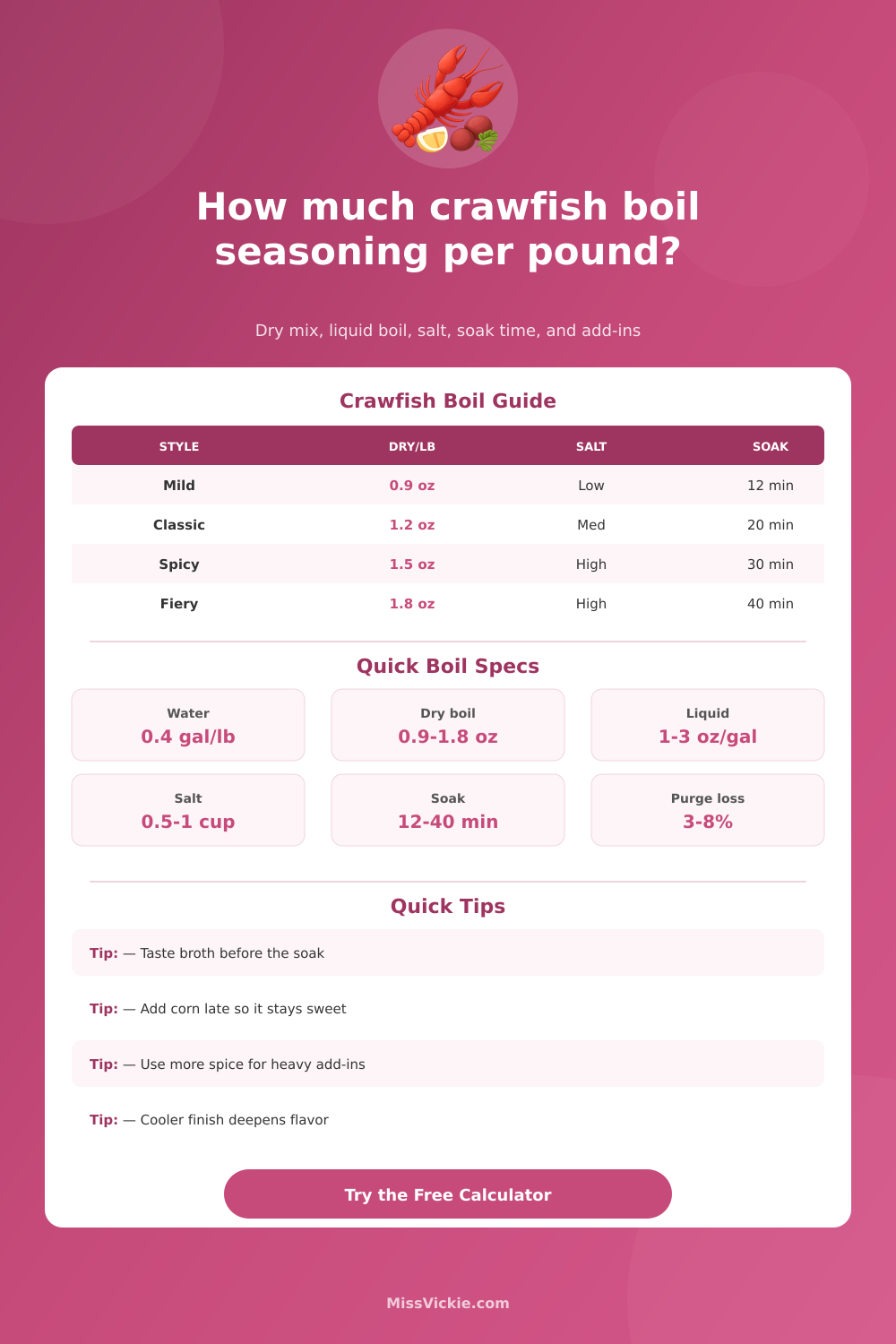
| Mild family boil | 0.8 to 1.0 oz per lb | 0.5 to 1.0 oz per gal | Low | 10 to 15 min |
| Classic backyard boil | 1.1 to 1.3 oz per lb | 1.0 to 1.8 oz per gal | Medium | 18 to 25 min |
| Spicy party boil | 1.4 to 1.6 oz per lb | 1.8 to 2.5 oz per gal | High | 25 to 35 min |
| Fiery extra-hot boil | 1.7 to 2.0 oz per lb | 2.5 to 3.2 oz per gal | High or briny | 30 to 45 min |
💧Water, Batch, And Pot Load Table
| Crawfish Load | Typical Water | Pot Size | Dry Mix Start | Batch Note |
|---|---|---|---|---|
| 10 lb | 4 to 5 gal | 30 to 40 qt | 10 to 14 oz | Small family pot |
| 35 lb sack | 12 to 16 gal | 60 to 80 qt | 2.5 to 3.5 lb | Most common boil |
| 70 lb | 24 to 32 gal | Two large pots | 5 to 7 lb | Split into batches |
| 100 lb | 35 to 45 gal | Event rig | 7 to 10 lb | Season each batch |
🌽Add-In Seasoning Adjustment Table
| Add-In Load | Potatoes | Corn | Sausage | Seasoning Boost |
|---|---|---|---|---|
| Light | 0.15 lb per lb crawfish | 0.15 piece per lb | 0.04 lb per lb | Add 3% |
| Balanced | 0.25 lb per lb crawfish | 0.30 piece per lb | 0.08 lb per lb | Add 6% |
| Heavy | 0.40 lb per lb crawfish | 0.45 piece per lb | 0.12 lb per lb | Add 10% |
| Very heavy | 0.55 lb per lb crawfish | 0.60 piece per lb | 0.16 lb per lb | Add 14% |
⏱Soak And Cooler Finish Reference
| Flavor Goal | Soak Time | Cooler Finish | Broth Taste | Best For |
|---|---|---|---|---|
| Gentle | 8 to 12 min | 0 to 5 min | Lightly salty | Kids and mixed crowds |
| Classic | 18 to 25 min | 5 to 10 min | Bold and briny | Most backyard boils |
| Deep spice | 28 to 35 min | 10 to 15 min | Hot and salty | Spice lovers |
| Very intense | 36 to 45 min | 15 to 20 min | Very strong | Short, small servings |
⚖Crawfish Boil Comparison Grid
Lower dry mix and short soak for sweeter crawfish flavor.
Balanced salt, heat, and soak for a standard sack boil.
More dry mix, more liquid boil, and a longer covered soak.
Strong broth and careful tasting to avoid oversalting the batch.
💡Boil Timing Tips
Before you toss your crawfish in the boiling pot, you want to know how much seasoning is needed. Youve got a hot pot waiting for them with a precise blend of flavor and a lot of live crustacean to fill it. These numbers are what make the difference between salty mud and something realy special. Once you put your weight and heat level into this calculator tool, itll crunch the numbers for you while the water is heating up; no more guessing when the time comes. Knowing how they work will help ensure consistency in the boil.
Your dry mix will be your base for flavor. The seasoning is typically stated as ounces per pound of crawfish. For a milder crawfish, you might use 0.9 ounces of dry mix per pound. An extra hot crawfish would come in at one and three quarters of an ounce. It’s not just about the heat. That’s also about the amount of seasoning stuck to the shell when the broth has cooked down.
How to Season Your Crawfish Boil
Dilution also affects taste. Less is more when it comes to water. There should be enough water to fill entire pot (including the basket) and allow the crawfish to swim about. On the other hand, too much water will produce dishwater with only faint hints of spice. To address this, the tool requests how full your pot actualy is with water.
Rather than measure the contents once the basket is inside, most folks estimate their pot’s capacity. Depending on your set-up, a typical thirty-five-pound sack require approximately fourteen gallons. However, if you split it between two pots or make a smaller batch, getting the seasoning amount per gallon exactly right becomes crucial. The calculator compensates for this by calculating the concentrate to match, ensuring no one ends up with one bland pot and another overly salty one.
The spice sponge: The thing that makes it a bit tricky is add-ins. Things like potatoes, corn, and sausage, which taste great, but also suck all the spice out of your broth fast. To account for this, the calculator features a setting for add-in load. So if your dish calls for lots of corn and potatoes, the system adjusts upward amount of seasonings recommended. It takes into account that those starchy veggies will soak some of the spice right up. This little tweak ensures that flavor stays as strong at the end of the bowl as it did in the first bite. Maybe you thought you wanted more cayenne? Nope, you just wanted more base seasoning so it could soak into your starchy additions.
The best part of the whole process, and the one with the least hype, may be the soak. If I can take it easy for a few minutes longer, letting those seasoned juices seep deep inside without any heat, that’s better than rushing the broiling time. Twelve minutes for a mild version, thirty or more for a spicy. That soak is factored into the overall plan, and itll help set your timer so everything’s hot at the right moment. Don’t rush soak, strong shells and weak taste; wait too long, overcooked meat. Rushing the soak means strong shells and weak taste, so you need to balance heat, salt, and patience. Balance all three.
The other kind of reality check is purge loss. Spreadsheets don’t take into account purging loss. Remove the odd ones and rinse away the mud, the debris, or maybe a few dead crawfish in the mesh bag. Five to eight percent weight loss are the norm when you go through a purge. So it’s not just seasoning for ghosts. It takes that weight loss into consideration. Buy thirty-five pounds; end up cooking thirty-two. That makes a difference if you’re scaling up to party size.
Last but not least is that cooler finish. After draining the cooked crawfish into a cooler, cover them with something and let them sit for at least ten minutes, up to 15. Thatll allow the meat to tenderize and let the flavors blend together. A generation (or two) of Louisiana cooks has handed that down, and it does work; it allows the food to stay hot while stopping the cook. This step is built into the timing output from the calculator, so there’s no chance youll rush out some bland, cold crawfish because you’re impatient to put ’em on the table.
There’s some science to boiling crawfish, but it’s mostly ritual. You can follow a recipe card, or you can understand the mechanics of salt, water, and absorption. It’s all about knowing the ratio per pound. It’s about gaining control over that hot pot. You have to learn just enough so the correct amount makes the difference between something you survive and something you master. And it’s always about getting bold flavor, tender meat, and never second guessing whether your guest will grab the final claw.