Crawfish, sides, seasoning, pot capacity, and soak math
Crawfish Boil Calculator
Plan live crawfish pounds, potatoes, corn, sausage, boil batches, water, seasoning, ice, and resting time from guest count, appetite, pot size, and side-dish style.
Load a real backyard, tailgate, holiday, or block-party setup, then adjust pounds per person, side amounts, pot size, and seasoning strength.
Boil Breakdown
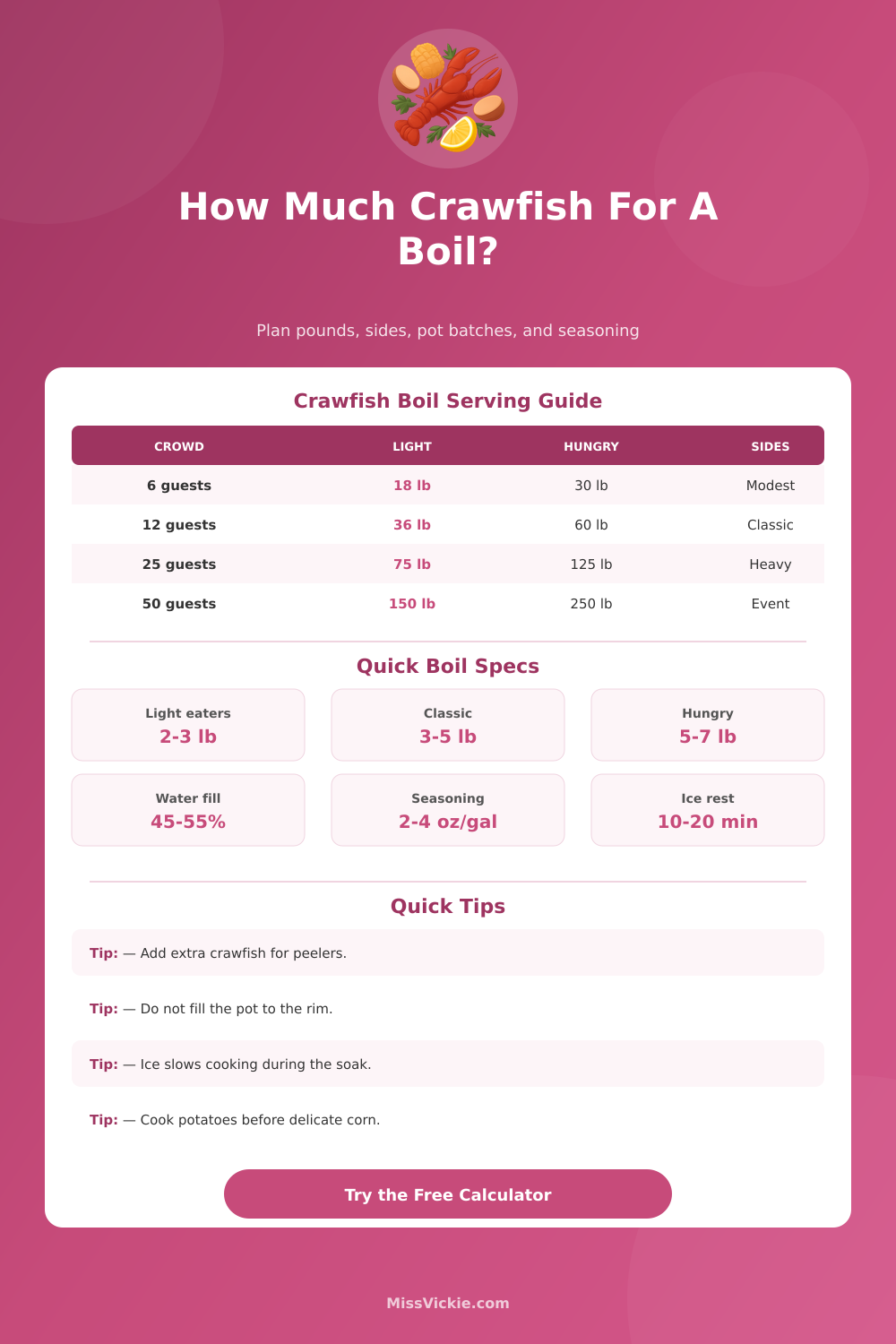
| Guest type | Crawfish per person | Potatoes per person | Corn pieces per person | Sausage per person |
|---|---|---|---|---|
| Light eaters or appetizer table | 2 to 3 lb | 1 to 2 small potatoes | 1 half ear | 1 to 2 oz |
| Classic backyard boil | 3 to 5 lb | 2 small potatoes | 1 to 2 half ears | 2 to 4 oz |
| Hungry crawfish crowd | 5 to 6 lb | 2 to 3 small potatoes | 2 half ears | 3 to 5 oz |
| Serious peelers | 6 to 7 lb | 1 to 2 small potatoes | 1 half ear | 2 to 3 oz |
| Leftover-friendly party | 5 to 7 lb | 2 to 3 small potatoes | 2 half ears | 4 to 6 oz |
Plan live weight per person; yield is much lower after shells, heads, and peeling loss.
Small red potatoes are dense and should start early so they finish tender.
Half ears soak up spice quickly; add them later to keep kernels sweet and firm.
Smoked sausage adds fat and salt to the pot, so heavy amounts make the boil richer.
Dry mix is usually scaled by gallons of water, then adjusted by soak time and heat preference.
Ice and resting time help flavor move into the shells while slowing carryover cooking.
| Pot size | Working water | Typical crawfish load | Best crowd size | Batch note |
|---|---|---|---|---|
| 30 qt / 7.5 gal | 3.5 to 4 gal | 10 to 15 lb | 4 to 6 guests | Small family boil with light sides. |
| 60 qt / 15 gal | 7 to 8 gal | 20 to 30 lb | 6 to 10 guests | Good single-bag backyard setup. |
| 80 qt / 20 gal | 9 to 11 gal | 30 to 40 lb | 10 to 16 guests | Classic basket size for one sack plus sides. |
| 100 qt / 25 gal | 11 to 14 gal | 40 to 50 lb | 14 to 20 guests | Handles bigger sacks if burner recovery is strong. |
| 120 qt / 30 gal | 14 to 16 gal | 50 to 60 lb | 18 to 25 guests | Large party pot; lift weight becomes important. |
| 160 qt / 40 gal | 18 to 22 gal | 65 to 85 lb | 25 to 35 guests | Event size with multiple batches or baskets. |
| Flavor target | Dry seasoning rate | Liquid or booster note | Ice rest | Best use |
|---|---|---|---|---|
| Mild family boil | 1.5 to 2.5 oz per gal | Use lemon, garlic, onion, and bay for aroma. | 6 to 10 min | Kids, mixed guests, lighter heat tolerance. |
| Medium classic boil | 2.5 to 3.5 oz per gal | Add liquid crab boil only if the dry mix is gentle. | 10 to 15 min | Most backyard crawfish boils. |
| Hot Cajun-style boil | 3.5 to 4.5 oz per gal | Extra cayenne, hot sauce, or liquid boil can push heat. | 15 to 20 min | Adults who expect spice and salt. |
| Extra spicy soak | 4.5 to 6 oz per gal | Use caution with long soaks because salt keeps building. | 18 to 25 min | Experienced peelers and short serving windows. |
| Ingredient | Typical add time | Cook or soak target | Texture cue | Planning note |
|---|---|---|---|---|
| Small potatoes | Before crawfish | 12 to 18 min head start | Knife slides in with slight resistance. | Large potatoes need more time or should be halved. |
| Smoked sausage | Before or with crawfish | 8 to 12 min heat-through | Plump slices, not split apart. | Heavy sausage makes the liquid saltier. |
| Live crawfish | At rolling boil | 3 to 5 min after return boil | Tails curl and shells turn bright red. | Most flavor is built during the seasoned soak. |
| Corn halves | Late in the boil | 5 to 8 min plus soak | Hot, sweet, and still crisp. | Add late so kernels do not turn mushy. |
| Mushrooms or garlic | With crawfish or late | 5 to 10 min | Tender but not collapsed. | They absorb seasoning quickly. |
| Ice rest and soak | After burner is off | 10 to 20 min | Crawfish taste seasoned inside the shell. | Longer soaks get saltier and softer. |
Calculating an correct amount of crawfish for the boil is a necessary step. Calculating the correct amount of crawfish will ensure that you dont prepare too little food that will leave some guests hungry, or too much food that will result in leftover crawfish. The amount of crawfish that you prepare will depend on the amount of guests that you are cooking for, the level of hunger that your guests will have, and the amount of side dish that you plan to serve at the boil.
Side dishes like potatoes and sausage will take up space in the pot, thus impacting the amount of crawfish that can be prepared in that pot. In order to calculate these different variables, a calculator can be utilize to determine the amount of crawfish that should be prepared. Another factor to consider is the size of the pot in which the crawfish will be boiled.
How Much Crawfish to Boil
The size of the pot will determine how much water and food can be cooked in that particular pot. However, it is important to ensure that the pot isnt filled to it’s maximum capacity with the food to be boiled. Such an action can result in the water boiling over, and can cause the burner that is used to heat the pot will struggle in boiling the water to a boil between batches of the crawfish boils.
Thus, both the size of the pot and the strength of the burner must be consider in creating the batches of crawfish that will be prepared. Another factor in the boil is the amount of seasoning that is used in the boiling water. The seasoning will affect the flavor of the boiled crawfish, the amount of salt and spice that is used in the pot will impact the flavor of the cooked crawfish.
Additionally, the longer that the seasoning rests with the crawfish (after you turn off the burner) the more flavor will be able to enter the crawfish flesh. However, if the rest period is too long, the crawfish may become too salt to eat. Thus, both the rate of seasoning and the strength of the seasoning must be considered prior to boiling the crawfish.
In addition to seasoning, the side dishes for a crawfish boil will also impact both the flavor and the volume of the pot. For instance, boiled potatoes will absorb much of the seasoning from the pot, and the corn may become too soft if it is boiled in the liquid for too long. The sausage will also take up space in the pot, as well as add to the flavor of the boiled crawfish due to the fat and salt in the sausage.
Thus, the type of side dish that are prepared will impact the amount of crawfish that can be boiled in the pot. Considering all of these factors, it is necessary to plan the crawfish boils in batches. Each batch of crawfish take a period of time to heat the water, as well as a resting period for the crawfish to sit in the seasoned water.
If there are too many crawfish to fill the size of the pot, there will be many batches of crawfish to boil. Thus, the time required for each batch will create the total time required to boil all of the crawfish. The same factors that impact the number of batches also impact the total time required to boil the crawfish for a crowds.
Another factor to consider in a crawfish boil is the use of ice. The use of ice will lower the temperature of the liquid in which the crawfish are boiled. Lowering the temperature of the liquid allows for the crawfish to soak in the seasoning without boiling the crawfish further.
The length of time in which the seasoning rests with the crawfish is called the rest period. The length of the rest period can be variable; longer periods allow for more seasoning to enter the shells of the crawfish, but the crawfish can become too salty if rested for too long. Thus, both the length of the rest period and the strength of the seasoning must be considered prior to serving the boiled crawfish.
In order to prepare a successful crawfish boil, it is first necessary to determine the level of appetite that will be exhibited by the guests, as well as the type of side dish that will be prepared. After determining these variables, a calculator can be utilize to determine the volume of crawfish that can be prepared in the size of the pot that will be used. If the calculation indicates that a large number of batches will be required to boil all of the crawfish that will be served, then the size of the pot can be increased, or the amount of food that must be boiled can be reduced.
In addition, if the amount of seasoning indicated on the recipe is too high, then the strength of the seasoning can be reduced, or the length of the rest period can be reduced. Thus, by adjusting these factors, it is possible to prepare a boil that contains plentifully crawfish for each guest, while at the same time ensuring that the crawfish will be boiled in an efficient amount of time.