Crackers Per Person For Charcuterie Calculator
Plan crackers for a charcuterie board by guest count, cracker size, crackers per ounce, cheese and meat load, gluten-free share, breakage, package size, board duration, dips, and refill buffer.
Start with a real hosting setup, then fine-tune cracker size, gluten-free needs, package size, dipping load, and refill buffer.
Your Cracker Plan
Cracker quantities will appear here after calculation.
Portion Breakdown
Package Breakdown
| Board Style | Cracker Weight | Typical Pieces | Best Use |
|---|---|---|---|
| Small tasting board | 0.75 oz per person | 5 to 8 crackers | Short tasting with a few cheeses |
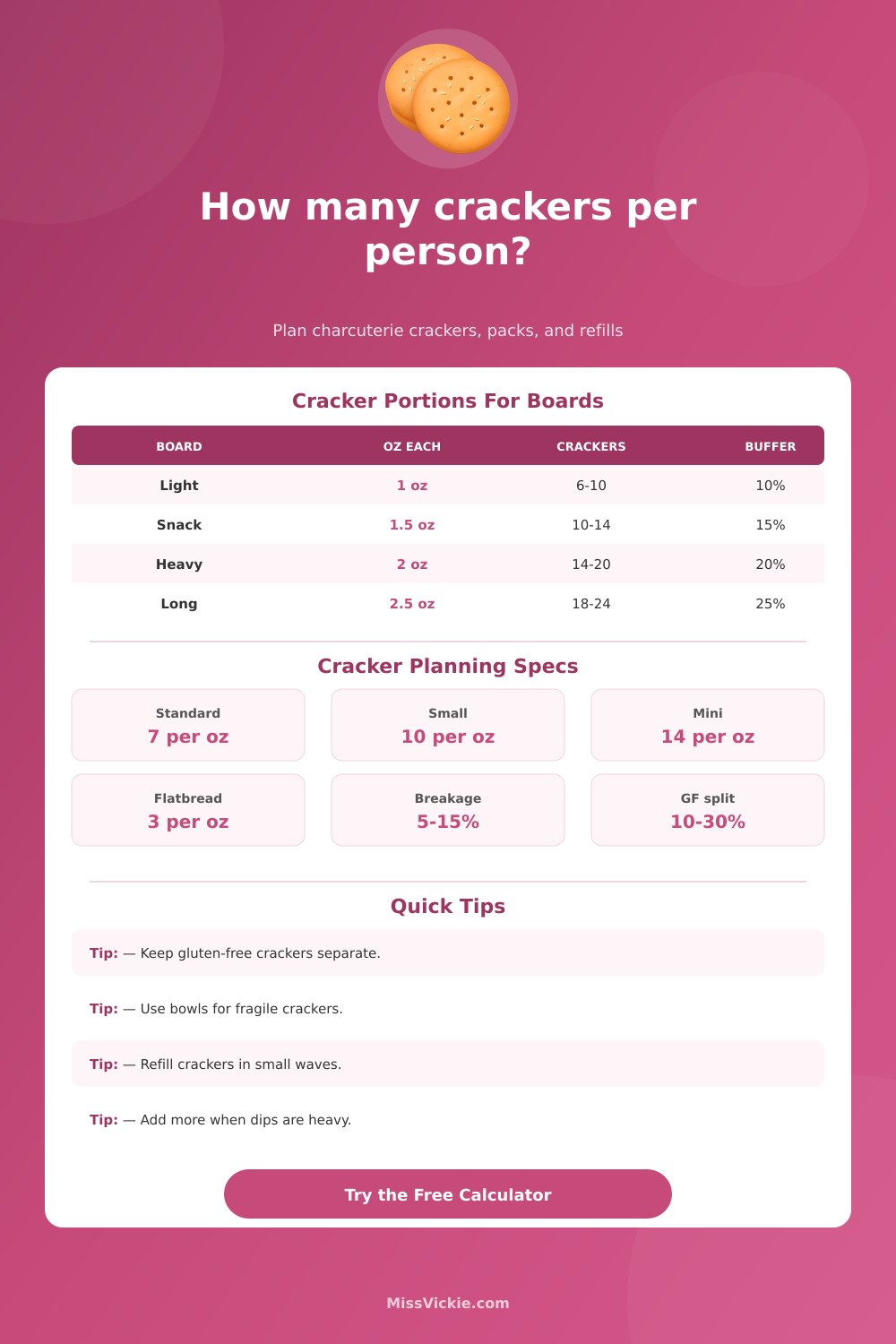
| Light pre-dinner board | 1 oz per person | 6 to 10 crackers | Before a full meal |
| Standard appetizer board | 1.5 oz per person | 10 to 14 crackers | Classic charcuterie starter |
| Heavy appetizer spread | 2 oz per person | 14 to 20 crackers | Longer party with several cheeses |
| Meal-style grazing board | 2.5 oz per person | 18 to 24 crackers | Board acts as the main food |
Piece counts vary because mini crackers, water crackers, seeded crackers, and flatbread crisps pack very different numbers into the same ounce.
| Cracker Type | Crackers Per Ounce | Texture Note | Board Fit |
|---|---|---|---|
| Mini rounds or thins | 12 to 16 per oz | Small and crisp | Good for bite-size grazing |
| Small assorted crackers | 9 to 12 per oz | Light and stackable | Flexible with cheese cubes |
| Standard water crackers | 6 to 8 per oz | Neutral and brittle | Classic for soft cheeses |
| Hearty seeded crackers | 4 to 6 per oz | Dense with toppings | Good with firm cheese |
| Flatbread crisps | 2 to 4 per oz | Large and fragile | Use a higher breakage factor |
| Crostini or toast rounds | 4 to 6 per oz | Sturdy and dry | Works well with spreads |
| Guest Count | Light Board | Appetizer Board | Heavy Board |
|---|---|---|---|
| 8 guests | 1 x 8 oz box | 2 x 8 oz boxes | 2 to 3 boxes |
| 12 guests | 2 x 8 oz boxes | 3 x 8 oz boxes | 3 to 4 boxes |
| 20 guests | 3 x 8 oz boxes | 4 to 5 boxes | 6 x 8 oz boxes |
| 35 guests | 5 x 8 oz boxes | 7 to 8 boxes | 10 x 8 oz boxes |
| 50 guests | 7 x 8 oz boxes | 10 to 11 boxes | 14 x 8 oz boxes |
| Adjustment | Add | Use When | Calculator Input |
|---|---|---|---|
| Breakage | 5% to 15% | Crackers are fragile or moved often | Breakage factor |
| Refill buffer | 10% to 25% | You want fresh crackers held back | Refill buffer |
| Gluten-free split | By guest share | GF crackers must stay separate | Gluten-free share |
| Long board | 8% per hour | Service runs past two hours | Board duration |
| Heavy dips | 12% to 25% | Guests scoop spreads often | Dip and spread use |
Neutral, crisp, and easy to pair with soft cheeses.
Sturdy enough for firm cheeses, meats, and dense spreads.
Look generous on boards but need more breakage allowance.
Useful for gluten-free sections and lighter toppings.
When done right, a charcuterie board is a thing of beauty. It is full of meat and cheese but lacks crackers, since nobody thought ahead about what happens when you break a cracker. The lack of planning destroy your first course. You could stack the finest prosciutto and aged cheddar, but if structural integrity fails when guests reach for snacks, the whole setup collapses into a pile of crumbs. But when people try to grab a bite, the whole thing fall apart like crumbs before your eyes.
Counting crackers isn’t rocket science. It’s not just a matter of purchasing however many boxes you think you’ll need. It’s an exercise in considering three things at once: service style, density, and weight. What does this mean? No more guessing. Just plug in your variables and let the calculator do the work for you.
How to Count Crackers for Your Party
Most guides only ask how many people you are serving, but the real question is what kind of board you will be serving. Will it be just light snacks before dinner or will it double as the main event with a heavier “grazing” style of table? You’ll have the option to switch back and forth so the calculator knows exactly which role your board is playing.
If it’s a snack board, you won’t need nearly as many ounce per person. This is different than a meal-style spread, where people graze for hours and run out much quicker.
The other element of complexity not captured by straight-up piece counts is cracker size: One ounce of mini rounds delivers far more pieces than the same weight of flatbread crisps or hearty seeded squares. This is why you must consider how easily items break; if you serve fragile water crackers, they will either crack during shipping or fall apart if handled rough. A crumble buffer avoids the embarrassing “I have only dust” incident.
The density differences between these shapes appear on the page reference table, illustrating that mini rounds pack like sardines whereas flatbreads spread out to no extra weight gain. Knowing this prevents you from buying too much by weight or not enough by volume.
You also have to consider spreads and dips. When there’s something to scoop onto it, guests will eat crackers more quickly. A plate full of paté, jam, and soft cheeses empties cracker supplies more rapidly then a platter of hard cheeses and dry meats. That dip load gets included in the calculator, so no one finds themselves shorthanded because everyone dipped their snacks into honey mustard.
And finally, there is the gluten-free factor. Though just a small percentage of your crowd may require wheat-free fare, they still need all their own crackers. No cross-contamination allowed. Setting that portion aside from the start of the planning process keeps the math precise for the regular supply and prevents anyone from being left out.
But here’s another thing: length of service matters. Four hours of a reception isn’t the same as two hours of a cocktail party. For longer events, plan on waves of refills (don’t place all of your crackers on the board). Left out for more hours, they’ll be either brittle or chewy. Having extra stock on hand means you can replenish items, turning them as often as necessary to keep them looking fresh and having the right texture. This small detail significant improves guest experience.
It’s nice to buy big when something seems safe; however, you tend to over-portion when buying in bulk and end up wasting food. The package breakdown shows exactly how much to order by net weight rather than guessing, and it shows if the packaging matches your guests’ dietary needs, such as gluten-free options requiring speciality bags instead of standard sleeves. You should of considered a speciality bag?).
Ultimately, it is all about confidence. By knowing the numbers associated with your spread, you won’t have anything to worry about and can just focus on chatting with your company. There will always be enough food for everyone, the cheese will find its cheese, and no one will leave hungry.