Tubs, ounces, dessert moisture, chill time, and piping hold
Cornstarch to Thicken Cool Whip Calculator
Estimate a sifted cornstarch dusting for stabilized whipped topping by tub size, fold-in moisture, dessert use, serving temperature, chill time, powdered sugar support, and piping needs.
Cornstarch can tighten thawed whipped topping, but too much tastes dusty. This calculator keeps the dose in a topping-safe range and flags when pudding mix or powdered sugar is the better stabilizer.
Full Stabilizing Breakdown
Cornstarch Dusting
Neutral
Best for small texture fixes when the topping is already cold and not watery.
Powdered Sugar
Sweet
Adds light body and covers a tiny starch taste, but softens in wet fruit desserts.
Instant Pudding
Firm
Better for sliceable pies, trifle layers, and toppings that need several hours of hold.
Gelatin
Clean
Stronger for warm rooms, but needs blooming and can set unevenly if folded too cold.
| Topping Amount | Soft Dollop | Sliceable Layer | Piping Hold | Maximum Dusting |
|---|---|---|---|---|
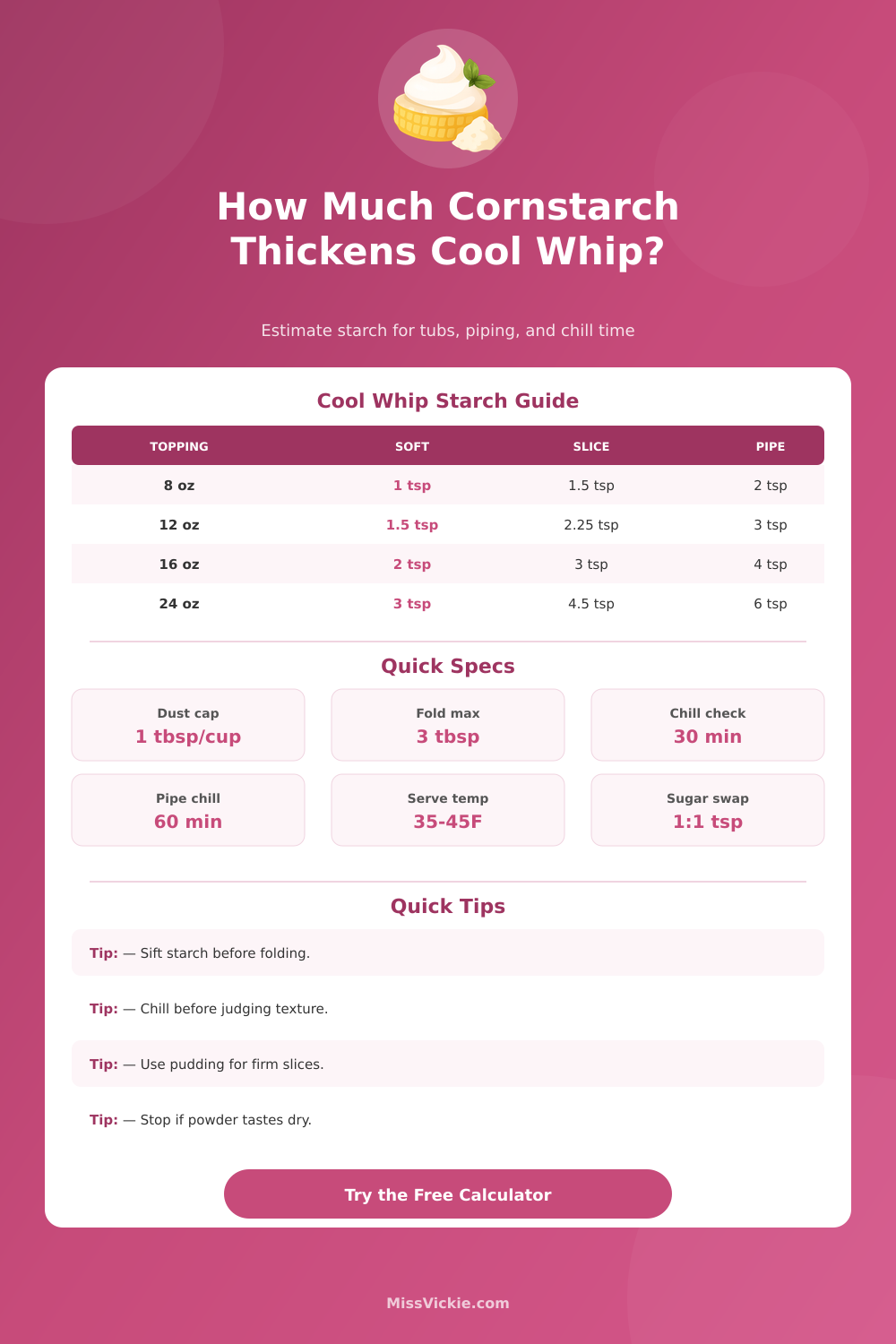
| 8 oz tub | 3/4 to 1 tsp cornstarch | 1 1/4 to 1 1/2 tsp | 1 3/4 to 2 tsp | Do not exceed 3 tbsp |
| 12 oz tub | 1 to 1 1/2 tsp | 2 to 2 1/4 tsp | 2 1/2 to 3 tsp | Do not exceed 4 1/2 tbsp |
| 16 oz topping | 1 1/2 to 2 tsp | 2 1/2 to 3 tsp | 3 1/2 to 4 tsp | Do not exceed 6 tbsp |
| 24 oz party batch | 2 1/2 to 3 tsp | 4 to 4 1/2 tsp | 5 1/2 to 6 tsp | Do not exceed 9 tbsp |
| Dessert Use | Texture Goal | Chill Minimum | Serving Temp | Better Alternative |
|---|---|---|---|---|
| Cream pie topping | Clean slice, soft fork mark | 45 to 60 minutes | 35 to 45F | Instant pudding for tall slices |
| Fruit salad | Reduced weeping | 30 minutes | 35 to 45F | Drain fruit first |
| Cake frosting | Spreadable swoops | 60 minutes | 35 to 50F | Powdered sugar blend |
| Piped rosettes | Holds ridges briefly | 60 to 90 minutes | 35 to 40F | Pudding mix or gelatin |
| Trifle layer | Stable spooned layer | 2 hours | 35 to 45F | Vanilla pudding mix |
| Fold-In Moisture | Examples | Starch Adjustment | Prep Move | Warning Sign |
|---|---|---|---|---|
| Dry | Cookie crumbs, nuts, dry mix | Keep base amount | Fold gently after dusting | Chalky streaks |
| Low | Mini chips, coconut, graham | Add about 5 percent | Chill bowl first | Loose edges |
| Medium | Drained fruit, jam, pie filling | Add about 15 percent | Blot fruit well | Pink or syrupy pools |
| High | Berries, crushed pineapple | Add about 25 percent | Drain and pat dry | Watery bottom layer |
| Wet | Puree, undrained canned fruit | Use pudding instead | Reduce liquid first | Thin topping, grainy taste |
| Stabilizer | Use Per 8 oz | Best Use | Texture | Flavor Impact |
|---|---|---|---|---|
| Cornstarch | 1 to 2 tsp | Small thickening correction | Slightly denser | Neutral if sifted |
| Powdered sugar | 1 tsp to 1 tbsp | Sweet frosting-style topping | Soft body | Sweeter |
| Instant pudding mix | 1 to 2 tbsp | Pies, trifles, long holds | Firm and sliceable | Vanilla or chosen flavor |
| Gelatin | 1/2 tsp bloomed | Warm rooms and piping | Springy hold | Very mild |
The topping can gets soupy between pan and plate, especially if you’re adding some juicy fruit or piping tall swirls on top of cupcake. Cornstarch is a quick pantry fix. But how do you know when to use just a little or a lot? Add too little and nothing change; add too much and it will taste like an uncooked piece of pie crust. You has to judge the right amount based off different factors each time.
Consider the amount of topping and its moisture content. Think about what fruit is being added and how long it will sit on the counter before being served. Also, consider whether it was piped. A lot of folks guess and hope for the best. It’s fine for pudding that goes down soft, but not when you want to keep frosting up on the edge of a cupcake and cut a neat slice into your cream pie.
How to Use Cornstarch for Toppings
Too little starch and too much water in the topping are factors. So is the elapsed time between assembly and eating. For instance, a warm buffet table will draw out more moisture then a cold refrigerator tray. Fresh-from-the-pan fruit will release some moisture, and then even more as time passes. Every variable affect the needed quantity of starch.
After you describe your particular scenario, the calculator does the math for you (above). Enter size of your tub, syrup- or fruit-only, desired storage time, and whether dessert will be standing up in a piping bag. It responds with one recommended dose that take all those interactions into account. That’s not some magic bullet number, usable for everything. That’s a starting dose tuned to whatever dessert you’re concocting.
But getting to the bowl is just half the battle. Folding gently avoids air pockets from collapsing and sifting removes any dry pocket that won’t dissolve. Once mixed, let it sit awhile (a couple minutes) before tasting. Is there a slight chalky quality? A small dusting of confectioner’s sugar covers the problem but doesn’t affect the structure. Still too runny? Usually it’s better to use instant pudding mix instead of adding more cornstarch.
One thing that people tend to forget: Chill time does half the work. The starch must be set in a cold environment. To illustrate with an example: Putting a borderline mix in the fridge for a brief period makes it sliceable; the same quantity left out on a warm counter will get loose again. This is why I want to know not just about fruit moisture, but also about your serving temperature. Those two inputs tells me how much post-kitchen chill time the starch gets.
Knowing when it’s at its limit, that’s what makes any stabilizer valuable. When the calculator says that amount of dusting needs to be pushed up to max, chances are your topping contain too much liquid to work with just cornstarch. At that point, it makes sense to drain off some of the fruit (or use another stabilizer). The calculator let you see that in advance, rather than wasting ingredients.
As such, it’s not so much a crapshoot as a minor adjustment: Measure, fold with care, let it cool completely, and voilà! The cake keeps its shape, stays sliceable, and doesn’t clue anyone in to whether they’ll recieve chalk or cream on their fork when the next spoon arrives.