Cornstarch to Thicken Gravy Calculator
Calculate cornstarch and slurry water for turkey, beef, chicken, pork, mushroom, country, or make-ahead gravy using final volume, pan drippings, stock strength, spoon-coating target, salt level, and reheating plans.
🥣 Gravy Presets
Choose a real gravy situation, then adjust volume, drippings, stock body, fat, salt, starch choice, slurry water, nappe target, and holding plan.
⚖ Gravy Inputs
Your Gravy Thickening Plan
The calculator will size starch for your gravy volume and serving plan.
Batch Breakdown
Texture And Seasoning Checks
Gravy Notes
- Use cold water or cold stock for the slurry.
- Whisk into gently simmering gravy and stop when the spoon coat looks right.
🥄 Quick Gravy Measures
📋 Cornstarch Gravy Reference
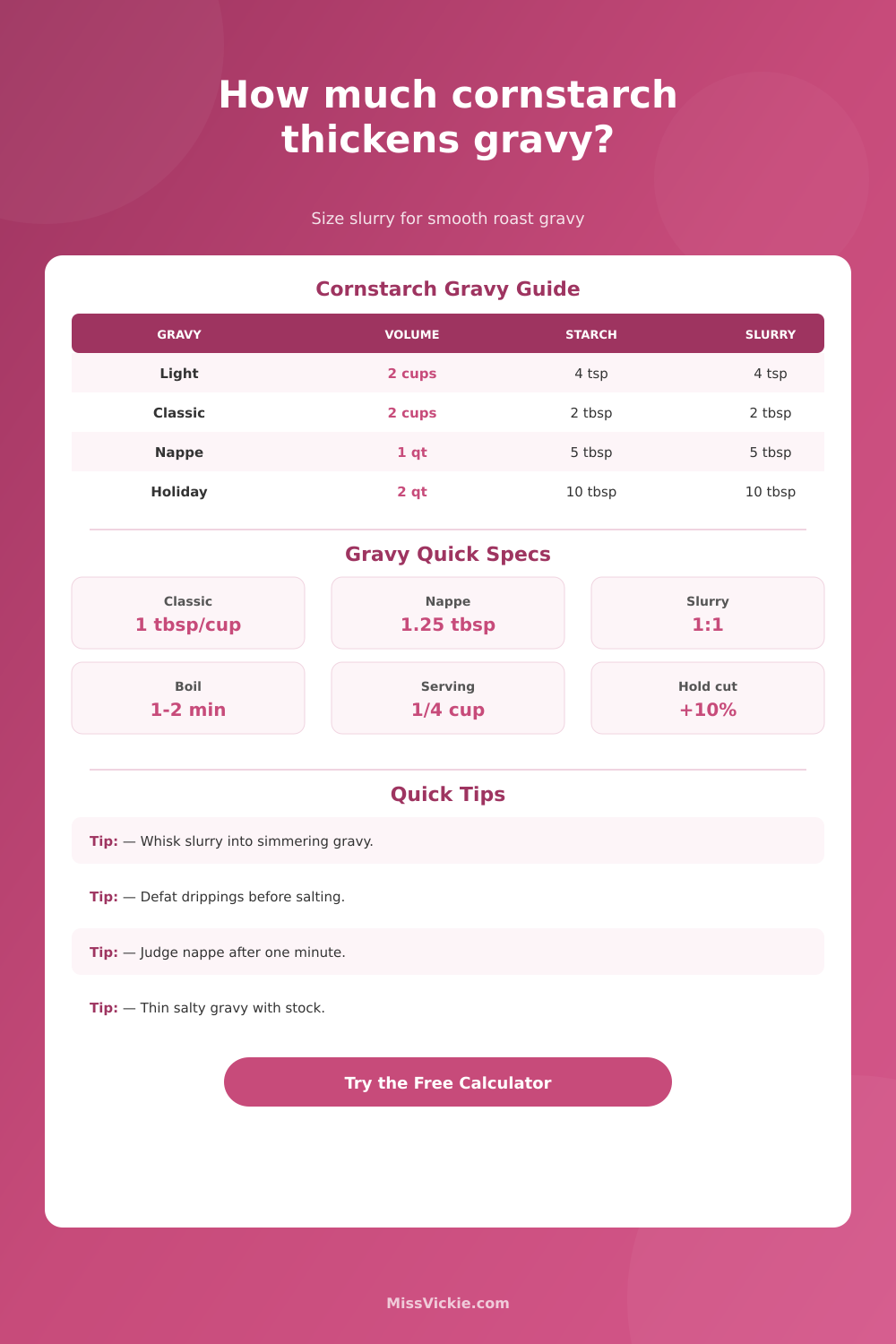
| Gravy Texture | Cornstarch Per Final Cup | Spoon Cue | Best Use |
|---|---|---|---|
| Light pouring gravy | 2 tsp | Thin coat, runs quickly | Roast chicken, jus-style gravy, lighter plates |
| Classic gravy | 1 tbsp | Coats spoon, still pours smoothly | Turkey dinner, beef roast, everyday mashed potatoes |
| Nappe gravy | 1.25 tbsp | Clear finger line holds briefly on the spoon | Holiday gravy boats and carved meat platters |
| Thick plate gravy | 1.5 tbsp | Slow pour, firm spoon coat | Mashed potatoes, open-face sandwiches, buffet trays |
| Buffet hold gravy | 1.35 to 1.6 tbsp | Slightly thick hot because it loosens over time | Warmers, holiday service, repeated stirring |
Measure starch against final gravy volume, not raw pan liquid, because simmering and holding reduce water while concentrating salt.
🕯 Holiday Serving Table
| Meal Size | Gravy Volume | Classic Cornstarch | Holiday Notes |
|---|---|---|---|
| Dinner for 4 | 1 to 1.25 cups | 1 to 1.25 tbsp | Enough for light plates; make 1.5 cups if serving stuffing |
| Family of 8 | 2 to 2.5 cups | 2 to 2.5 tbsp | Good for one gravy boat and a refill |
| Holiday table for 12 | 3 to 4 cups | 3 to 4 tbsp | Use the higher amount with mashed potatoes and dressing |
| Gathering of 20 | 5 to 6.5 cups | 5 to 6.5 tbsp | Keep extra low-salt stock warm for thinning |
| Buffet for 40 | 10 to 12 cups | 10 to 14 tbsp | Thicken in stages and hold gently to avoid thinning |
🔬 Starch Choice And Slurry Table
| Starch | Use Versus Cornstarch | Gravy Finish | Watch Point |
|---|---|---|---|
| Cornstarch | 1:1 baseline | Glossy, clean, gluten-free | Boil briefly; long boiling can weaken it |
| Potato starch | Use about 0.85x | Fast thickening, soft opacity | Add near the end and avoid aggressive boiling |
| Arrowroot | Use about 1.1x | Glossy and clear | Less ideal for dairy country gravy |
| Tapioca starch | Use about 1.2x | Shiny, slightly elastic | Can turn stretchy if overused |
| Wheat flour | Use about 2x | Opaque, traditional roux body | Needs longer simmer to lose raw flour flavor |
🧂 Salt, Fat, And Drippings Checks
Dilute with unsalted stock before thickening. Extra starch can make salty gravy feel heavier instead of fixing the seasoning.
Skim or separate fat until the gravy is glossy, not oily. Cornstarch thickens water-based liquid, not a layer of rendered fat.
Use a little less starch when chilled stock jiggles. Gelatin helps nappe texture and keeps roast gravy silky.
Make-ahead gravy often needs a modest starch margin, then gentle heat and whisking rather than a hard second boil.
💡 Gravy Tips
It’s Thanksgiving morning: you’ve roasted the bird, skimmed off the fat, and deglazed the roasting pan with broth or white wine. The aroma fill the house; dinner awaits on the table.
Now here come those key moments: the thickening stage. Your gravy runs like water or becomes starchy paste. Is that cornstarch I see? It is a strong thickener, but it work only within a very small window. Too little and you’ll get soup instead of gravy; too much and…you get glue. Temperature control and proper ratios matters a lot, and the line between a successful dish and a dud can be razor-thin.
How to Make Perfect Gravy
When you heat up cornstarch, it absorb the liquid and swells up. As it does, each granule breaks and lets go of its long chains of starch molecules. These then start tangling with one another, trapping water. Voila: viscosity! Except, of course, if you cook it too long or too hard, at which point those very same molecules will disintegrate, breaking apart the tangles they’ve created, making the gravy thin again, right before your eyes.
That’s where the texture of the nappe comes into play. The word nappe is French; it refers to the ability of a sauce or whatever to coat the back of a spoon while leaving a clean line behind when you drag your finger through it. In other words, it’s the visual indicator that your starch net has remained intact.
For an approximate answer, most home cooks use a “rule of thumb”, like one tablespoon of cornstarch to every cup of liquid. It is fine for a last-minute weeknight skillet gravy. Not so much for a holiday roast: Those factors change chemistry in your pan drippings. The calculator above takes into account all those changing factors and runs the numbers for you.
Rich bone stock? You’ll need less starch, since the gelatin in bone stock gives body on its own. You might have salty drippings from a brined turkey. Maybe dilute with some unsalted stock. That alters the overall liquid volume, which in turn changes how much starch you’ll need.
Another variable is fat. Cornstarch thickens water-based liquids, not oil; with excess fat sitting on top of your liquid, that’s less water available for the starch to grab onto and help gel. With excess fat sitting on top of your liquid, that’s less water available for the starch to grab onto and help gel. To achieve the right consistency, you may end up using too much cornstarch, muddying the flavor. By skimming off the fat before adding the starch, you’ll provide it with an unobstructed highway to its goal. The result will be a glossy gravy instead of one that’s greasy.
How you mix it is nearly as important as the math. The trick is using cold stock (or cold water) and working with the cornstarch off the heat first. Sprinkling dry powder on top of a hot liquid makes instant, unwhippable lumpy glops. You want an even spread of a smooth slurry instead. Stir it in gently then bring to a simmer. For best results, let it cook just long enough, about a minute, to set up; longer than 5 minutes will begin to break down the structure.
You should also consider reheating. Because cornstarch gravy breaks down more easiler than roux-based gravy, it will lose its structure faster. If you plan to make this ahead or hold it in a warmer during a buffet, you will want to account for that breakdown. Make the gravy a little thicker then your final goal. The page has a table as a reference, and it shows that for reheats, or for holding in a warmer/buffet, you’ll want to go up just a hair. It is better to serve up a slightly thicker gravy than one that separates on the plate.
The last hurdle is seasoning. Once the gravy reaches desired thickness, take a spoonful and taste. Salt will have been concentrated during the reduction time, and starch gives its own subtle muting effect on flavor. Sometimes, a little acidity, a final squeeze of lemon (or even vinegar) brightens up the rich heaviness of meat. It cuts through that fat and makes the cornstarch feel lighter in your mouth.
Gravy’s all about heat, liquid, starch interaction, no need to remember specific recipes to master this. The goal: Complement the meat, don’t compete with it, make sure the sauce coats the tongue. Use what is in front of you to get your ratios right, but rely on your eyes for the finishing touch.
The nappe check). The pour is smooth and the spoon is held in place. Good job. A clean line on the spoon unites each bite with the whole meal.