How Much Cornstarch to Thicken Milk Calculator
Estimate cornstarch, slurry liquid, cooking temperature, simmer time, and texture strength for milk sauces, puddings, pie fillings, and cocoa bases.
Choose a common milk recipe base, then fine-tune the milk volume, dairy fat, sugar, acid, temperature, and slurry ratio.
Full Thickening Breakdown
Per cup for light coating over desserts or vegetables.
Per cup for spoon-coating vanilla or cocoa milk bases.
Per cup for chilled cups that hold a soft mound.
Per cup for a cleaner slice after full chilling.
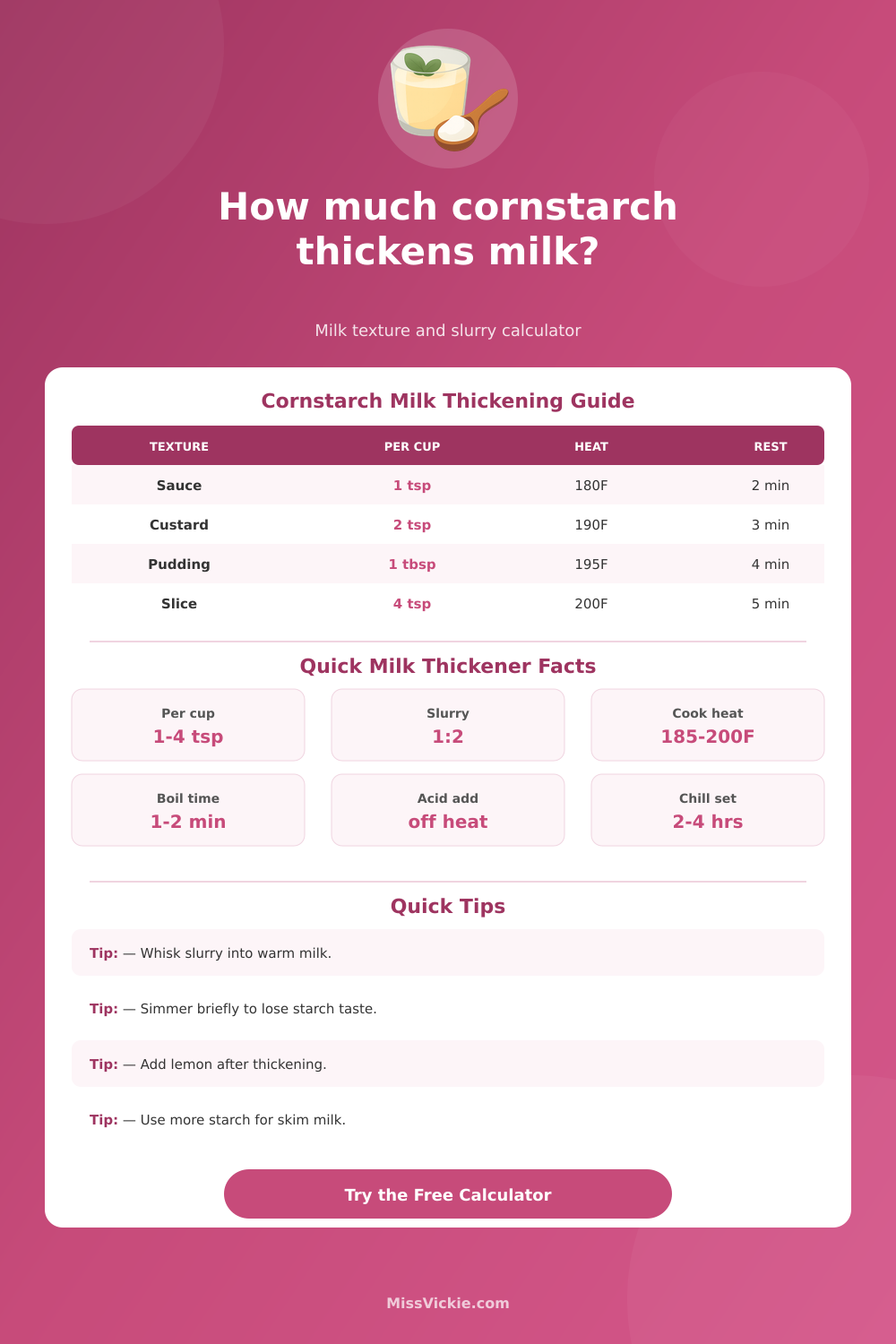
| Target Texture | Cornstarch per Cup | Per 500 ml | Best Use |
|---|---|---|---|
| Light nappe sauce | 1 to 1.5 tsp | 6 to 8 g | Thin dessert sauce, light gravy, creamy soup finish |
| Thick sauce | 2 tsp | 11 g | Hot cocoa, cheese sauce, white sauce, pourable custard |
| Custard sauce | 2.5 tsp | 13 g | Vanilla custard, banana milk base, pastry sauce |
| Spoon pudding | 1 tbsp | 17 g | Chilled pudding cups, chocolate pudding, milk dessert |
| Cream pie filling | 4 tsp | 22 g | Banana cream pie, coconut cream pie, layered trifle |
| Sliceable set | 5 tsp | 27 g | Firm custard bars or fillings that need clean edges |
| Peak Heat | What Happens | Adjustment | Kitchen Cue |
|---|---|---|---|
| 175°F / 79°C | Starch hydrates slowly | Add 18% | Looks cloudy and loose for longer |
| 185°F / 85°C | Thickening begins well | Add 8% | Spoon starts to leave trails |
| 195°F / 91°C | Best milk simmer zone | No change | Lazy bubbles, glossy surface |
| 205°F / 96°C | Fast thickening | Subtract 4% | Short boil, whisk constantly |
| 212°F / 100°C | Full boil can thin if prolonged | Add 5% | Boil briefly, then lower heat |
| Ingredient Factor | Effect on Starch | Calculator Modifier | Best Practice |
|---|---|---|---|
| Skim or plant milk | Less fat body | Add 8% to 12% | Cook to full glossy thickness |
| Whole milk | Balanced body | No change | Use as the baseline for most recipes |
| Cream or half-and-half | More natural body | Subtract 6% to 10% | Heat gently to avoid scorching |
| High sugar | Slows hydration | Add 6% to 10% | Whisk sugar with starch before heating |
| Cocoa or chocolate | Absorbs liquid | Add 5% | Blend cocoa with sugar first |
| Citrus or yogurt | Can weaken starch gel | Add 12% to 18% | Add acidic ingredients off heat |
| Milk Volume | Sauce | Pudding | Pie Filling |
|---|---|---|---|
| 1 cup / 237 ml | 1 to 2 tsp | 1 tbsp | 4 tsp |
| 2 cups / 473 ml | 2 to 4 tsp | 2 tbsp | 2 tbsp + 2 tsp |
| 4 cups / 946 ml | 1.5 to 2.5 tbsp | 4 tbsp | 5 tbsp + 1 tsp |
| 6 cups / 1.42 L | 2.5 to 4 tbsp | 6 tbsp | 8 tbsp |
| 8 cups / 1.89 L | 3 to 5.5 tbsp | 8 tbsp | 10 tbsp + 2 tsp |
Cornstarch is a thickening agent that can help you to increase the thickness of liquids like milk. Cornstarch can absorbs the liquid in the mixture when the cornstarch reach a certain temperature, leading to the thin liquid becoming a thick sauce or pudding. The amount of cornstarch that you need will depend on several factors, including the fat content of the milk, the amount of sugar in the liquid mixture, and the presence of acid in that liquid.
The fat content of the milk is one factor that will impact the amount of cornstarch that you need to add to the liquid. Whole milk has a high amount of fat, so less cornstarch are required to thicken the milk. Skim milk and plant milk alternatives like oat or almond milk contain less fat then whole milk, so the cook will require more cornstarch to achieve the same thickness as milk with a high amount of fat.
How to Thicken Milk with Cornstarch
Another factor that will influence the amount of cornstarch needed is the amount of sugar in the liquid mixture. Sugar will slow the thickening power of the cornstarch. Therefore, recipes with alot of sugar will require more cornstarch than those that contains less sugar.
Acid is another factor that will influence the thickening of the liquid mixture. If you add an acid like lemon juice or yogurt to a mixture while it is heating, the acid will reduce the thickening power of the cornstarch. To avoid this, add the acidic ingredient to the mixture after it has thickened and you removed it from the heat source.
The temperature of the mixture and the length of time that it simmers are also two factors that will influence the thickening of the liquid mixture. If the mixture simmers for too long, the sauce will thin again due to boiling. In order to prepare the cornstarch properly, you will have to make a slurry.
A slurry is made of cornstarch and a small amount of cold milk whisked together. Once you have prepared the slurry, you will have to add it slow to the warm milk mixture while constantly stirring the mixture. Using cold milk in the slurry will prevent the cornstarch from clumping, and constantly stirring the mixture will ensure that the cornstarch is evenly distribute throughout the mixture.
Simmer the mixture for a short time after adding the cornstarch slurry; a short simmer will remove the raw taste of the cornstarch. Another factor that will impact the behavior of the cornstarch is the size of the batch that you are making. A large stockpot will have a different heat distribution and evaporation rate than a small saucepan.
The difference in evaporation rate will make the batch prepared in a large stockpot thicker or thinner than batch prepared in a small saucepan. The temperature to which the food will be served is one final factor to consider when adding cornstarch. Cornstarch thickens with cooling.
A sauce that is thin when hot will become firm when the sauce cools and is placed in the refrigerator.