How Much Cornstarch to Thicken Soup
Calculate the cornstarch and cold liquid needed for a smooth slurry based on soup volume, soup style, starting thickness, texture goal, simmer time, and serving plan.
Choose a real kitchen scenario to load the pot size, soup base, texture target, and slurry ratio before fine-tuning your batch.
Full Slurry Breakdown
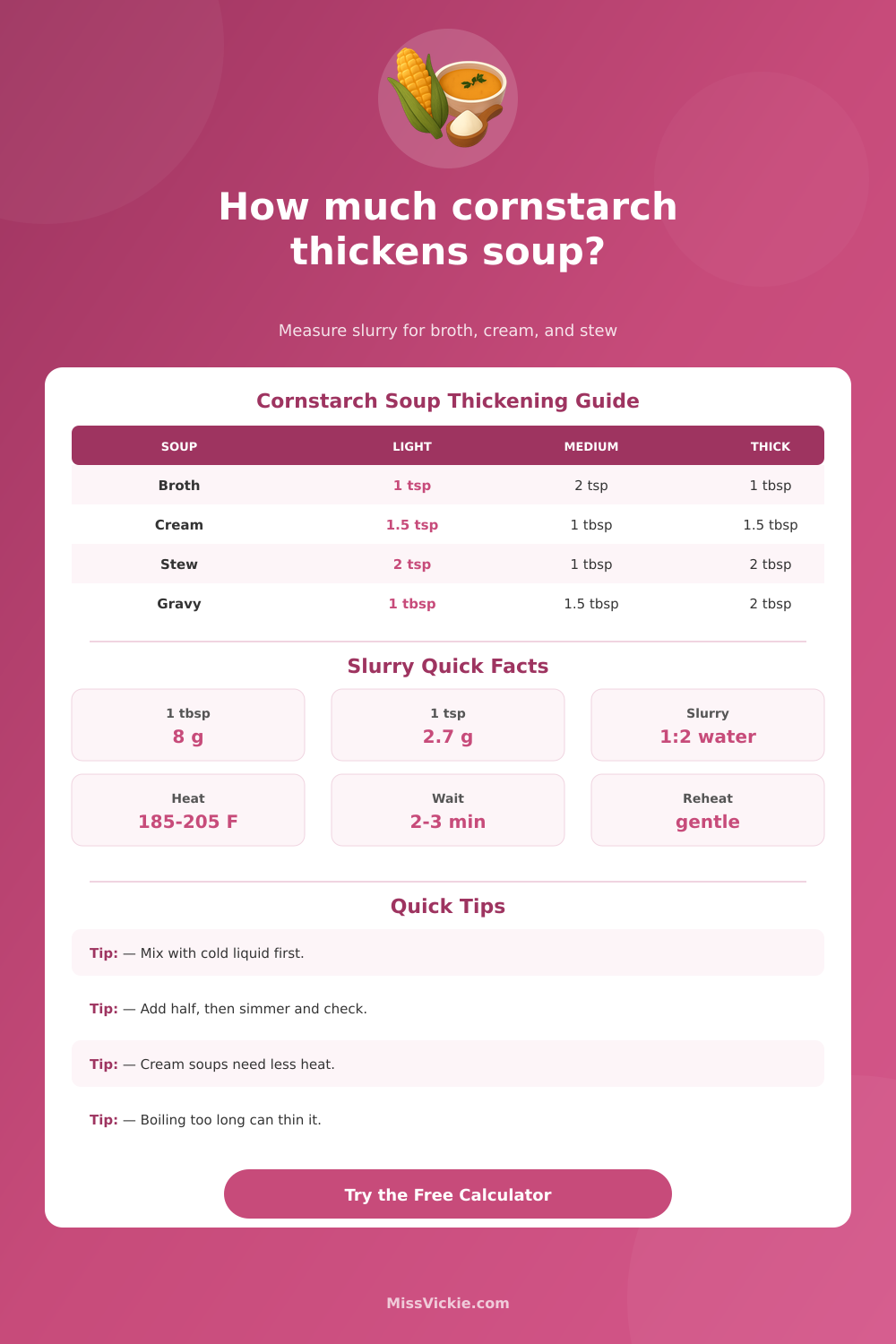
| Soup Style | Light Body | Spoon-Coating | Very Thick |
|---|---|---|---|
| Clear broth | 1/4 tsp per cup | 1/2 tsp per cup | 3/4 tsp per cup |
| Noodle or vegetable soup | 1/3 tsp per cup | 2/3 tsp per cup | 1 tsp per cup |
| Cream soup or bisque | 1/2 tsp per cup | 3/4 tsp per cup | 1 1/4 tsp per cup |
| Chowder | 2/3 tsp per cup | 1 tsp per cup | 1 1/2 tsp per cup |
| Stew or filling | 3/4 tsp per cup | 1 1/4 tsp per cup | 2 tsp per cup |
| Cornstarch | Approx Grams | Cold Liquid at 1:2 | Best For |
|---|---|---|---|
| 1 teaspoon | 2.7 g | 2 teaspoons | Small cup of soup or light correction |
| 1 tablespoon | 8 g | 2 tablespoons | 2 to 4 cups soup, medium body |
| 2 tablespoons | 16 g | 1/4 cup | Large pot or chowder finish |
| 1/4 cup | 32 g | 1/2 cup | Party batch or stew-like soup |
| 1/2 cup | 64 g | 1 cup | Catering pot, add in stages |
| Soup Batch | Light Finish | Medium Finish | Chowder Finish |
|---|---|---|---|
| 2 cups | 1/2 tsp | 1 tsp | 2 tsp |
| 1 quart | 1 to 2 tsp | 1 tbsp | 1 1/2 tbsp |
| 2 quarts | 2 to 3 tsp | 2 tbsp | 3 tbsp |
| 1 gallon | 1 1/2 tbsp | 1/4 cup | 1/3 cup |
| 3 gallons | 1/2 cup | 3/4 cup | 1 cup |
| Condition | What Happens | Calculator Adjustment | Kitchen Move |
|---|---|---|---|
| Gentle steam | Thickens slowly | Small increase | Stir longer before adding more |
| Active simmer | Best activation | Baseline | Whisk slurry in a thin stream |
| Rolling boil | Can break gel | Small decrease | Lower heat after the first minute |
| Hot hold | May loosen over time | Reserve some slurry | Add final portion near service |
| Freeze and reheat | Texture can turn thinner | Modest reserve | Retighten after thawing |
Fastest for clear or Asian-style soups; use a cold slurry and avoid a long hard boil.
Better for creamy, buttery soups when you want a cooked flour flavor and longer simmer tolerance.
Thickens quickly with a clean finish but can become stretchy if overworked or overheated.
Best when potatoes, beans, squash, or vegetables can supply body without extra starch.
Cornstarch is a thickening agent that can be used to change the consistency of a soup. If the soup has too much liquid, adding cornstarch will thicken the soup. The amount of cornstarch that you need to add to your soup will depend on the volumes of the soup, the type of soup you are making, and the thickness you would like the soup to achieve.
The calculator on this page can help you determine how much cornstarch to add to your soup. You must enter the size of your batch of soup and the type of soup in the calculator. For example, you will need more cornstarch to thicken a gumbo than you will to thicken a clear broth.
How Much Cornstarch to Add to Soup
Additionally, cream soups can curdle if you add the cornstarch slurry while the soup are too hot or if you add the cornstarch slurry too quickly. You will also need to enter the thickness of the soup before you start the simmering process and the thickness you would like your soup to have when simmered. Furthermore, some ingredients in the soup, like acidic ingredients, dairy, or noodles, can play a role in how thick the soup becomes.
Therefore, you must account for these ingredients in the cornstarch calculator to determine the correct amount of cornstarch that you must add to your soup. Cornstarch should always be mixed with a liquid before adding it to your simmering soup. The mixture of cornstarch and liquid is referred to as a slurry.
If you attempt to add cornstarch directly to your simmering soup, it will create small white lumps in the soup. By mixing cornstarch with cold liquid before adding it to your soup, you can avoid these lumps in your final product. Furthermore, the calculator will provide you with the amount of slurry to add to your soup to ensure that you dont add too much cornstarch to your pot.
Cornstarch is a good thickener for soups that should remain clear. For example, if you use a flour roux to thicken your soup, it will become somewhat opaque. Cornstarch allows your soup to remain clear and glossy, making it an ideal ingredient for Asian-style hot and sour soups or chicken broth.
Cornstarch can also be used to thicken cream soups if the soup has become too thin after adding dairy products. However, you must take care when thickening cream soups with cornstarch as the heat should be gentle to avoid loosening the gel of the cornstarch. The type of texture that you would like your soup to have will depend on the meal that is being created.
For example, the soups for a meal light supper may have a light and silky texture while a chowder may have a thicker texture. The calculator compares the starting thickness of the soup with the target thickness desired and considers the style of soup to calculate the amount of cornstarch to add. If you are making soup for a large groups of people, you may want to initially hold back some of the cornstarch so that you can adjust the thickening of the soup to taste before serving.
Several factors will impact the effectiveness of cornstarch in your pot of soup. For example, ingredients like noodles and rice will continue to absorb the liquid from the soup after adding the cornstarch. Therefore, you may have to add more cornstarch later in the cooking process.
Acidic ingredients, like tomatoes or wine, will also impact the thickening properties of the cornstarch so you may also need to add more of the thickener to your pot of soup. Finally, if you are making a soup that contains ingredients like meat or vegetable stocks that will be frozen and later defrosted, you should also add more cornstarch to the soup since cornstarch loses some of its thickening power after thawing. Tables are provided on this page to help you determine the amount of cornstarch to add without using the cornstarch calculator.
These tables include the amount of cornstarch that should be added to clear broth, cream soups, and stews. Furthermore, these tables indicate the amount of cornstarch that can be used to create a soup that ranges from light to spoon-coating thickness or thickness to the point where a ladle will not pour smoothly from one container to another. While these tables can assist in your judgment of the amount of cornstarch to add to the pot, they are only a guide.
The amount of cornstarch that you add should not be all added at once. If you add all of the cornstarch at once, you may add too much. Cornstarch requires simmerming for two to three minutes to reach its full thickening power.
Therefore, you should add about two-thirds of the amount of cornstarch that the calculator has indicated you need. After adding this amount to your pot of simmering soup, you should allow the soup to simmer for three minutes. If your soup is still too thin after simmering, you can add the remainder of the cornstarch slurry.
However, you should not of had to add more than the amount that the calculator has determined for you. Cornstarch will change the thickness of the soup as it cools. For example, a soup that has a spoon-coating thickness when hot may become noticeably thicker when allowed to cool.
Therefore, if you are making soup that will be served later or as part of a meal that you will prepare in advance, the consistency of your soup while it simmers on the stove should be slightly thinner. This way the soup will cool to the correct thickness. Using the cornstarch calculator will ensure that you reach the consistency of soup that you would like to serve to your guests.