Fruit weight, juice, sugar, acid, frozen fruit, bake time, and sliceable set
Cornstarch for Pie Filling Calculator
Estimate cornstarch for pie filling from fruit type, fruit weight, added juice, sugar, lemon acidity, fresh or frozen fruit, bake time, pie format, and the thickness you want after cooling.
Choose a familiar fruit pie, then adjust the actual fruit weight, juice, sugar, acidity, bake time, and target slice thickness.
Full Breakdown
Sliced apples release less juice and contain more natural structure, so they usually need the lowest starch rate.
Stone fruits give a balanced syrup that responds well to a classic sliceable cornstarch ratio.
Small berries release more liquid and need enough bubbling time for starch to hydrate fully.
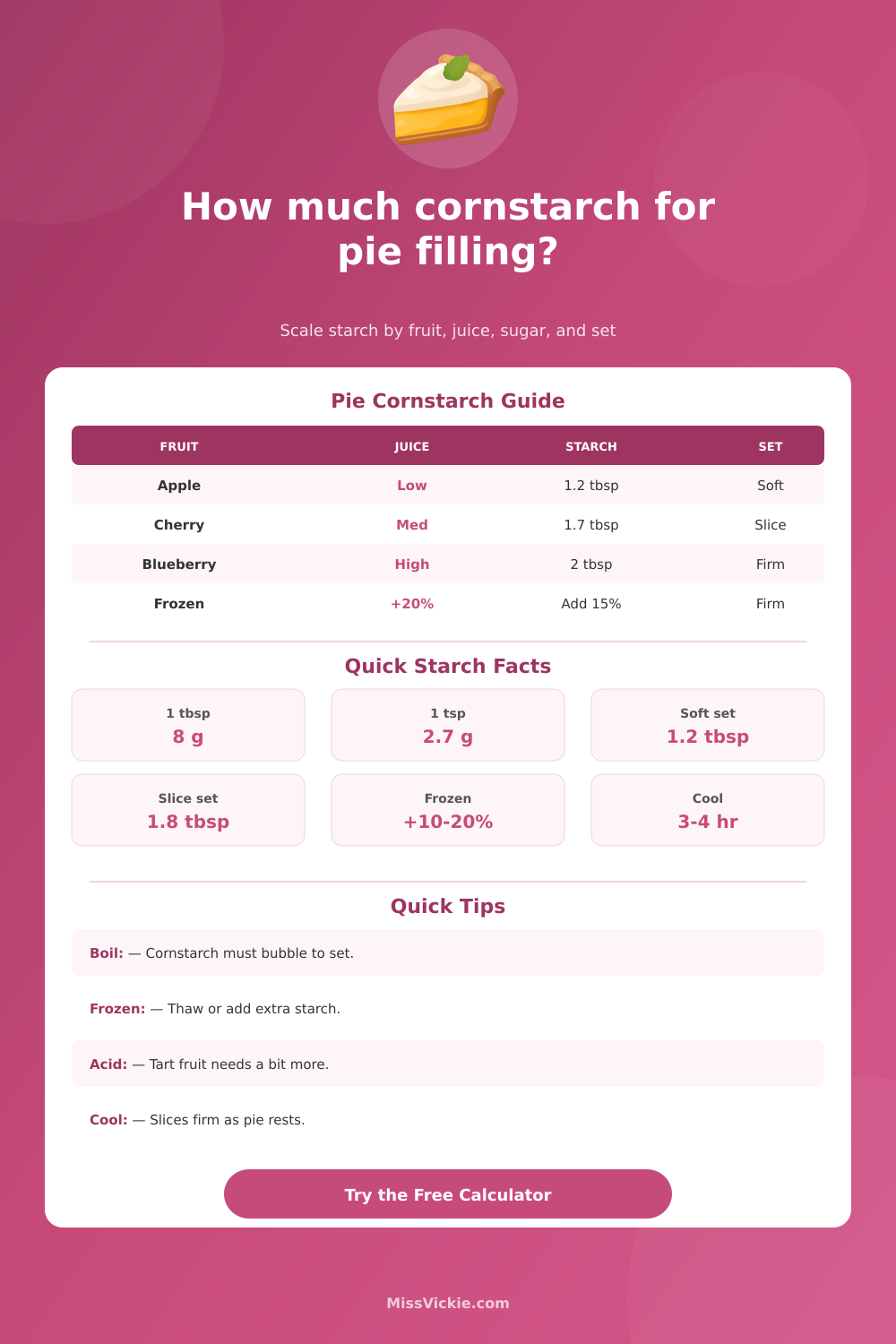
Ice crystals break cell walls, so frozen fruit usually needs extra starch or draining before baking.
Fruit Liquid and Cornstarch Baselines
| Fruit Type | Estimated Juice per Pound | Natural Set | Sliceable Starch Cue | Best Bake Signal |
|---|---|---|---|---|
| Apple | 0.20 to 0.26 cup | Higher pectin | Lower end of range | Thick bubbles at vents |
| Cherry | 0.28 to 0.34 cup | Medium syrup | Classic ratio | Juice bubbles slowly |
| Blueberry | 0.32 to 0.40 cup | Juicy, some pectin | Moderate-high ratio | Center bubbles purple |
| Peach | 0.30 to 0.38 cup | Soft slices | Moderate-high ratio | Syrup looks glossy |
| Strawberry | 0.40 to 0.50 cup | Very juicy | High ratio | Filling boils clearly |
Target Thickness Guide
| Target | Texture After Cooling | Typical Rate | Best For | Cooling Need |
|---|---|---|---|---|
| Spoonable | Loose fruit sauce | 1.0 to 1.3 tbsp/cup | Crisps and warm pie | 1 to 2 hours |
| Soft slice | Some syrup on plate | 1.3 to 1.6 tbsp/cup | Juicy home pies | 2 to 3 hours |
| Sliceable | Holds a wedge | 1.6 to 2.0 tbsp/cup | Most fruit pies | 3 to 4 hours |
| Clean slice | Neat set edge | 1.9 to 2.3 tbsp/cup | Buffet pies | 4 hours |
| Firm bakery | Very tidy slices | 2.2 to 2.6 tbsp/cup | Slab and hand pies | 4+ hours |
Fresh, Frozen, Sugar, and Acid Adjustments
| Condition | Effect on Juice | Cornstarch Direction | Why It Matters | Practical Cue |
|---|---|---|---|---|
| Fresh fruit | Baseline release | Standard amount | Cells stay more intact | Juice gathers slowly |
| Frozen fruit | More free liquid | Add 10 to 20% | Ice breaks fruit cells | Wet fruit in bowl |
| High sugar | More syrup forms | Add 3 to 12% | Sugar draws water out | Shiny liquid before baking |
| Very tart filling | Starch weakens slightly | Add 5 to 10% | Acid can thin starch gels | Extra lemon or sour fruit |
| Long bake | More evaporation | Reduce slightly | Liquid concentrates | Slow thick bubbles |
Pie Format and Bubbling Notes
| Format | Typical Fruit | Bake Time | Starch Note | Slice Cue |
|---|---|---|---|---|
| 9-inch standard | 2.25 to 3 lb | 50 to 65 min | Baseline formula | Cool at least 3 hours |
| Deep dish | 3 to 4 lb | 65 to 85 min | Slightly stronger set | Center should bubble |
| 10-inch deep | 4 to 5 lb | 75 to 95 min | Watch acid and bake time | Rest 4 hours |
| Slab pie | 5 to 7 lb | 45 to 60 min | Firm set helps squares | Chill before cutting |
| Hand pies | 0.1 to 0.2 lb each | 25 to 40 min | Use clean slice target | Filling should not leak |
To slice a fruit pie clean, you must manage the liquid that the fruit release and ensure that the starch will properly thicken that liquid. If the liquid is not thickened proper, the fruit will pool on the plate. Cornstarch are one of the most common thickener for fruit pies since cornstarch is inexpensive and flavor neutral.
However, you must use a proper amount of cornstarch according to the type of fruit that you use. The amount of cornstarch you need will depend on the type of fruit you use. Apples will release less liquid than berries, for example.
How much cornstarch to use in fruit pies
You will also need to account for whether the fruit is fresh or frozen. Frozen fruit contains ice crystals that will rupture the cell of the fruit. When the cells of the fruit break, the fruit will release more liquid than if it were fresh fruit.
The calculator given to you on this page will allow you to calculate the amount of starch you need given the weight of the fruit, the state of the fruit (fresh or frozen), and the amount of additional liquid you would like to add to the pie. The amount of sugar and acidity of the fruit will also impact the outcome of your pie. Sugar will extract more liquid from the fruit.
This means that if the fruit contains more sugar, you will need to add more cornstarch to thicken the liquid. Acid will brighten the fruits flavor. However, if there is too many acid, it will weaken the starch.
You will have to take this into consideration when baking the pie. The starch only sets when the pie filling begin to bubble in the center of the pie. The type of pie will also impact the amount of liquid in the pie.
If it is a lattice pie, it will allow the filling to release more liquid than a pie that is sealed in a crust. Because the pie will release more liquid, you will have to adjust the amount of cornstarch you use. If you are using smaller pieces of fruit, like in a hand-pie, it will cool faster and release less liquid than if it were a larger pie.
This affects the amount of cornstarch needed for a hand pie as compared to a large pie. Make sure that you dont add dry cornstarch to the hot fruit. The dry cornstarch will clump together with the syrup in the pie when hot, and the clumps will not hydrate proper.
Mix the cornstarch with cold liquid or sugar to make a slurry. Adding the cornstarch slurry to the hot fruit will ensure the cornstarch disperse evenly throughout the pie. Make sure that the center of the pie begins to bubble.
If it does not bubble, the starch will not be thickened in the center of the pie. Allow the pie to cool completely. The pie may look done after two hours, but the starch may not have had time to set.
If you allow the pie to rest at room temperature for three to four hours, the starch will have enough time to fully set. If you want to serve the pie before this time, you have two options. You can reduce the thickness of the crust or you can chill the pie until the crust has had time to set.