Dairy volume, fat, sugar, yolks, cook temp, and churn style
Cornstarch to Thicken Ice Cream Calculator
Estimate cornstarch for an ice cream or gelato base by weighing liquid dairy, butterfat, sugar, egg yolks, target stabilizer level, cooking temperature, aging time, and the scoop texture you want after freezing.
Cornstarch thickens after the base reaches a gentle simmer. This calculator treats it as a starch stabilizer, then adjusts for butterfat, sugar, yolk emulsifiers, churn speed, cook temperature, aging time, and final scoop firmness.
Soft Spoon
1.2-1.5%
Best for high-fat or soft-serve bases that already resist iciness.
Classic Scoop
1.6-2.0%
Good starting range for eggless vanilla, chocolate, and home churns.
Gelato Pull
2.0-2.5%
Supports dense low-overrun texture with a slower melting edge.
Freezer Firm
2.3-2.8%
Useful for low-fat bases, icy fruit ripples, or very cold home freezers.
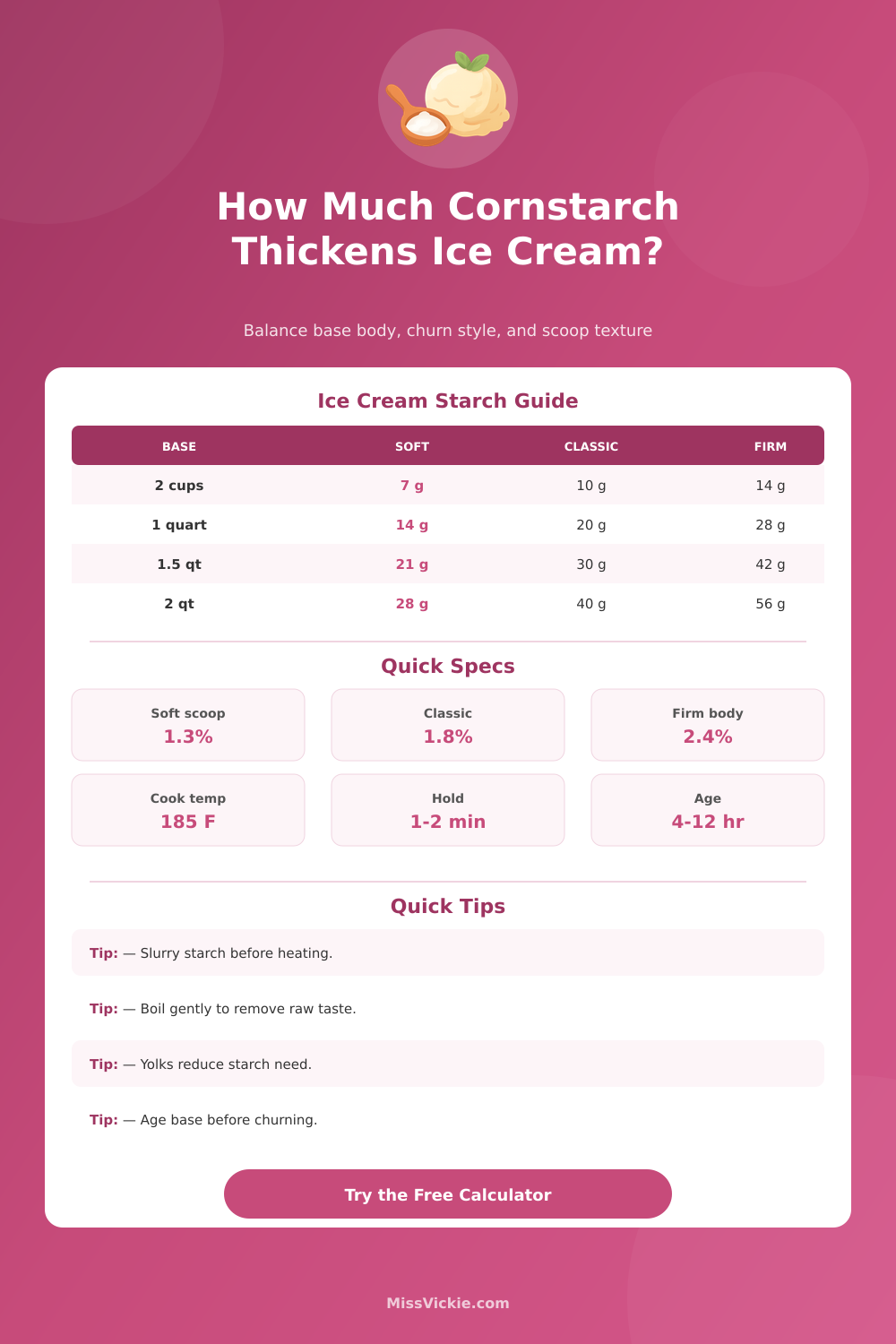
| Dairy Volume | Soft Body | Classic Body | Firm Body |
|---|---|---|---|
| 2 cups / 475 ml | 7 g / 0.9 Tbsp | 10 g / 1.3 Tbsp | 14 g / 1.8 Tbsp |
| 3 cups / 710 ml | 11 g / 1.4 Tbsp | 15 g / 1.9 Tbsp | 21 g / 2.6 Tbsp |
| 1 quart / 950 ml | 14 g / 1.8 Tbsp | 20 g / 2.5 Tbsp | 28 g / 3.5 Tbsp |
| 1.5 quarts / 1.4 L | 21 g / 2.6 Tbsp | 30 g / 3.8 Tbsp | 42 g / 5.3 Tbsp |
| 2 quarts / 1.9 L | 28 g / 3.5 Tbsp | 40 g / 5 Tbsp | 56 g / 7 Tbsp |
| Base Condition | Effect on Starch | Why It Matters | Practical Move |
|---|---|---|---|
| High butterfat | Reduce 5-12% | Fat gives body and slows ice crystals. | Stay near soft range. |
| Low butterfat | Add 8-18% | Lean milk freezes harder and icier. | Use classic to firm. |
| Many yolks | Reduce 4-15% | Lecithin and custard proteins thicken. | Avoid gummy finish. |
| High sugar | Reduce 3-10% | Sugar softens frozen texture. | Check sweetness total. |
| Fruit ripple | Add 5-14% | Water and acid can loosen the base. | Cook starch fully. |
| Cook Temperature | Starch Hydration | Texture Risk | Best Use |
|---|---|---|---|
| 160-170 F | Weak | Raw taste, thin body | Custard safety only |
| 175-180 F | Partial | May weep after aging | Egg-rich bases |
| 182-190 F | Strong | Best balance | Most starch bases |
| 191-200 F | Very strong | Can feel pasty | Low-fat gelato |
| Churn Style | Overrun | Starch Lean | Scoop Result |
|---|---|---|---|
| Home canister | Medium | Classic | Balanced scoop |
| Compressor | Medium-low | Slightly lower | Clean melt |
| Gelato churn | Low | Slightly higher | Dense pull |
| Soft-serve | High | Lower | Soft ribbon |
| No-churn | Variable | Lower | Folded body |
When making ice cream from scratch, consistency of your base determine its texture before it freezes. To stabilize the mixture while it cooks, use a starch (I’ve used cornstarch) that also retains its thickness in cold temperatures during both churning and setting. You want just enough structure to slow down formation of large ice crystals, but not too much that it gets pasty or even chewy.
That’s a different balance each time around. All those elements, fat, sugar, egg yolks, how it’s churned, all plays into the texture. As for starch, the quantity depend on how rich and how much milk is used. Fat in dairy naturaly resists iciness. So, you might be able to get away with less starch while still getting that smooth spoonful. More help are required with leaner bases. Creamier mixes may need a lower percentage of starch than low-fat milks.
Why Starch Matters in Ice Cream
Sugar also comes into play here. It lowers the freezing point, making the ice cream softer during service. If there’s too much sugar, however, it will loosen the texture even when using starch. Not enough, and the base will freeze solid and feel icky no matter how much you stir.
Custard protein and emulsifying egg yolk creates body. If structure is coming from yolks, then the calculator will reduces its starch goal. Why? This avoids gumminess in finished product. It is also important to know what type of churner you are using. Soft serve has higher overrun, meaning it incorporates more air which can covers up a somewhat lighter base. A gelato churn with lower overrun show off every detail of thickening.
Finally: how long did you age the base? Milk protein keeps absorbing water in the fridge; so does starch. Before turning on your machine, these components thickens even more. The activation of the starch depends on the cooking temp and hold time. Under about 175 degrees, the granules remains under-hydrated. The result is a mix with a raw taste. Full swelling require a brief, gentle simmer (minute or two). That removes the cereal taste.
Your desired cook temperature is an input to the calculator. Running cooler results in higher starch content to make up for weak hydrating power. Pushing hotter leads to a warning about going pasty on the base if you don’t pay attention to clock. This table of references lays it all out and does so at a range of typical batch sizes. So there’s no need to do math yourself. See how things scale. Understand what moves the result and adjust accordingally.
Want more solids? Add some milk powder. Not too rich? Back off on the yolks. Like the texture to mature over time? Stretch the aging window. A small tweak to any input affects final scoop. Which is where the tool come in.
Starch is one of those ingredients people tend to write off in a recipe. It feels as if there is no choice about whether to use it or not. But once you’ve decided how much fat, sugar and dairy: it is one of your only tools. And using it intentionally will be the difference between an iced-up ice-cream and a clean-melting one; a dense ice-cream versus a creamy one. You can see that decision made by calculator. It would of been left to guesswork or memory.