Cornstarch to Thicken Hot Chocolate Calculator
Estimate cornstarch for thick hot chocolate from mug count, milk volume, cocoa percentage, melted chocolate, simmer time, dairy type, sugar level, European-style target, and slurry ratio.
Choose a real hot chocolate style, then fine-tune the milk, chocolate, sugar, simmer time, and slurry ratio.
Full Hot Chocolate Breakdown
Light body for marshmallows and whipped cream.
Noticeably creamy but still easy to sip.
Rich, glossy cup with slow movement.
Dessert-style thickness for small cups.
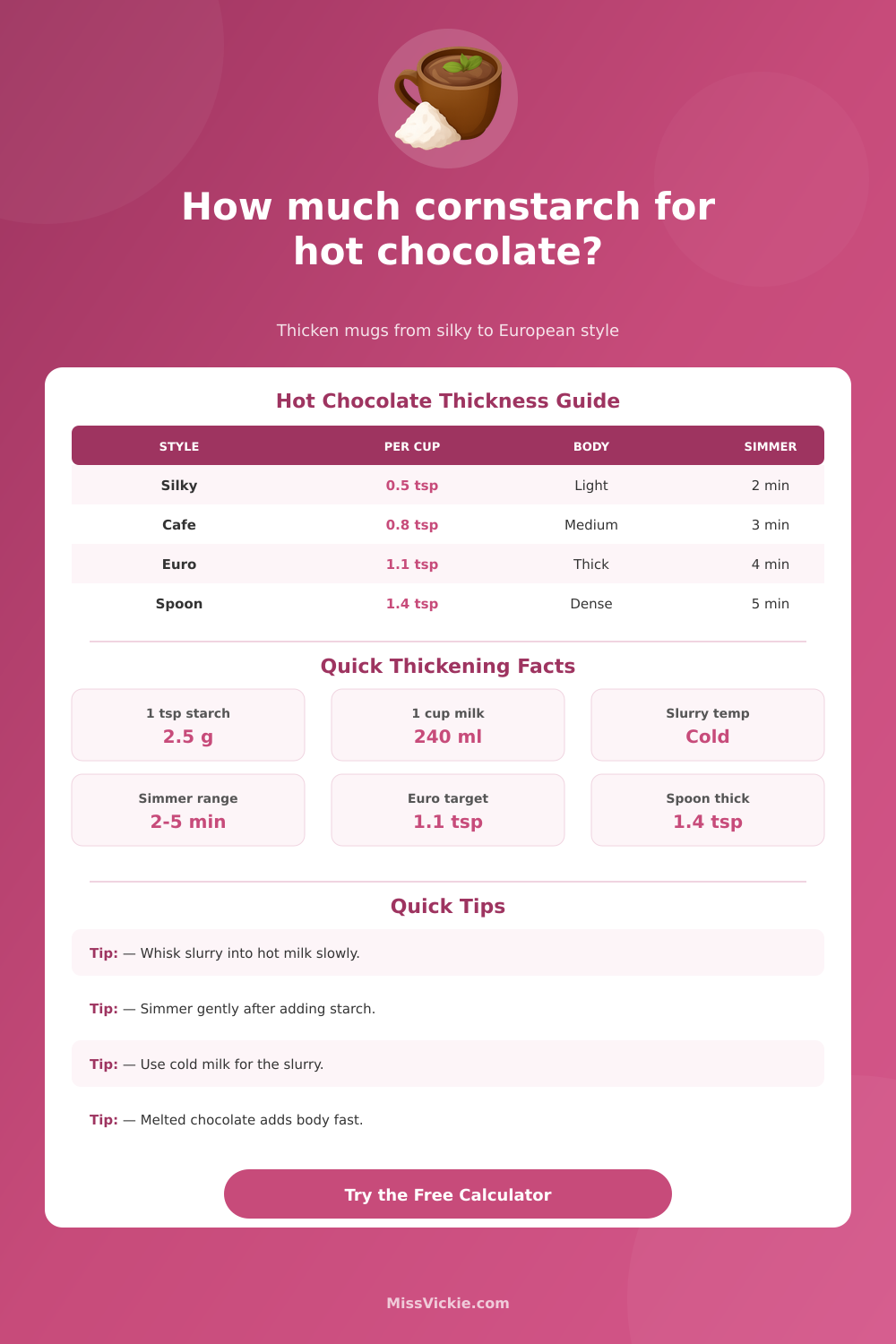
| Target | Cornstarch Per Cup | Texture Cue | Best Simmer |
|---|---|---|---|
| Silky sip | 0.45 to 0.65 tsp | Coats a spoon lightly | 2 to 3 minutes |
| Cafe thick | 0.70 to 0.90 tsp | Soft ribbon from whisk | 3 to 4 minutes |
| European style | 1.00 to 1.20 tsp | Glossy slow pour | 4 to 5 minutes |
| Spoon dessert | 1.25 to 1.50 tsp | Holds a thick trail | 5 minutes |
| Dairy Type | Starch Adjustment | Why It Changes | Best Target |
|---|---|---|---|
| Whole milk | Base amount | Balanced fat and protein | Cafe thick |
| Skim or low-fat | Add 12 percent | Less natural body | Silky or cafe |
| Half-and-half | Use 92 percent | More dairy fat | European style |
| Oat milk | Add 6 percent | Varies by brand | Cafe thick |
| Almond milk | Add 18 percent | Thin, low protein base | Silky sip |
| Soy milk | Add 4 percent | Good protein structure | Cafe thick |
| Chocolate Add-In | Body Effect | Calculator Treatment | Kitchen Cue |
|---|---|---|---|
| No melted chocolate | Needs full starch | No reduction | Thin cocoa base |
| 10 g per mug | Light body | Small reduction | Gloss improves |
| 20 g per mug | Medium body | Moderate reduction | Richer sip |
| 35 g per mug | Strong body | Larger reduction | Dessert texture |
| 70 percent cocoa | Firmer finish | Extra reduction | Dark and glossy |
| Ratio | Cold Milk Needed | Best Use | Whisking Note |
|---|---|---|---|
| 1:1 | Equal weight | Small pots | Paste, whisk firmly |
| 1.5:1 | Looser paste | Everyday mugs | Easy to scrape in |
| 2:1 | Pourable slurry | Family batch | Streams in smoothly |
| 3:1 | Thin slurry | Large thermos | Prevents lumps best |
Making hot chocolate isn’t just about adding chocolate to milk to make a treat especially if you want it nice and thick. It turns out that making a nice cup of hot chocolate depend as much on the amount of starch you use and how you manage it. Starch will gel up and swell as it heats, which is why cornstarch is such a good choice.
However, you might need more or less starch depending on what kind of milk you’re using (and how fat it is) and how long you let it boil. Plug in your variables: how much milk you have, how many mug you are making, what kind of dairy you are using, and how much cocoa powder or melted chocolate you want to use. Then, the calculator does the math for you.
How to Make Thick Hot Chocolate
Because different types of milk will already be thicker due to their proteins and fats (whole is obviously thickest), it also takes into account that skim milks and other non-dairy alternatives like almond milk requires more thickener (starch) to get a similar consistency. Similarly, the amount of chocolate you’ve melted adds its own thickness so the tool adjust the suggested starch amount to take that into consideration. Sugar content and cocoa percent can affect mouthfeel too, so they factor into this as well.
The amount of simmer time is another variable: Two minutes of bubbling will not cook out all the starch leaving something like a slightly gummy bubble bath. But four to five minutes will cook it through to a silken end point (the calculator accounts for that, as well as for your preferred hot chocolate style, lighter American style or a denser European style that trickles slowly from your tilted mug).
The ratio of the slurry. Cornstarch to cold milk, is also important. Thinning out the mixture make it easier to whisk together without lumps, especially when making a large amount for a small gathering or a thermos.
Read this: How to Make the Ultimate Macaroni Salad.
There are also folks who assume there’s some magic ratio of X to Y and wind up either with something that doesn’t set up properly or a glue-like substance when you take a sip and it has cooled. There is no magic number: starch requires two things: time and heat. If you’re not being patient enough and simmering gently, the result will be an under-thickened batch; if you dump in too much, you’ll have a hot chocolate that tastes more like pudding then like its namesake.
By setting aside a little milk to make the slurry before measuring the rest, you know exactly how much liquid goes into the finished product and you won’t end up with a watery-tasting drink. Your milk choice affects more than just taste. Higher-fat varieties coats the starch granules differently. Even if they use less starch, it may still feel like you are drinking something richer. While there’s variation among plant milks (some brands are thicker, others run thinner than dairy), you have to adjust calculation, which is why choosing almond or oat milk causes it to go up. To avoid needing to memorize a different rule for each milk, the calculator accounts for this difference in its final figure.
The drink will thicken rapidly once the slurry is added. Simmer gently, stirring continuously to ensure even cooking of the starch without burning on the bottom. Let it sit briefly after simmering. This allows surface skin to form, which you can just stir back in, and gives it time to settle down to the right consistency. These little touches make all the difference between a good cup and an intentional one.
And then there’s that moment. It is the first spoonful that flows in a slow ribbon rather than running straight off the spoon. In that moment, you know that the combination of time, fat, and starch has come together just as intended.