How Much Cornstarch to Thicken Custard Calculator
Size cornstarch for custard by dairy volume, egg yolks, sugar, texture target, added creaminess, cooking temperature, serving style, and chill set.
Choose a custard scenario, then fine tune the starch percentage, yolks, sugar, dairy richness, and chill time to match your pan or filling.
Custard Breakdown
For vanilla sauce, plated desserts, and warm spooning over cake.
For pudding cups that hold a mound but still eat softly.
For piped cream, doughnut filling, and layered desserts.
For cream pies, tarts, and clean chilled portions.
| Texture Target | Cornstarch Range | Per 1 Cup Dairy | Cooked Feel | Best Uses |
|---|---|---|---|---|
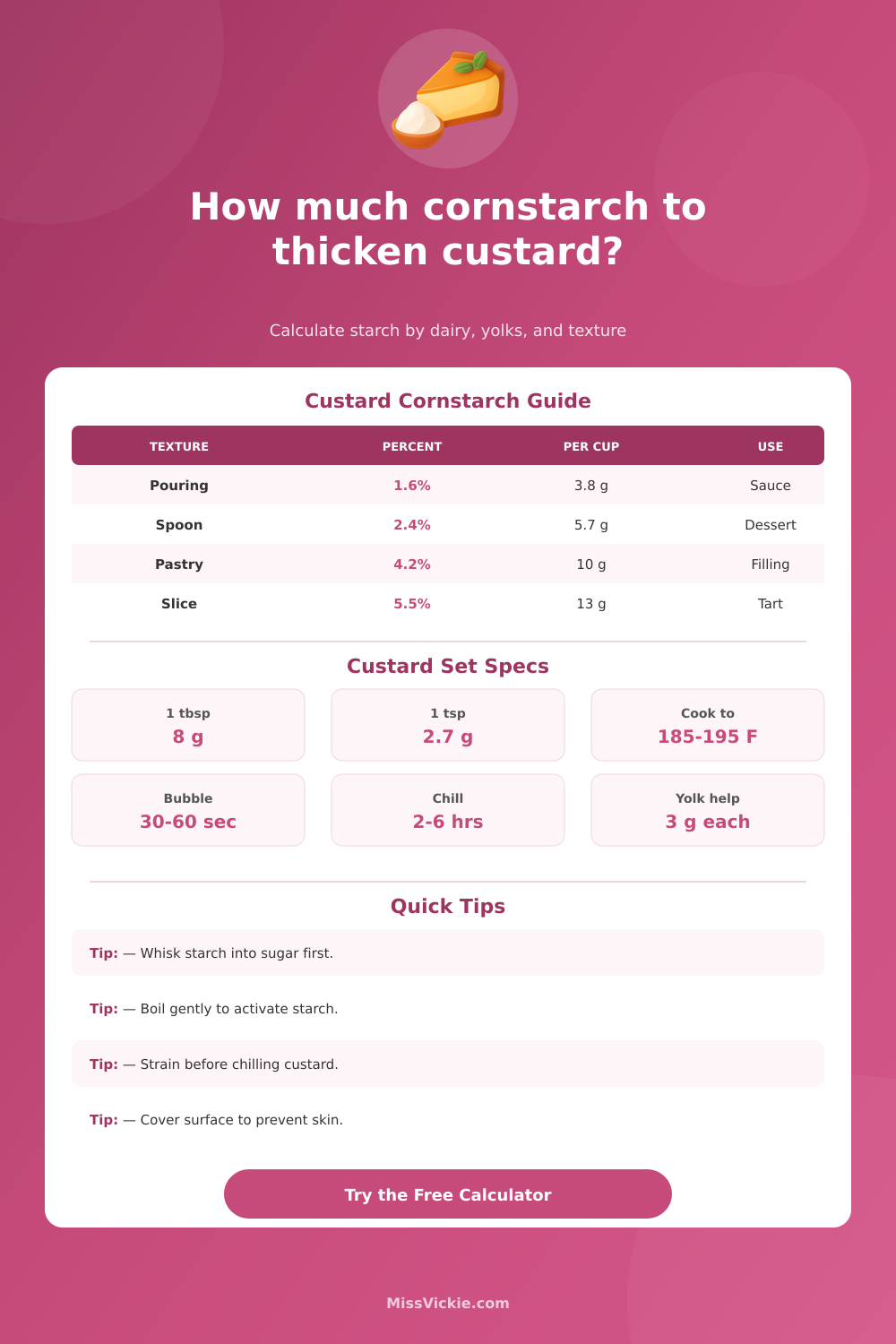
| Pouring sauce | 1.4% to 1.8% | 3.4 to 4.3 g | Coats spoon lightly | Creme-style sauces, warm dessert pours |
| Soft spoon custard | 2.2% to 3.0% | 5.3 to 7.2 g | Soft mound | Pudding cups, trifles, chilled bowls |
| Pastry cream | 3.6% to 4.6% | 8.6 to 11 g | Pipeable body | Eclairs, cream puffs, cake layers |
| Cream pie set | 4.8% to 5.4% | 11.5 to 13 g | Clean soft slice | Banana cream pie, coconut cream pie |
| Firm tart slice | 5.5% to 6.2% | 13 to 15 g | Firm chilled slice | Fruit tarts, icebox bars, buffet pieces |
| Yolk Level | Typical Ratio | Starch Adjustment | Custard Effect | Watch Point |
|---|---|---|---|---|
| No yolks | 0 per 2 cups | Add 8% to starch | Clean dairy gel | Needs full boil for body |
| Light yolk | 1 to 2 per 2 cups | Use base amount | Silky but starch-led | Whisk constantly near simmer |
| Classic yolk | 3 to 4 per 3 cups | Subtract 3 g max | Rich spoon custard | Temper eggs carefully |
| Pastry cream | 4 to 6 per 3 cups | Subtract 4 g max | Thick and glossy | Bubble to remove raw starch |
| Very rich | 8 plus per quart | Subtract 5 g max | Eggy luxury set | Avoid scorching at pot edges |
| Cook Stage | Temperature | Starch Status | Visual Cue | Best Action |
|---|---|---|---|---|
| Steaming | 160 to 175 F | Starting to swell | Thin foam, hot dairy | Keep whisking |
| Thickening | 176 to 184 F | Gel building | Whisk trails appear | Lower heat slightly |
| Full activation | 185 to 195 F | Reliable set | Large slow bubbles | Bubble 30 to 60 seconds |
| Too hot dry pan | 200 F plus | Risk of scorch | Bottom catches | Remove and strain |
| Batch Size | Dairy Volume | Soft Custard | Pastry Cream | Pie Slice Set |
|---|---|---|---|---|
| Small bowl | 1 cup | 5 to 7 g | 9 to 11 g | 12 to 13 g |
| Family dessert | 3 cups | 16 to 22 g | 26 to 33 g | 35 to 39 g |
| Pie filling | 4 cups | 21 to 29 g | 35 to 44 g | 46 to 52 g |
| Party pan | 2 quarts | 43 to 58 g | 69 to 88 g | 92 to 104 g |
When using cornstarch to thicken a custard, you are using cornstarch to change teh texture of the liquid. The thickener can take hot dairy from a thin liquid to one that hold its shape. The amount of cornstarch you use will determine if your custard is a thin sauce or a thick slice of custard.
If you use too much or too little of the cornstarch, the custard will not properly set and may result in a custard that is either too stiff or rubbery to eat. The amount of cornstarch that you need can be dependent upon three different factor. The first is the volume of the dairy ingredient that you use.
How Much Cornstarch to Use in Custard
The second is the richness of the dairy products. For instance, heavy cream contain more fat than milk. Lastly, the amount of egg yolk that you use will play a role in the thickening power of the custard.
Because egg yolks contain thickening power, the more egg yolks that you use, the less cornstarch is required. Finally, the amount of sugar that you use will impact the activation of the cornstarch. Because sugar raises the temperature at which cornstarch activates, the more sugar that is used in the custard, the more cornstarch is required to compensate.
One of the first decisions you must make before you begin cooking the custard is the texture that you would like your finished custard to have. For instance, if you would like your custard to pour from a pan, you will need less cornstarch than if you wanted to make custard that is supposed to be thick and set. Pastry cream, which is often piped into pastries, require more cornstarch than pudding.
Additionally, cream pies and tart fillings require some of the most cornstarch to set because the pies are sliced. Each of these textures require a different percentage of cornstarch relative to the weight of the liquid that is to be thickened. Another set of factors that will impact the amount of cornstarch that is required to thicken a custard are the cooking and chilling times.
Cornstarch will not activate until the custard reaches a full simmer. Additionally, the custard must simmer for a set amount of time to allow the cornstarch to activate completely. If the custard is not allowed to reach a simmer, it will have a raw taste and will not set properly.
However, if you simmer the custard too long or at too high of a temperature, the dairy products may scorch. Finally, the custard must be allowed to chill, as the more it chills the more it will firm. To make the determination of the amount of cornstarch that is required to create a specific custard recipe, use the calculator provided.
In the calculator, you will be able to enter the amount of dairy, the amount of egg yolks, the amount of sugar in the custard, the desired texture, the cooking temperature, and the chill time of the custard. These variables will allow the calculator to determine the amount of cornstarch (in both weight and percentage) that is required to successfully create your custard recipe. These relationships among these variables can also be seen in the reference tables included in this article.
One of the most common mistakes that is made in the creation of custard recipes is assuming the ratio of cornstarch to custard will never change. In reality, however, the amount of cornstarch that is required will change with the fat and sugar content in the custard recipe. Additionally, some individuals will add dry cornstarch directly into their hot dairy ingredients.
This can lead to the formation of lumps in the custard. You should avoid these lumps by whisking the cornstarch into the sugar in the custard, then adding a small amount of cold liquid to create a slurry. Cornstarch begins to swell at 176 degrees, but requires a temperature of 185 degrees to fully activate.
A gentle bubble can be held for thirty to sixty seconds before testing the temperature of the custard. If the temperature is kept under 185 degrees, the custard will not fully set. If the temperature continues past 200 degrees, the dairy product in the custard may break down.
The serving style for the custard will also impact the amount of cornstarch required. For instance, a sauce that is to be served warm may need to be under-set in comparison to a custard that is to be served chilled and cut into squares. Finally, any custard that is to be served in the icebox may need more cornstarch to stand up to the potential for the starch network to weaken while setting at 32 degrees.
These serving styles can be selected in the calculator to determine the amount of cornstarch necessary. The egg yolks that is added to the custard provide thickening power. For this reason, the amount of cornstarch that is required may be reduced for every egg yolk that is added.
In recipes that do not contain any egg yolks, more cornstarch would of been required to provide the same thickening properties of the egg yolks. To prepare the custard, combine the cornstarch and the sugar, whisking in a small portion of the dairy products to make a slurry. Add the egg yolks to the custard mixture, if they are required by the recipe.
Whisk the mixture together while heating it until it reaches the target temperature and forms a gentle bubble. Finally, strain the custard and press plastic wrap directly onto the surface of the custard. This prevents a skin from forming on the custard.
Allowing the custard to chill as recommended will allow it to set correctly.