Corned Beef Brine Calculator
Plan a brisket, round, tongue, or pastrami-style beef cure by meat weight, brine coverage, nitrite target, salt percent, sugar percent, pickling spice, injection pickup, thickness, and refrigerator time.
🧂Choose a corned beef brine preset
Each preset loads a realistic starting point for a specific cut and cure style. Adjust every field to match your exact meat weight, container, and tested process.
⚖Batch, cure, and brine inputs
Imperial inputs use pounds, quarts, and inches.
Cut choice adjusts default timing guidance.
Changes the cure weight basis and schedule notes.
Trimmed green weight in lb.
Percent water before container overage.
Extra brine for headspace and displacement.
Common cured beef range is 120 to 156 ppm.
Cure #1 is usually 6.25% sodium nitrite.
Percent salt on the cure basis.
Percent sugar on the cure basis.
Grams per kg of beef weight.
Grams per kg of beef weight.
Thickness in inches.
Target refrigerator temperature in F.
Percent of meat weight retained as brine.
Used for finished sodium estimate.
Your corned beef brine plan
Enter your beef and brine details, then calculate Cure #1, water, salt, sugar, spice, curing time, and strength.
Full calculation breakdown
Method notes and checks
📏Corned beef planning grid
The calculator treats water as roughly 1 kg per liter and subtracts the salt carrier inside Cure #1 from the plain salt addition.
🧪Comparison grid by brine style
📚Reference tables for corned beef brine planning
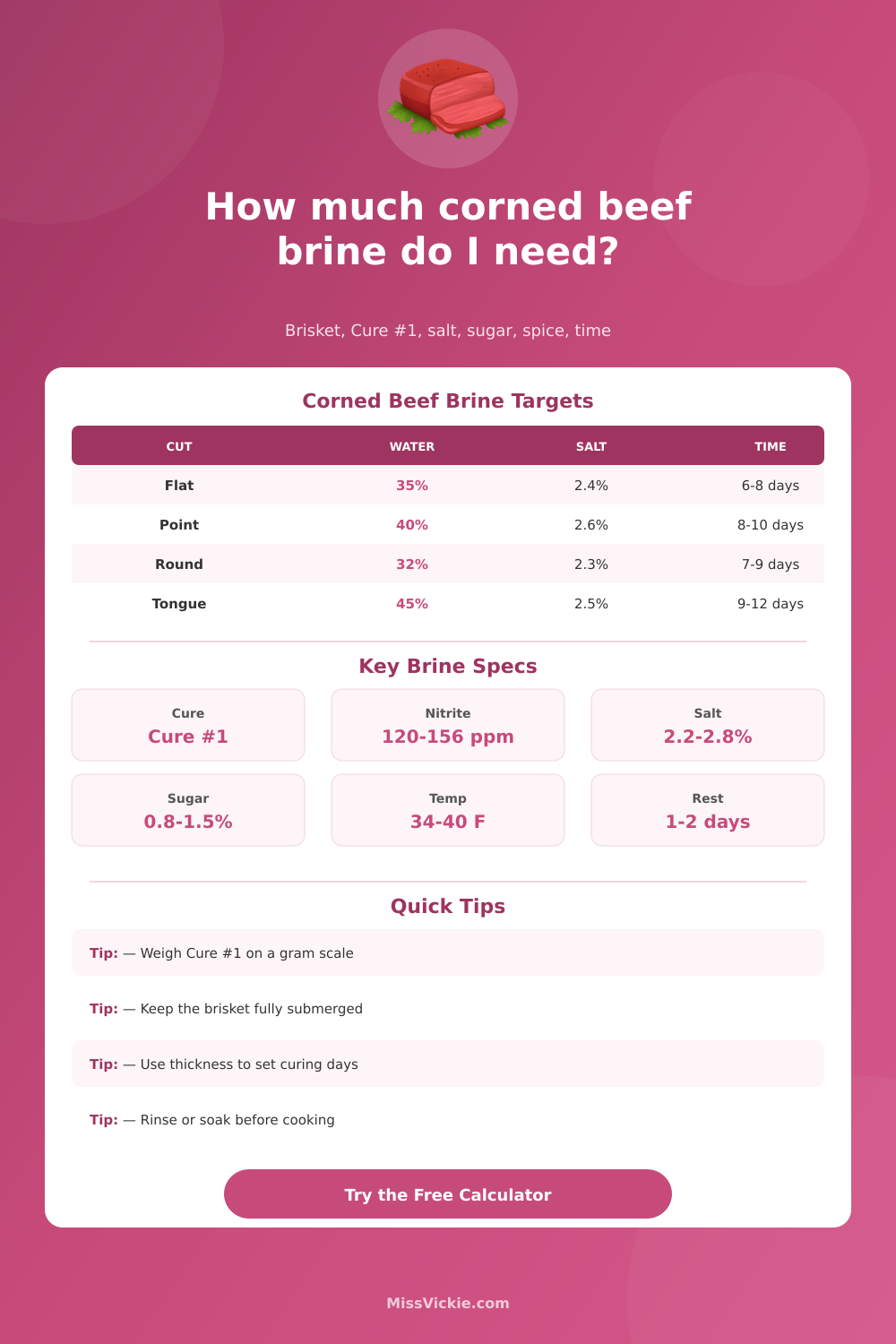
Cut and brine coverage table
| Cut | Water Ratio | Thickness Cue | Best Method |
|---|---|---|---|
| Brisket flat | 32% to 40% of meat weight | Usually even, 1.75 to 3 inches | Equilibrium cover or light injection |
| Brisket point | 38% to 45% of meat weight | Thicker fat seams and uneven shape | Injection plus cover brine |
| Whole brisket | 40% to 50% of meat weight | Large mass, thick point end | Injection plus long covered cure |
| Eye or bottom round | 28% to 36% of meat weight | Dense lean muscle, round shape | Injection or longer equilibrium cure |
| Beef tongue | 42% to 50% of meat weight | Irregular surface and skin | Covered equilibrium brine |
Nitrite and salt target table
| Style | Nitrite Target | Salt Target | Flavor Result |
|---|---|---|---|
| Mild deli corned beef | 120 ppm | 2.1% to 2.3% | Less salty, lighter cured flavor |
| Classic brisket flat | 140 ppm | 2.3% to 2.6% | Balanced salt and cure character |
| Traditional bold cure | 156 ppm | 2.5% to 2.9% | Deeper cured color and stronger brine |
| Pastrami prep | 156 ppm | 2.4% to 2.7% | Seasoned base before rub and smoke |
| Lean round roast | 120 to 140 ppm | 2.2% to 2.5% | Cleaner cure with less perceived salt |
Thickness timing table
| Thickest Point | No Injection | With Injection | Rest After Cure |
|---|---|---|---|
| 1.5 inches or 4 cm | 4 to 5 days | 3 to 4 days | 12 to 24 hours |
| 2 inches or 5 cm | 5 to 7 days | 4 to 5 days | 24 hours |
| 2.5 inches or 6.5 cm | 7 to 9 days | 5 to 7 days | 24 to 36 hours |
| 3 inches or 7.5 cm | 9 to 11 days | 7 to 8 days | 36 hours |
| 4 inches or 10 cm | 12 to 14 days | 8 to 10 days | 36 to 48 hours |
Seasoning and conversion table
| Ingredient | Planning Rate | Per 5 lb Beef | Calculator Role |
|---|---|---|---|
| Pickling spice | 6 to 10 g per kg beef | 14 to 23 g | Aromatic brine seasoning |
| Garlic | 2 to 5 g per kg beef | 5 to 11 g | Savory brine depth |
| Brown sugar | 0.8% to 1.5% of basis | Varies by brine basis | Balances salt and spice |
| Water | 1 qt is about 946 g | By coverage need | Dissolves cure, salt, sugar |
| Cure #1 | 2.5 g per kg at 156 ppm | About 5.7 g for meat only | Calculated from nitrite ppm |
💡Brine planning tips
Curing corned beef require you to determine the correct amount of salt, cure, water, and time to apply to your specific piece of beef. The amount of salt, cure, water, and time that you will need will depend upon the specific cut of beef that you choose to use and how thick the cut of beef is. The specific curing method that you use will also alter the amount of salt, cure, water, and time required for your corned beef.
For instance, a small flat brisket will behave different than a cut of tongue or point beef, and curing in a refrigerator that is warmer than usual will take more longer than if you were to cure the beef in a refrigerator that maintains the proper temperature for curing. In order to determine the proper amount of salt, cure, and water that should be used in the curing of your corned beef, some math must be performed. Variables to consider include the weight of the beef, the target nitrite level, the percentage of salt to use, and the amount of water that will be used to cover the beef.
How to choose salt, cure, water and time for corned beef
Once you have decide upon the weight of the beef, the target nitrite level, the percentage of salt to use, and the amount of water to use, the remaining variables will follow from the percentages that you have chosen to use in the curing of your corned beef. This calculator will perform the math for you once you have entered the variables for your specific situation. The strength of the brine is a choice that you must make when you are preparing to cure your corned beef.
Using too little salt will result in a product that is spongy and gray, whereas using too much salt will make the corned beef taste like thinly sliced deli meat that has been sitting in it’s package for too long. The target range for the level of salt that should be used in the curing process should be between 2.2 and 2.8% of the total weight of the beef and water mixtures. The salt range is visible to the user on the calculator, allowing them to see how each choice of salt will impact the strength of the brine that is prepared.
Furthermore, the user can choose the level of salt to use, whether they would like the flavoring of the corned beef to be mild (by choosing a lower salt amount) or traditional (by choosing a higher amount of salt). The nitrite level that you use in the curing process is another choice that you must make. Cure number one is the most common ingredient used to add nitrite to corned beef, and the nitrite will help the meat to retain its pink color and prevent the growth of certain bacteria.
The recommended amount of nitrite is 120-156 part per million. The calculator calculates the amount of cure required to provide this percentage of nitrite, as the cure contains its own salt content. Additionally, you must weigh the cure on a gram scale to ensure accuracy in the curing process, as the amount of cure can vary in volume between brands, and even 1/2 teaspoon of cure too much can lead to a corned beef product with nitrite levels that are too high for safety.
Finally, the thickness of the cut of beef will have the most impact upon the curing time required for the beef. A three-pound round cut that is three inches thick will require a different curing time than a five pound flat cut that is two inches thick. The schedule for corned beef is based off the thickness of the beef that you are curing.
However, if you inject the brine directly into the meat, you can adjust the schedule to account for this. Injecting the brine into the meat will shorten the distance that the cure must travel through the meat, which is especially helpful in cases where the cuts of beef is not even in thickness or are especially thick. The amount of water that is added to the brine will affect the final concentrations of both the salt and cure that will interact with the beef.
Methods that rely on the concept of equilibrium calculate the amounts of each ingredient based on the combined weights of the beef and the water. Adding water to the batch after calculating the amount of water that should be used will dilute both the salt and the cure. To avoid this dilution, you can use the overage percentage to account for the amount of water that the beef will displace in the container.
Using the overage percentage will ensure that the percentages of salt and cure that are calculated is accurate. The amount and type of sugar and spices will impact the flavor of the corned beef, but will not impact the calculations related to the safety of the product. Sugar balance the salt in the meat and creates a crust on the corned beef during the cooking process.
Pickling spice and garlic contribute to the aroma of the meat. The calculator can calculate the amount of sugar and spices that should be used to ensure that their amounts match the amount of beef that is to be cured. After the curing process is complete, the corned beef will need to be rinsed or soaked in water to remove any excess salt.
The length of time that the meat is soaked in water will depend upon both how salty the cut of beef is and how it is to be cooked. For instance, pastrami that is going to be smoked can be more salty than brisket that is going to simmer. To account for this difference in salting, the calculator also includes an option to calculate the length of time that the beef should be soaked in water.
Temperature control is necessary for each of the steps in the curing of corned beef. The curing process must take place in the refrigerator to ensure that the temperature is maintained within a narrow range. If the temperature in the refrigerator is a few degrees above 40 degrees Farenheit, the curing process will slow down.
However, if the temperature is a few degrees below 36 degrees Farenheit, the curing process will extend and the texture of the beef may become too firm. The calculator will record the temperatures that you enter into the calculator to ensure that the temperature for each step is within the recommended range. The tables on the webpage allow for you to compare different options for your corned beef without having to perform a new calculation with the calculator.
One table displays different options for cuts of beef and the time that they will take to cure. A second table displays the thickness of the cuts of beef and the number of days that is required for curing. A third table displays the amount of nitrite and salt that is required in different styles of corned beef.
These tables can be utilized to gain an understanding of the curing process for different cuts of beef or different methods of curing.