Corn Sugar Per Gallon Of Beer Calculator
Calculate dextrose priming sugar for finished beer by batch size, bottling loss, target CO2 volumes, warmest beer temperature, style range, fermentability, bottle count, bottle size, and keg or bottle packaging.
Pick a real packaging scenario, then fine-tune the temperature, style, bottle format, volume loss, fermentability, and safety margin before priming.
Priming Sugar Result
Your priming sugar recommendation will appear here.
Batch Breakdown
Sugar And Bottle Check
The base rate is for corn sugar used as beer priming sugar. It is not a mash sugar, wine sugar, backsweetening, or kombucha sugar dose.
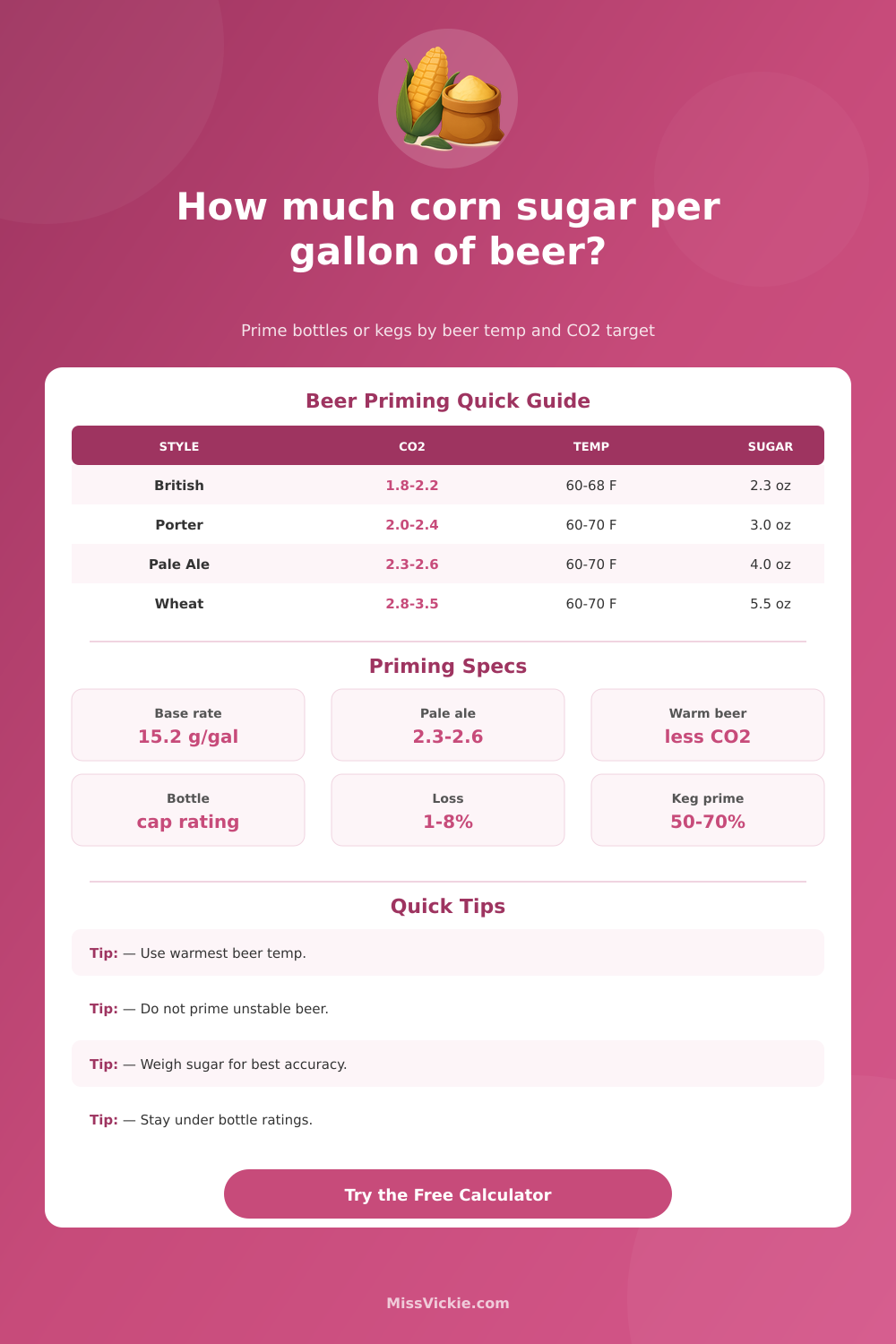
| Beer style | Typical CO2 volumes | Calculator target | Packaging caution |
|---|---|---|---|
| British mild, bitter, ordinary ale | 1.5 to 2.2 | 1.9 | Low fizz is normal; do not force a sparkling profile. |
| Porter, stout, brown ale | 1.8 to 2.4 | 2.2 | Moderate carbonation supports body and foam. |
| American amber, pale ale, IPA | 2.2 to 2.7 | 2.45 | Most standard beer bottles are comfortable in this range. |
| Pilsner, helles, lager | 2.4 to 2.8 | 2.55 | Use the warmest post-fermentation temperature for residual CO2. |
| Wheat beer, hefeweizen | 2.7 to 3.5 | 3.0 | Use strong bottles when aiming above everyday ale levels. |
| Belgian tripel, saison, farmhouse | 2.8 to 3.8 | 3.2 | High carbonation needs compatible bottles and stable final gravity. |
| Warmest beer temp | Residual CO2 volumes | What it means | Priming effect |
|---|---|---|---|
| 40°F / 4°C | 1.45 | Cold beer retains more dissolved CO2. | Needs less added sugar. |
| 50°F / 10°C | 1.20 | Cool-fermented beer still holds noticeable CO2. | Reduce compared with room temperature. |
| 60°F / 16°C | 1.00 | Common ale finishing range. | Moderate priming sugar. |
| 68°F / 20°C | 0.86 | Typical room-temperature conditioning reference. | Standard calculator baseline. |
| 75°F / 24°C | 0.75 | Warm beer has driven off more CO2. | Needs more sugar for same target. |
| 80°F / 27°C | 0.68 | Very warm storage leaves low residual gas. | Check bottle safety before high targets. |
| Container | Common volume | 5 gallon count | Best use |
|---|---|---|---|
| Standard longneck | 12 fl oz / 355 ml | About 53 bottles | Everyday ale and lager batches. |
| Bomber bottle | 22 fl oz / 650 ml | About 29 bottles | Shared pours, saisons, and strong ales. |
| Half-liter bottle | 16.9 fl oz / 500 ml | About 38 bottles | Wheat beer, lager, and mixed cases. |
| Swing-top bottle | 16 to 33.8 fl oz | Depends on size | Use only sound, rated bottles with good seals. |
| Corny keg | 5 gal / 19 L | 1 keg | Natural keg priming at reduced sugar. |
| Mini keg | 1.3 gal / 5 L | About 4 mini kegs | Use lower targets and manufacturer guidance. |
Dextrose is the calculator basis and dissolves easily for beer priming.
Sucrose usually needs about 5 percent less by weight than corn sugar.
Dry malt extract is less fermentable and often needs about 25 percent more.
Kombucha bottle sugar follows a separate live-culture safety model.
| Check | Safer sign | Risk sign | Action |
|---|---|---|---|
| Final gravity | Stable for 2 to 3 days | Still falling | Wait before packaging. |
| Target CO2 | Within style and bottle rating | Above 3.0 in weak bottles | Use stronger bottles or lower target. |
| Beer temperature | Warmest actual temp entered | Only cold crash temp entered | Recalculate with warmest temp. |
| Sugar mixing | Priming solution evenly stirred | Dry sugar added unevenly | Use dissolved solution in bottling bucket. |
| Bottle condition | Clean, sound, pressure-rated | Chips, cracks, unknown glass | Replace questionable bottles. |
You’ve got your bottle filler in one hand and the fermenter towering above you and suddenly there’s a certain type of panic that takes hold. How much sugar should I add? I know how much beer I am pouring into my bottles…but I don’t know how many grams of dextrose per gallon Ill need. Add too much sugar, and you’re making dangerous pressure bombs that can explode and shatter glass and ruin your weekend. Add too little sugar and your beer won’t have any bubbles and it will taste flat, no way to let the malt sweetness or hop aroma shine through.
There’s a very narrow band here, often only a couple of grams of dextrose per gallon between these two extremes. This is where precision beats intuition…there’s simply no room for error. To account for all those variables, the calculator do the hard work for you (and the ones that most homebrewers ignore while rushing to pour into bottles).
How to Prime Your Beer Correctly
The one variable you should pay closest attention to are the warmest temperature your beer has been post-fermentation, regardless of what temp it’s currently at. It’s a physics thing: warmer liquids have less dissolved CO2 than cold. This affect how much of it needs to be added back in. If you put in a cold crash temp, the beer is assumed to be already super-carbonated, which means you’ll be under-priming and drinking flat swill. Always go with the highest temperature the beer hit when conditioning it even if that was days ago. That one change will alter the baseline residual carbonation enough to make or break it.
After setting the temp, the next part of the calculator consider your target carbonation volume. This range widely from style to style. A British bitter have a gentle fizz that’s often closer to one point eight volumes of gas. Something like a hefeweizen need a lively sparkle that pushes up to three or even more volumes. You can’t try to prime a stout like an IPA without it being heavy on the tongue and dull to taste; carbonation level isn’t appropriate for that style. Likewise, you don’t want to prime a mild ale to a level appropriate for a wheat beer, the bite is too aggressive and overwhelms the delicate malt flavor.
If you’re not sure where your recipe fits into that range, use the reference table on the page. It shows different styles and gives you a safe starting place. Surprisingly, it is very little. It is not enough to alter the finished beer’s sweetness or alcohol level in any way. Rather, you’re feeding your yeast just enough to complete one more round of fermentation within the closed container.
Dextrose (corn sugar) is what most people use because it’s extremely fermentable and imparts no taste or color of its own. Table sugar is also a good option. In fact, you need a bit less of it by weight since sucrose breaks down into two simple sugars during fermentation. Avoid dry malt extract, although it contain both color and flavor, that can muddle the profile of a pale ale or clean lager. Unless you have a good reason, keep to the neutral priming sugars.
In practice, theory goes out the window when you’re mixing. Dumping dry granules on top of your bottling bucket will create hot spots with a higher concentration of sugar. This get the yeast closest to the clump drunk faster so the carbonation in the bottles is uneven, with some being flat and others gushing. To ensure an even mix, dissolve the measured dose of sugar in a little hot water first. Avoid stirring too hard as this introduces oxygen which leads to staling. Let it cool down then add it to your beer.
Give some thought to bottle strength: Most brewers underemphasize this variable. Many reused liquor bottles (and standard soda bottles) aren’t suitable for holding high internal pressures. For sours and Belgian styles, particularly those on the upper end of the carbonation range, spring for thick, pressure-rated brewer’s bottles.
There’s a reason why the calculator have an input for safety margin. If you’re unfamiliar with how stable your final gravity will be, or if your bottles have sketchy origins, it’s better to err on the side of lowering your sugar a little bit and having peace of mind. The final variable you can control is priming. There’s a science to this process.
If you trust the process, use quality equipment, and respect the math, everything will come together beautifuly when you finally crack that first bottle and hear that perfect hiss and see that perfect foam. All of those careful calculations would of paid off in the best way possible.