🍲 MissVickie kitchen math
Cooking Pot Volume Calculator
Estimate brim volume, safe working volume, food expansion, batch servings, and displacement for stockpots, Dutch ovens, saucepans, roasters, and tapered pots.
📌Pot and recipe presets
Start with a common cooking scenario, then adjust inside dimensions, pot shape, safe fill, food expansion, servings, and insert or food displacement.
⚙Calculator inputs
Detailed breakdown
📊Quick volume snapshot
📘Cooking pot volume tables
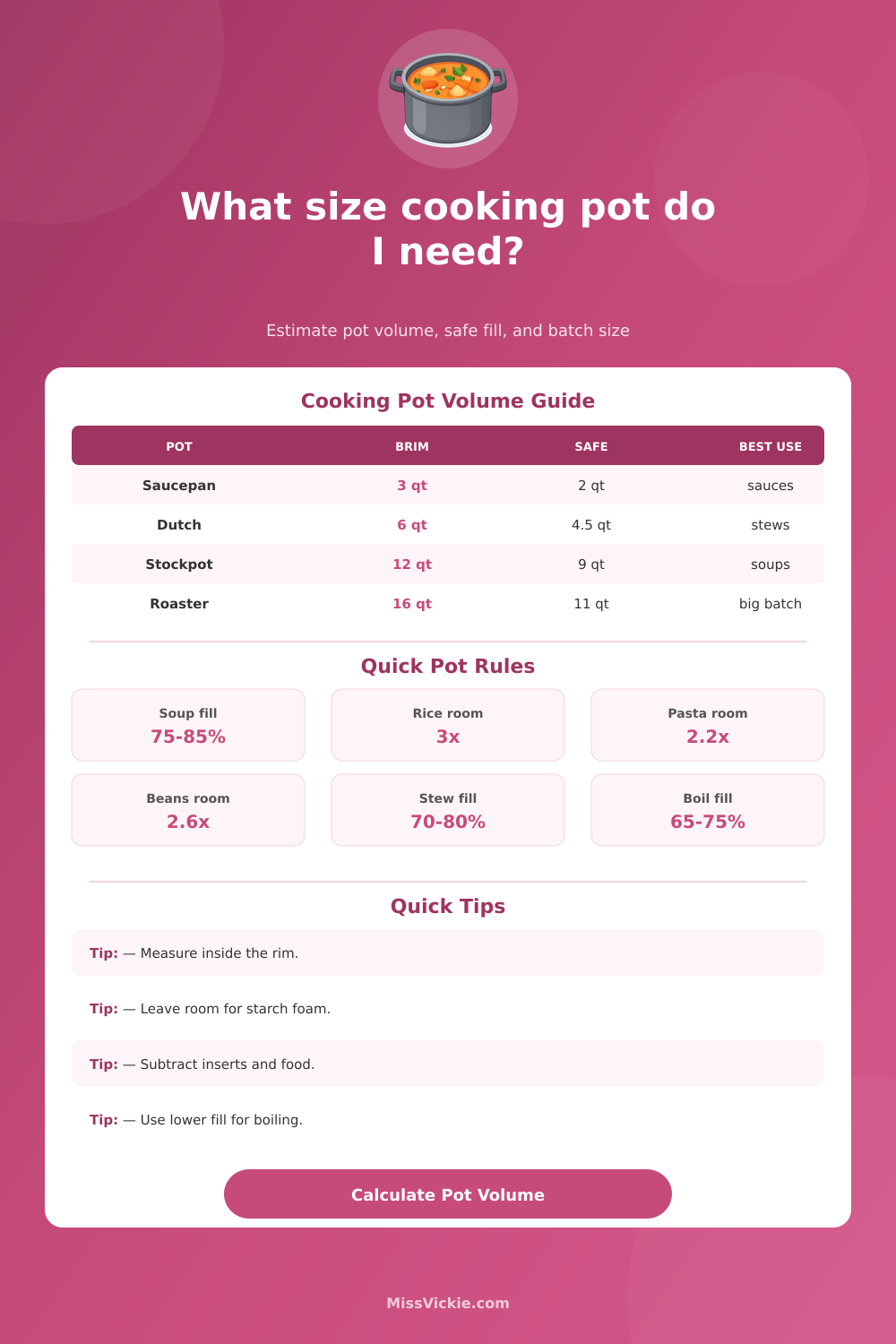
Common round pot capacities
| Inside diameter | Inside height | Approx brim | Good safe working range |
|---|---|---|---|
| 6 in / 15.2 cm | 4 in / 10.2 cm | 2.0 qt / 1.9 L | 1.3 to 1.6 qt for sauces and grains |
| 8 in / 20.3 cm | 5 in / 12.7 cm | 4.4 qt / 4.1 L | 3.0 to 3.5 qt for soup or stew |
| 9 in / 22.9 cm | 6 in / 15.2 cm | 6.6 qt / 6.2 L | 4.6 to 5.3 qt for Dutch oven meals |
| 10 in / 25.4 cm | 8 in / 20.3 cm | 13.6 qt / 12.9 L | 9.0 to 10.9 qt for stock or pasta |
| 12 in / 30.5 cm | 10 in / 25.4 cm | 29.4 qt / 27.8 L | 20 to 23 qt for large stock batches |
These are geometric estimates from inside dimensions; manufacturer listed capacity may differ because rims, curves, and fill marks vary.
Safe fill guide by cooking style
| Cooking style | Suggested fill | Why it changes | Best examples |
|---|---|---|---|
| Gentle soup simmer | 80 to 85% | Low bubbling and easy stirring. | Broth soups, thin sauces |
| Chunky stew or braise | 70 to 80% | Solids lift liquid and make stirring taller. | Beef stew, chili, curry |
| Rolling water boil | 65 to 75% | Bubbles surge above the liquid line. | Pasta, potatoes, blanching |
| Starchy or foamy boil | 55 to 68% | Foam can climb fast and spill over. | Rice, oats, beans, pasta water |
| Stock with bones | 65 to 75% | Bones and inserts displace usable space. | Chicken stock, broth bones |
Use the lower end when the pot has a narrow top, a vigorous burner, or ingredients that foam.
Food expansion and displacement reference
| Food profile | Expansion factor | Typical portion start | Planning note |
|---|---|---|---|
| Soup or broth | 1.05x | 1.5 cups / 355 ml | Mostly liquid, low expansion. |
| Chunky stew | 1.20x | 1.25 cups / 295 ml | Solids make the pot act fuller. |
| Pasta boil | 2.20x | 2.0 cups / 475 ml | Water, pasta, and foam need extra room. |
| Rice or grains | 3.00x | 0.75 cup / 180 ml | Absorption and starch foam both matter. |
| Beans or lentils | 2.60x | 0.80 cup / 190 ml | Soaked volume and simmer foam can rise. |
| Oatmeal or porridge | 3.40x | 0.50 cup / 120 ml | Thick bubbles climb above the surface. |
| Stock with bones | 1.35x | 1.5 cups / 355 ml | Bones and vegetables occupy dead space. |
| Sauce reduction | 0.85x | 0.75 cup / 180 ml | Reduces down, but splatter still needs room. |
Expansion factors are planning multipliers, not food safety rules. Use judgement when ingredients foam, swell, or trap steam.
Servings by safe pot volume
| Safe usable volume | Soup servings | Stew servings | Rice servings |
|---|---|---|---|
| 2 qt / 1.9 L | 5 cups, 3 to 4 bowls | 4 to 5 portions | About 3 cooked servings |
| 4 qt / 3.8 L | 10 cups, 6 to 7 bowls | 7 to 9 portions | About 6 cooked servings |
| 6 qt / 5.7 L | 15 cups, 10 bowls | 11 to 13 portions | About 9 cooked servings |
| 9 qt / 8.5 L | 22 cups, 14 to 15 bowls | 16 to 20 portions | About 14 cooked servings |
| 12 qt / 11.4 L | 30 cups, 20 bowls | 22 to 26 portions | About 18 cooked servings |
The calculator uses your serving size, expansion profile, and displacement, so its serving estimate may be lower than a simple liquid-only table.
🍳Pot shape comparison grid
Stockpots and saucepans use a simple cylinder formula. If the sides are nearly vertical, this is the cleanest volume estimate.
Frustum math uses top and bottom diameter, so it handles Dutch ovens, sauciers, and pots that narrow toward the base.
Oval volume uses length, width, and height. It is useful for braises, roasts, and long ingredients that displace liquid.
Rounded bottoms hold less than a straight cylinder with the same top diameter. The calculator applies a practical curve factor.
💡Two practical pot volume tips
🧮How the calculator thinks
- Round stockpots use cylinder volume: pi times radius squared times height.
- Tapered pots use frustum volume, so the top and bottom diameters both matter.
- Oval and rectangular pans use top area times inside height, with a small shape factor when needed.
- Safe working volume starts with brim capacity, then applies your fill percentage, extra reserve, and displacement.
- Batch demand starts with servings and starting volume per serving, then applies food expansion and cooking action.
- The suggested minimum pot size is the brim capacity needed to hold the expanded batch at your selected fill safety.
When choosing the correct pot, you must understand the volume of the pot and the volume of the foods that will be cooked in it. Many individuals makes the mistake of choosing a pot based on it’s total capacity. However, the total capacity that the pot can hold may not be the same as the amount of usable volume in the pot.
You must account for the volume of the food that will be cooked, the expansion of the food that occurs during the cooking process, and the displacement of the food in the cooking pot. Otherwise, the food may foam over the top of the pot or splash out of the cooking pot. The usable volume of a cooking pot isnt the same as the brim capacity of the cooking pot.
Choose the Right Pot Size
The brim capacity of a cooking pot is the amount of liquid that the pot can hold when the liquid reaches the very top of the cooking pot’s rim. However, you should never fill cooking pots to the brim capacity. This is because the food in the cooking pot will expand when heated.
Additionally, the shape of the cooking pot will also impact the amount of volume of the cooking pot that can be used for cooking. For example, a stockpot will have a different usable volume than a saucier or woks. The calculator use specific measurements of the cooking pot to determine the usable volume of the cooking pot.
The cook must measure the top diameter of the cooking pot, as well as the bottom diameter if the cooking pot features tapered side. Additionally, if the cooking pot is rectangular or oval in shape, the length and the width of the cooking pot will be required. Additionally, the usable inside height of the cooking pot must be measured, measuring the height below any rolled rim or lid to the cooking pot.
Based on these measurements, the cook can determine the cooking pot’s brim capacity. Multiplying the brim capacity of the cooking pot by a safe percentage ensures that the food will not reach the cooking pot’s brim. Expansion is the process whereby certain cooking ingredients increase in size during the cooking process.
For example, dry rice will expand to three time its original volume when heated. Beans will expand during the cooking process but may create foam that rises to the top of the cooking pot. Additionally, pasta will require some extra volume in the cooking pot because the noodles will create bubbles around the noodles when boiling.
By selecting the type of food that will be cooked in the cooking pot, the cooking pot calculator can automatically account for the expansion of those ingredients. Displacement is another process that affect cooking pots. Any solid items in the food will take up some of the volume of the cooking pot.
For instance, if a stock contains the bones of the animal, those bones will take up some of the volume of the cooking pot. Therefore, when cooking with solid items, you will subtract the volume of such items from the total volume the cooking pot can hold. For instance, it may appear that a four-quart cooking pot has enough volume to hold ten servings of beef stock that includes bones.
However, if the cook subtracts the volume of the bones from the total volume of the cooking pot, it is possible that there is not enough volume to cook the stock. Additionally, some extra volume is required to allow for stirring the pot. A reserve percentage can be used to provide extra room for such cooking and unexpected cooking condition.
The amount of volume to leave in the cooking pot will depend on the cooking style that is used. For instance, a simmer is a gentle heat that may only require 80% of the volume of a cooking pot. However, starchy grains and pasta will require more headroom in the cooking pot.
The more vigorously the cooking action that is to be used in the cooking process, the lower the volume level that should be used in the cooking pot. For example, a six-quart cooking pot may be able to hold ten servings of thin broth. However, the same cooking pot may only be able to hold six servings of oatmeal because oatmeal requires more headroom due to it’s expansive nature.
By measuring the inside diameter of the cooking pot and the usable height of the cooking pot, an individual can avoid some of the common mistake in measuring cooking pots. For instance, many people will use the quart markings on the cooking pot to determine the volume of the cooking pot. However, these quart markings may not be accurate in measuring the volume of the cooking pot.
Additionally, the volume of the cooking pot may appear to be sufficient for the food that is to be cooked. However, the volume may not be enough once another bulky insert is added to the pot. The size of the cooking pot may differ on different burners.
Therefore, the cook will also use the cooking action setting to account for such a difference. The tables provided within this cooking pot calculator can aid in the decision of which of two pots is the better choice. The reference tables provide information regarding the reduction of the working volume of cooking pots from soup to rice and from gentle simmers to rolling boils.
These tables allow individuals to determine if the batch size of the food that they plan to cook will be too large for the cooking pots before they begin to cook. There are some variables that the cooking pot calculator cannot measure. For instance, if the lid to the cooking pot is not a tight-fitting lid, some of the steam that is produced will escape.
This will slightly reduce the expansion of the food. Additionally, the cooking pot may have a thick bottom, which will affect how quickly the food heats in the cooking pot. The altitude at which the cooking pot will be used may alter the boiling temperature of the water.
However, despite these unmeasurable variables, measuring the cooking pot to determine the space for the food, measuring the expansion of the food ingredients, and providing extra volume for the cooking style will ensure that the pot remains on the stove while the food simmers or cooks. You should of used these tips to make sure you dont run out of room. It is alot more easier to plan ahead.