
How many times do you open the cupboard and stare at all those pretty bottles in confusion? There is avocado oil next to olive oil, pushing out coconut oil that’s crowding coconut oil that’s being pressed by some sort of grapeseed thing. What’s this got to do with anything? So you grab one. The label sounds healthy (or maybe it was marked down?) and you don’t give a thought to what will happen once that bottle of liquid meets your hot metal.
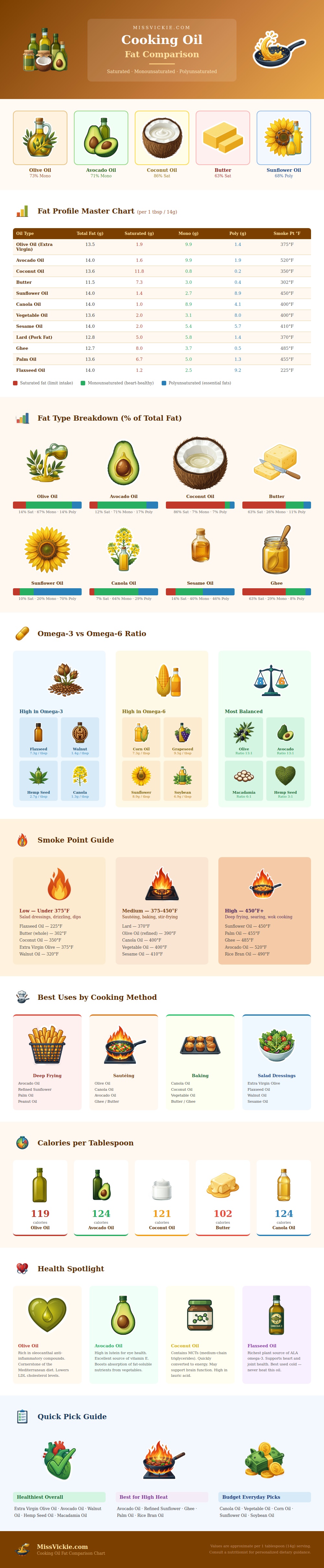
This is where having a fat comparison chart is more useful then you might think: It eliminates guesswork and changes your pantry from mystery to tool. That’s why I included the graphic above; it spells out the breakdown of fatty acids so that you know which are more saturated (like butter and coconut oil) and which has a higher proportion of monounsaturated fats (such as avocado or olive oil).
How to Choose the Right Cooking Oil
And that’s not just an exercise in labeling terms; it affects stability of the oil at high cooking temperatures. Polyunsaturated fats tend to be less stable and get rancid faster, whereas monounsaturated fats is typically more stable under moderate heat. Use this knowledge to avoid using fragile oils in ways they was not made for.
For example, there’s extra virgin olive oil. It has relatively little saturated fat but lots of good monounsaturated stuff, making it an all-around winner for light sautés or as a drizzle on top of something. However, who wants to waste their good olives (and money) by trying to deep fry with them? The graphic’s smoke point chart nails that. At about three hundred seventy-five degrees, olive oil begin to smoke; at more than five hundred degrees, avocado oil reaches its smoke point. That’s a difference worth noting, since the breakdown of oils into smoky compounds above the smoking point tastes bitter… And is hard on your lungs. See also: The best oils for cooking.
But then there are also the oils you’re supposed to keep cold. Oils like flaxseed and walnut is nutritional powerhouses: They’re loaded with heart-healthy omega-three fatty acids. But their smoke point is ridiculously low, less than three-hundred degrees Fahrenheit in some cases. Why would you heat an oil that’s filled with nutrients, only to end up destroying those nutrients? You wouldn’t. The visual guide groups these as best used as dips or salad dressings. That’s right; use ‘em as a finishing touch, not a cooking medium. Store ‘em in your fridge.
And then there’s coconut oil (which also deserves a post all to itself), because, well, it goes against the grain of so much what’s popular now. If you’ve been reading headlines, you’d think we shouldn’t be eating anything with such high levels of saturated fat: nearly eighty-seven percent! But look at how it’s built; and it starts to make more sense: that saturation means it’s stable at room temperature, and resists higher temperatures reasonably well. A lot of bakers use it for this reason. It can stand in for butter, and mimic its texture without any dairy. Plus, it brings a slight sweetness along with it that works especially well in things like granola bars or cookies.
The only thing you’ll need to get used to is coconut oil, which is completly different than liquid vegetable oils. The trick is balance. Many folks use too much of just one kind of oil for everything, which results in having too many omega-six fats compared to omega-three fats in their diet. As you can see from the graphic, omega-six fats dominate in corn and sunflower oils, both of which are okay in small amounts, but not if they make up most of what you eat. Use a combination of avocado, olive, and cold pressed flax or walnut oils depending on the occasion. For example, use olive for daily cooking, avocado when there’s lots of high heat involved, and flax or walnuts for dressing salad greens. This way, you get more balanced nutrition without overloading yourself with any one fatty acid.
Even more important is how to store oil. Air, light and heat make oils go bad… Far quicker than you might imagine. Store your oils in opaque bottles or dark ones, never near the stovetop. Most will stay fresh for a few months after opening, even if they smell and taste OK. Toss them when they get a metallic taste or turn bitter. Oil freshness affects flavor far more then brand name does.
At its core, however, cooking oil is simply a medium for delivering texture and flavor. To determine which type to use, consider what you are actualy doing in the kitchen: Are you frying, baking, or dressing? Use the correct tool for the task; this method ensures you spend less, eat better, and consume healthier meals without needing a degree in nutrition.
Next time you find yourself staring down a jam-packed pantry shelf, let the reason for the meal guide your selection instead of the words on the bottle, and your dinner (and your body) will thank you for it.