🫗 Recipe oil conversion
Cooking Oil Converter
Convert cooking oil between spoons, cups, fluid ounces, milliliters, grams, kilograms, and bottle sizes using oil-specific density, recipe scaling, and reserve for saute pans, dressings, baking, and fryer top-ups.
📌Quick Presets
🧴Converter Inputs
Volume stays consistent for measuring spoons and cups, but grams shift slightly by oil density. Add recipe scaling first, then use reserve to cover pan coating, fryer top-ups, or mixing bowl loss.
Conversion Breakdown
📊Selected Oil Snapshot
📐Kitchen Measure Equivalents
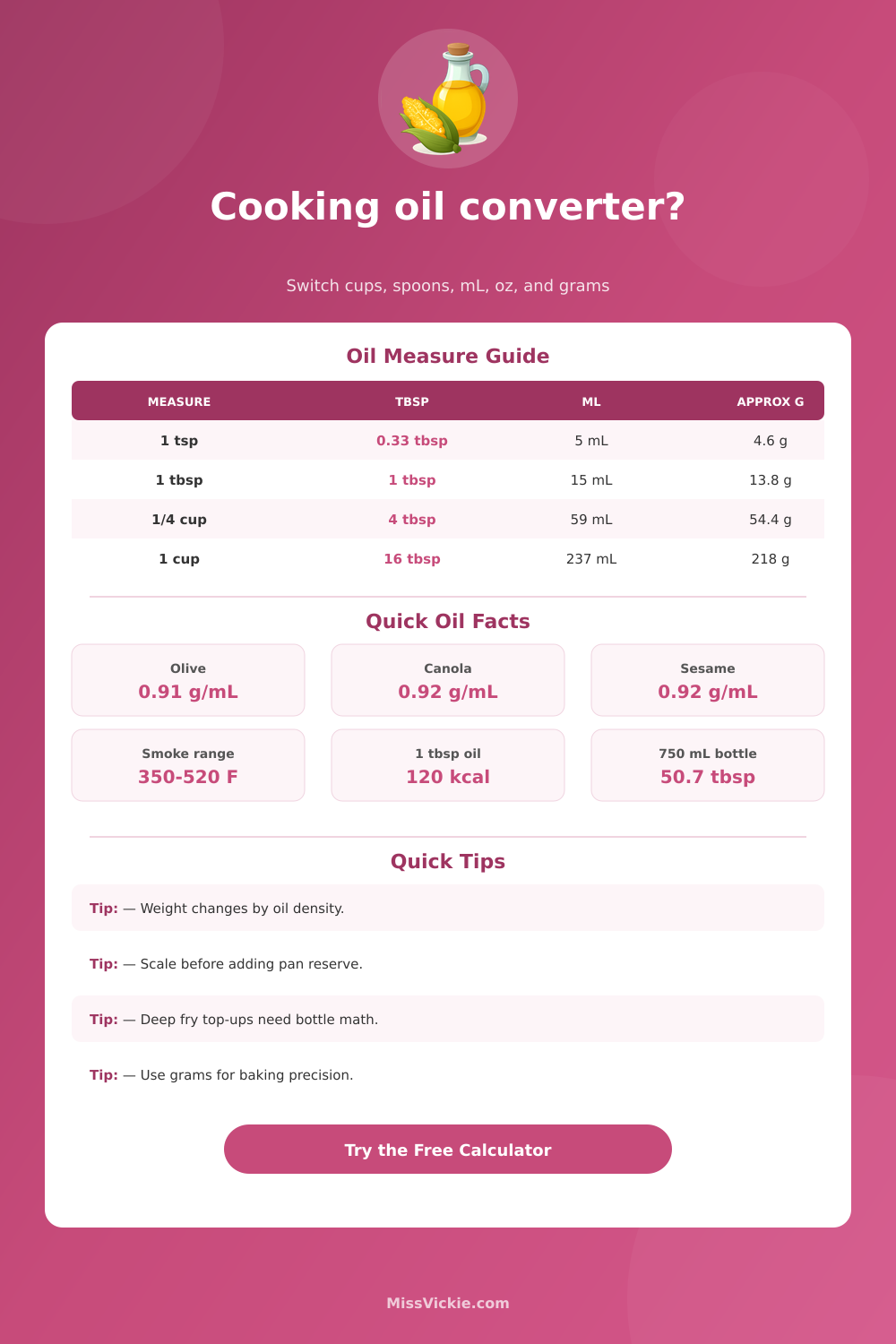
| Measure | mL | Fluid Ounces | Approx Olive Oil Weight |
|---|---|---|---|
| 1 teaspoon | 4.93 mL | 0.17 fl oz | 4.5 g |
| 1 tablespoon | 14.79 mL | 0.50 fl oz | 13.5 g |
| 1/4 cup | 59.15 mL | 2 fl oz | 53.8 g |
| 1/3 cup | 78.86 mL | 2.67 fl oz | 71.8 g |
| 1/2 cup | 118.29 mL | 4 fl oz | 107.6 g |
| 1 cup | 236.59 mL | 8 fl oz | 215.8 g |
🔥Oil Density and Smoke Guide
| Oil | Density | 1 Tbsp Weight | Approx Smoke Point |
|---|---|---|---|
| Extra virgin olive | 0.91 g/mL | 13.5 g | 375 F |
| Canola | 0.92 g/mL | 13.6 g | 400 F |
| Avocado | 0.91 g/mL | 13.5 g | 520 F |
| Coconut, melted | 0.92 g/mL | 13.6 g | 350 F |
| Peanut | 0.91 g/mL | 13.5 g | 450 F |
| Sunflower | 0.92 g/mL | 13.6 g | 440 F |
🛢Bottle Planning Reference
| Bottle Size | Tablespoons | Cups | Best Fit |
|---|---|---|---|
| 250 mL | 16.9 tbsp | 1.06 cups | Finishing oils and sesame drizzles |
| 500 mL | 33.8 tbsp | 2.11 cups | Weekly saute and salad use |
| 750 mL | 50.7 tbsp | 3.17 cups | Most home roasting and baking |
| 1 L | 67.6 tbsp | 4.23 cups | Frequent meal prep kitchens |
| 1.5 L | 101.4 tbsp | 6.34 cups | Bulk frying and batch cooking |
| 2 L | 135.2 tbsp | 8.45 cups | Large fryers or catering prep |
🍳Cooking Task Conversion Guide
| Kitchen Task | Typical Oil Need | Useful Unit | Planning Note |
|---|---|---|---|
| Salad dressing batch | 2 to 6 tbsp | tbsp or mL | Scale acid first, then match oil ratio. |
| Sheet pan vegetables | 3 to 8 tbsp | tbsp or cups | Use reserve for oil left on parchment. |
| Quick bread batter | 1/4 to 1/2 cup | cups or grams | Grams are steadier for repeat bakes. |
| Wok stir-fry | 1 to 3 tbsp | tbsp or teaspoons | High heat oils handle quick tosses best. |
| Mayonnaise batch | 3/4 to 1 cup | mL or cups | Steady pouring matters more than reserve. |
| Deep fry top-up | 500 mL to 2 L | mL or liters | Check bottle count before service starts. |
🧪Oil Comparison Grid
Everyday
Canola
Neutral flavor, steady 0.92 g per mL density, and an easy choice for baking, roasting, and weekday saute work.
Finishing
Olive
Sits near 0.91 g per mL, so gram swaps land slightly lighter than canola in dressings or dips.
High Heat
Avocado
Keeps a similar density to olive oil but pushes smoke point far higher for searing, roasting, and cast iron work.
Aromatic
Sesame
Use small spoon measures for toasted sesame oil because flavor intensity usually matters more than bottle-size efficiency.
Because cooking oil has a differents density from water, the weight of the oil must be calculate from the volume of the oil. Water has a density of one gram per milliliter. Cooking oil are less dense than water; most cooking oils has a density of 0.91 grams per milliliter or 0.92 grams per milliliter.
Therefore, an cup of olive oil will weigh 216 grams (approximately) rather than 237 grams, the weight of a cup of water. It is important to understand the density of cooking oil because the weight of the oil will vary from the weight of an equal volume of another liquid, even if the volume of oil is the same. Volume measurement (like cups and tablespoons) measure the amount of space that the oil occupies.
How to Measure and Use Cooking Oil
Weight measurements measures the amount of the oil itself. A tablespoon will always measure 15 ml of oil, but the weight of that oil will vary depending on the type of oil. For instance, one tablespoon of extra virgin olive oil weigh 13.5 grams; one tablespoon of canola oil weigh 13.6 grams.
Oil is often lost during cooking process like sautéing, roasting, or deep frying. To account for the oil that may be lost during cooking, cooks are often advised to add 5 to 15 percent more oil than the recipe require. The smoke point of a cooking oil determine the way in which that oil is to be used in the kitchen.
Extra virgin olive oil has a low smoke point, so it is best used for dressings or when cooked at low temperature. Avocado oil has a smoke point of 520 degrees Fahrenheit, making it an excellent oil for use in sautéing or when searing food. Canola oil and vegetable oil has smoke points of around 400 degrees Fahrenheit, making them best for use in baking.
Sesame oil has a distinct flavor, so it is typically used in small amount in specific dishes. You must choose the correct cooking oil base off the smoke point and the cooking task you are completing. If you are making emulsions, you must pour the oil steady into the mixture.
You will need a large volume of oil for emulsions, such as 180 milliliters for a recipe, but you will also need to account for the small amount of oil that will cling to the side of the bowl when you incorporate the ingredient. In baking, it is best to use gram to weigh the oil to get the most accurate measurement. For example, adding 100 grams of corn oil to a cake batter will provide the same result as 100 grams of another oil.
When deep frying food, it is a matter of convenience to measure the oil in liter due to the large volume of oil required for deep frying. In this case, you must plan for the amount of oil that will be lost during the deep frying process. Using specific measurement will help you plan for your oil need and avoid running out of oil during your cooking process.
A 750-milliliter bottle of oil contains 50 tablespoons of oil or three cup of oil. For catering to large group of people, you will likely need to use a 2-liter bottle of oil since 2 liters contains 135 tablespoons of oil or eight cup of oil. Oil begin to oxidize after opening the bottle.
Therefore, you should use the oil while it is fresh and not save it to use at a later date when the oil may go bad. Some of the mistake that can be made when cooking are ignoring the density of the oil and ignoring the smoke point of the oil. If you try to use volume measurements to calculate the weight of the oil for baking recipe you will end up with the wrong amount of oil.
If you do not set aside oil to account for emulsions you can end up with a dry stir-fry or roasted recipe. Finally, if you use oil with a low smoke point in high heat cooking the oil can scorch and the flavor of the food will be compromised. To avoid these mistake use grams for baking recipe, use milliliters to measure oil for dressings and emulsions and use tablespoons of oil for small cooking measurement.
Finally, ensure that you check the smoke point of the oil you are using before you begin to cook with the oil.