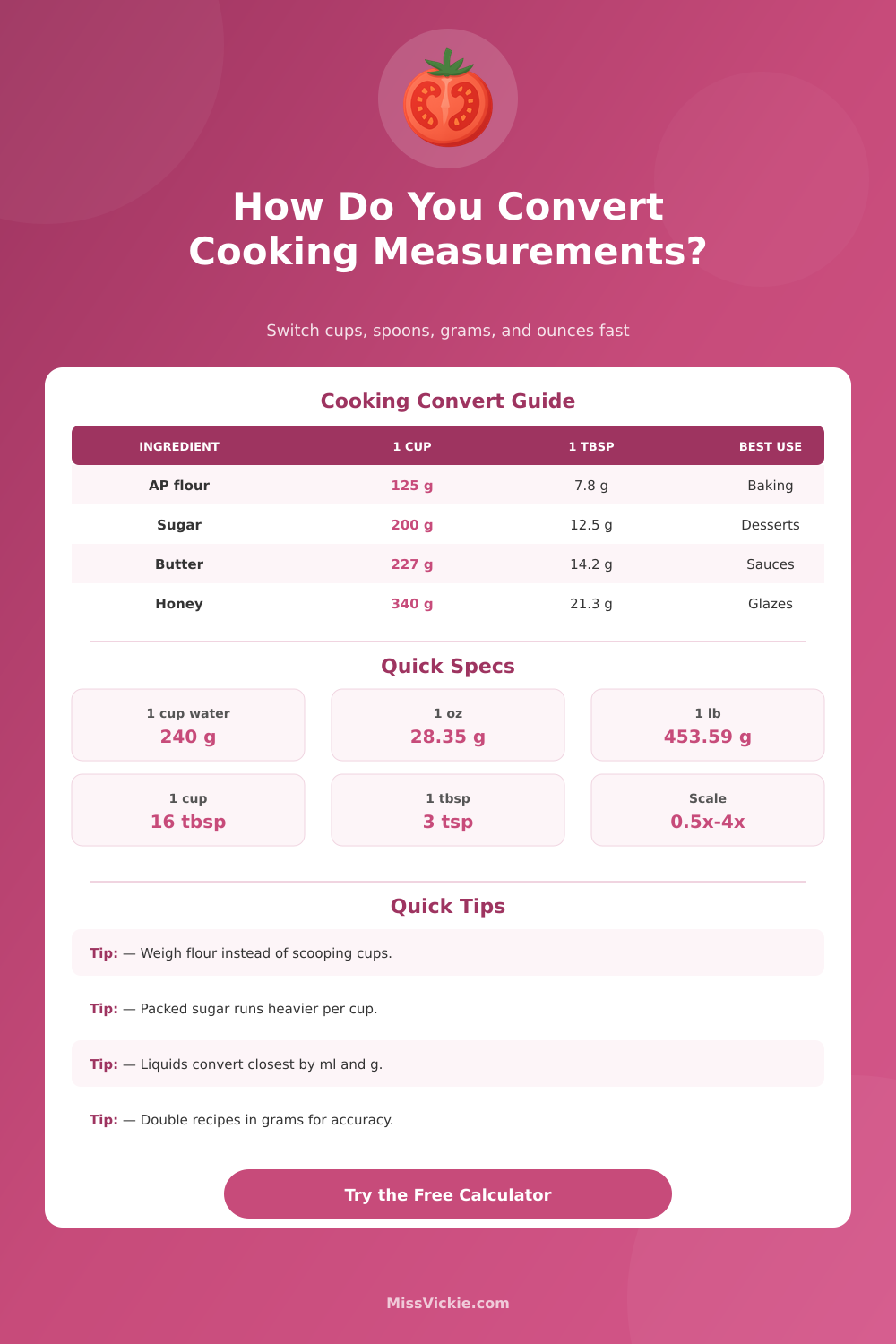
Cooking volume and weight conversions
Cooking Measurement Converter
Convert cups, tablespoons, teaspoons, ounces, pounds, grams, kilograms, and milliliters for everyday ingredients using cooking density data, recipe scaling, and practical measuring adjustments.
Volume conversions depend on ingredient density. Dry ingredients can shift slightly with scooping style, while packed and melted ingredients run heavier than loose spooned measures.
Flour
125 g
1 cup all-purpose flour, spooned and leveled.
Sugar
200 g
1 cup granulated sugar, standard dry measure.
Butter
227 g
1 cup butter equals 2 sticks or 16 tablespoons.
Honey
340 g
1 cup honey is much heavier than most dry ingredients.
| Ingredient | 1 Cup | 1 Tablespoon | Best For |
|---|---|---|---|
| All-Purpose Flour | 125 g / 4.4 oz | 7.8 g | Cakes, muffins, cookies |
| Granulated Sugar | 200 g / 7.1 oz | 12.5 g | Cookies, syrups, meringue |
| Brown Sugar, Packed | 220 g / 7.8 oz | 13.8 g | Bars, glazes, sauces |
| Butter | 227 g / 8 oz | 14.2 g | Baking, sauteing, sauces |
| Honey | 340 g / 12 oz | 21.3 g | Dressings, marinades, baking |
| Milk | 245 g / 8.6 oz | 15.3 g | Batters, custards, gravy |
| Rolled Oats | 90 g / 3.2 oz | 5.6 g | Granola, oatmeal, crisps |
| White Rice, Dry | 185 g / 6.5 oz | 11.6 g | Pilaf, rice bowls, sides |
| Measure | Teaspoons | Tablespoons | Metric View |
|---|---|---|---|
| 1 teaspoon | 1 tsp | 0.33 tbsp | 4.93 ml |
| 1 tablespoon | 3 tsp | 1 tbsp | 14.79 ml |
| 1/4 cup | 12 tsp | 4 tbsp | 59.15 ml |
| 1/3 cup | 16 tsp | 5.33 tbsp | 78.86 ml |
| 1/2 cup | 24 tsp | 8 tbsp | 118.29 ml |
| 1 cup | 48 tsp | 16 tbsp | 236.59 ml |
| 1 fluid ounce | 6 tsp | 2 tbsp | 29.57 ml |
| 1 pound | -- | -- | 453.59 g |
| Style | Factor | Typical Ingredients | When To Use |
|---|---|---|---|
| Spooned / Leveled | 1.00x | Flour, cocoa, cornstarch | Standard baking references |
| Packed / Pressed | 1.08x | Brown sugar, moist crumbs | When a recipe says packed |
| Sifted / Light | 0.92x | Flour, cocoa, powdered mixes | Airy volume after sifting |
| Melted / Warm Liquid | 1.03x | Butter, honey, syrup | Warm ingredients that pour cleanly |
| Original Amount | Half Batch | Double Batch | Triple Batch |
|---|---|---|---|
| 1 tbsp | 1 1/2 tsp | 2 tbsp | 3 tbsp |
| 1/4 cup | 2 tbsp | 1/2 cup | 3/4 cup |
| 1/3 cup | 2 tbsp + 2 tsp | 2/3 cup | 1 cup |
| 1/2 cup | 1/4 cup | 1 cup | 1 1/2 cups |
| 3/4 cup | 6 tbsp | 1 1/2 cups | 2 1/4 cups |
| 1 cup | 1/2 cup | 2 cups | 3 cups |
Measuring ingredient by weight is more accurate then measuring ingredients by volume. Additionally, measuring ingredient by weight will ensure that a recipe produce the same results every time it is prepared. When measuring ingredients by volume, the weight of the ingredient can vary depending on how the person fill the measuring tool.
However, the weight of ingredients measured on a scale will always remain the same, no matter how the person fill the tool. Many person choose to measure ingredients by volume because it is the most common method. However, using volume measurements for ingredients can lead to error when measuring those ingredients.
Measure Ingredients by Weight, Not by Volume
This is due to the difference in the densities of the ingredients. Density is the relationship between the weight of an ingredient and the space that the ingredient occupy. Flour is one ingredient that can have a variable density.
If a person scoops flour direct from the bag into the measuring cup, the flour will be compressed. Compressed flour will have a higher density than flour that has been scooped into the measuring cup without compress it. Using flour that has a higher density will result in using too much of the ingredient in the recipe.
To avoid this error, a person should spoon the flour into the measuring cup and level it with a knife. Additionally, if the recipe call for flour, it can be sifted before its measured. Sifting will make the flour light.
Brown sugar is another ingredient that can have a different density from the other ingredients when it is measure by volume. However, the density of brown sugar will be higher if the ingredient is packed into the measuring cup. If a person do not pack the brown sugar into the measuring cup, the density of the ingredient will be too low for the recipe.
Therefore, packing the brown sugar will ensure that the recipe use the proper weight of the ingredient. For liquids like water or milk, the density of the ingredient is very consistent. One cup of water weigh 240 grams.
One cup of milk also weigh 240 grams. However, for sticky liquids like honey or melted butter, volume measurements may not be the best option for measuring the ingredients. Using volume measurements for sticky liquids may lead to the ingredient stick to the side of the measuring cup.
Therefore, using a digital scale to measure sticky liquids will ensure the recipe use the correct weight of that ingredient. Scaling a recipe require increasing or decreasing the amount of each ingredient in the recipe. When a recipe is scaled, any error that occur in measuring ingredients by volume will also increase.
If a person doubles the amount of a recipe that is measured by volume, the error in that ingredient will also be double. To avoid these errors, using a digital scale to measure ingredients by weight is the best way to scale a recipe. When scaling a recipe, it is also important to account for the factor that some of the batter will stick to the mixing bowl.
A digital scale is a measuring tool that allows a person to measure the ingredients of a recipe by weight. Additionally, digital scales provide more precision than measuring cups. Using grams as a unit of measurement allows for smaller and more precise measurement of ingredients.
Additionally, if the ingredient that is being measured is a liquid, it can be converted from grams to milliliters because one gram of water weigh one milliliter. This same measurement can be used for milk. For most ingredient, measuring by weight is better then measuring by volume because the weight of the ingredient will not change the way that a person measure the ingredient into the recipe.
Using a digital scale for measuring ingredients will allow a person to achieve the consistency of the recipe. This is the main goal of cooking and baking recipes.