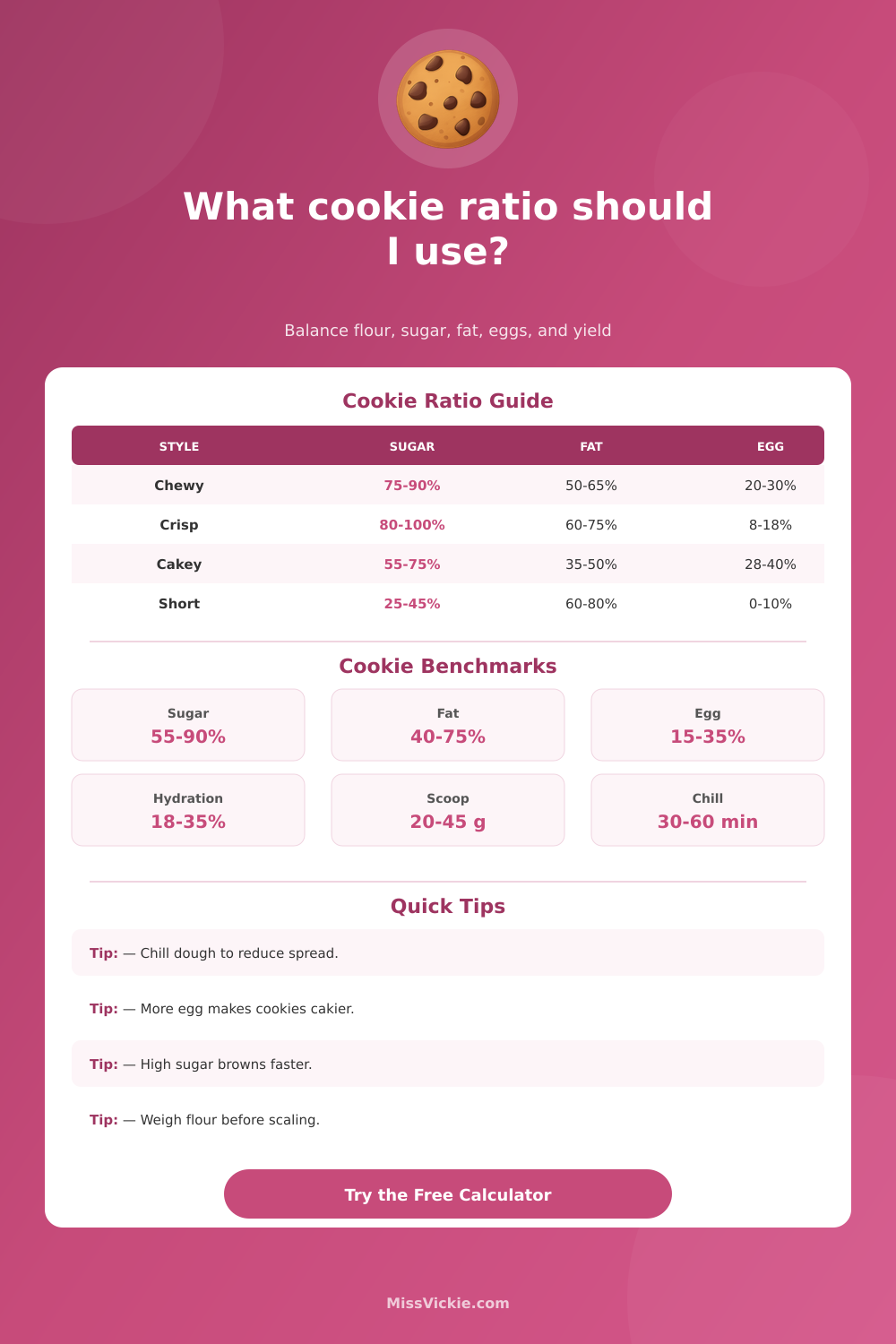
To make a cookie, an understanding of the ingredient ratio necesary to make that cookie is required. The ratio of ingredients will determine the texture of the cookie that is baked. Cookies may contain ingredients that result in thick and chewy cookies or thin and crisp cookies, each with different ratios of ingredient that create those differing textures.
Thus, individuals can consider the ingredient ratios within cookie recipes as systems themselves, rather than recipes that contains ingredients to be mixed together. Flour is considered to be the central ingredient within cookies. Flour helps to structure the cookie, and absorbs the moisture from the other ingredient within the cookie.
How Ingredient Amounts Change Cookie Texture
Additionally, other ingredients are measured as percentages of the weight of the flour that is to be used in the recipe. This allows for individuals to easily scale the recipe as needed, whether they need to bake only a few batches or numerous batches of cookies. If the amount of flour is altered, the other ingredients will automatically scale with the flour amounts, ensuring that the dough remain in the proper proportion regardless of the number of cookies that are to be baked.
Sugar performs a variety of functions within the cookie, but sugar does not act as the ingredient that provides the sweetness to the cookies. Sugar competes with the flour for the water content within the cookies. Because of this competition for the water, sugar leads to the spread of the cookie before the cookies firm up.
Additionally, more sugar leads to browning of the cookies due to the caramelization of the sugar. However, if too much sugar is used, the cookies may be thin and fragile, and will brown before the center of the cookies are cooked. Additionally, if there is too little sugar, the cookies will remain thick and cakey.
Fat also has an effect upon the texture of the cookies that are baked, but in a different manner then the sugar. Fat coats the proteins in the flour, which limits the ability of the proteins to form the gluten structure that provides texture to the cookies. The fat also contains water, which becomes steam during baking.
For instance, butter contains approximately sixteen percent water by weight, but oils does not contain water. Thus, the fat must contribute the amount of water that is accounted for when baking those cookies. Egg also contributes to the cookie dough both water and protein.
The water contributes to the hydration of the dough, while the protein structure hold the shape of the cookies. Because the egg contains both water and protein, the amount of eggs in the recipe can alter the texture of the cookies. Using more egg will lead to softer, more open cookies, while using less egg to the dough will result in shortbread-like cookies that are more crumbly.
It is also possible to add liquid to the cookie dough. For instance, additional liquid may be added to dough that is dry to rescue the dough. However, if additional liquid is added to dough that already contains a high percentage of egg, the cookies may spread too much during baking.
Thus, bakers must find a balance of hydration for desired texture of the baked cookie. Additionally, add-ins such as chocolate chips, oats, nuts, or dried fruit will also have an effect upon the texture of baked cookies. These ingredients will absorb the water content in the cookie dough.
Thus, the texture of the baked cookies may become tighter than that suggest by the recipe. To account for this, the dough can be allowed to rest for the add-ins to absorb the free water in the cookie dough. The add-ins are best measured as percentages of the weight of the flour that will be used in the recipe.
Finally, various temperatures and resting times will have an impact upon the baked cookies, even though these ingredients are not accounted for in the percentages. For instance, cold dough will hold its shape better in the oven than dough that is of the body temperature of the individual. Additionally, if the dough is rested overnight, the flour can become fully hydrated, leading to a tighter crumb within the baked cookies.
Using percentages allows for ease in altering the size of batches or cookies. For instance, if the flour is weighted, each of the other ingredients will automatically follow with that weight. This allows bakers to easily compare baking recipes to determine the ingredients that will lead to specific textures of cookies.
For instance, crisp cookies will contain more sugar, more fat, and less egg than cakey cookies. Shortbread recipes contain little sugar and little liquid. Thus, the dough will feel similar to that of a pie crust.
Many people make mistakes when attempting to bake cookies that use only one variable to change from the original recipe. For instance, increasing the amount of sugar without adjusting the fat that is used will lead to cookies that spread farther on the cookie sheets. Additionally, increasing the amount of eggs will introduce additional water that may make the dough too soft to scoop from the baking sheets.
Thus, individuals should only change one variable in the recipe to test for specific outcomes. Additionally, by altering only one variable within the recipe, the percentages of each ingredient can be used to determine the effect that each ingredient have upon the baked cookies.