Cooked Chicken Freezer Shelf Life Calculator
Estimate the best-quality freezer window for cooked chicken by cut size, bone, sauce coverage, package barrier, freezer temperature, freeze date, thickness, and thaw plan.
🍗 Cooked Chicken Presets
Choose a storage situation, then adjust the chicken shape, pack, freezer temperature, and serving plan for the exact batch.
🧊 Freezer Details
Freezer Quality Estimate
Choose the chicken and storage details to see the estimated freezer quality window.
Window Breakdown
Batch Details
📊 Quick Quality Markers
🧾 Cooked Chicken Freezer Reference
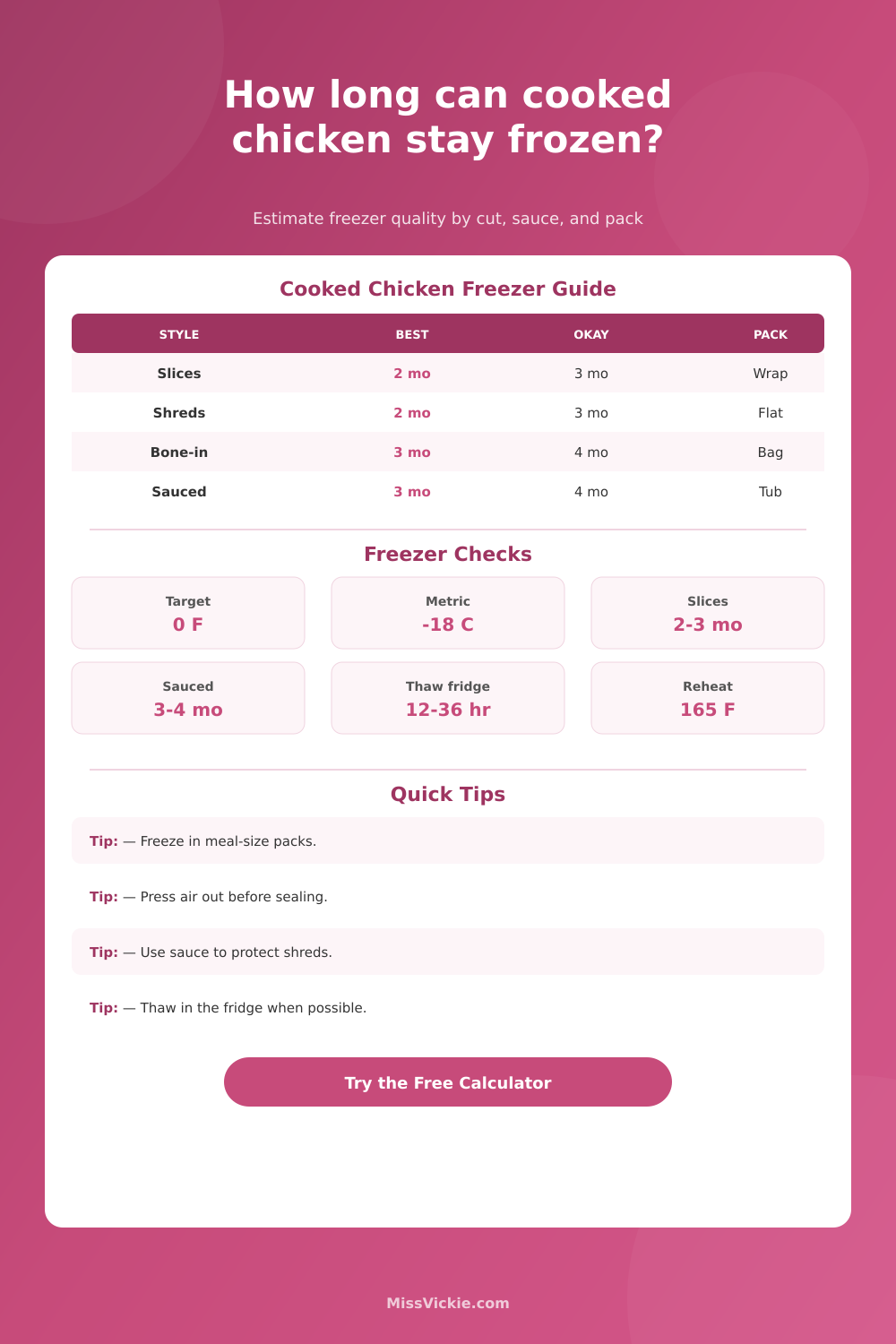
| Cooked Chicken Type | Best Quality Range | Useable Quality Range | Typical Quality Issue |
|---|---|---|---|
| Shredded or pulled chicken | 1.5 to 2.5 months | Up to 3 months | Dry strands and icy edges |
| Sliced cooked breast | 2 to 3 months | Up to 4 months | Firm texture after reheating |
| Bone-in cooked pieces | 3 to 4 months | Up to 5 months | Slow thaw near the bone |
| Chicken packed with broth or sauce | 3 to 4 months | Up to 5 months | Sauce separation or mild graininess |
🛍 Packaging Impact Table
| Package Method | Air Control | Best For | Quality Adjustment |
|---|---|---|---|
| Vacuum-sealed pouch | Excellent | Meal-prep cubes, sliced breast, pulled chicken | Adds about 3 weeks of quality margin |
| Pressed flat freezer bag | Good when air is pressed out | Shreds, chopped chicken, soup portions | Fast freeze and efficient thaw |
| Rigid airtight container | Good if filled near the top | Sauced chicken, broth packs, curry chicken | Protects moisture but may trap headspace |
| Takeout or deli container | Weak vapor barrier | Only very short freezer holding | Subtracts several weeks of quality time |
🌡 Temperature and Thickness Guide
| Freezer or Portion Detail | Quality Effect | Thaw Planning | Chicken Note |
|---|---|---|---|
| 0 F / -18 C or colder | Best home freezer target | Normal fridge thaw timing | Good for all cooked cuts |
| 5 to 10 F / -15 to -12 C | Faster flavor decline | Use earlier than the label date | Watch sliced breast and shreds |
| Flat pack under 1 inch | Freezes quickly | Often thaws overnight | Ideal for pulled chicken |
| Thick pack over 3 inches | Center freezes slowly | Plan one to two fridge days | Best for sauced or bone-in batches |
🍳 Thaw and Reheat Reference
| Plan | Best Match | Texture Result | Kitchen Check |
|---|---|---|---|
| Fridge thaw, then reheat | Most cooked chicken portions | Most even reheating | Heat center to 165 F |
| Simmer from frozen | Soup, gravy, curry, broth packs | Moist and forgiving | Stir until fully hot |
| Microwave thaw | Small flat packs | Can toughen edges | Cook immediately after thawing |
| Oven reheat | Bone-in pieces and fried chicken | Better for skin and coating | Cover first, crisp near the end |
📋 Freezer Scenario Comparison
Sauced thighs, broth-covered shreds, or vacuum packs hold moisture best.
Thin bagged chicken thaws evenly and works well for tacos, soup, and casseroles.
Lean sliced breast loses tenderness before sauced or bone-in pieces.
Air space, warm freezer readings, and frost crystals point to faster quality loss.
💡 Freezer Quality Tips
Freezing keeps properly handled cooked chicken from spoiling while frozen, but this calculator focuses on taste, moisture, freezer burn, and reheating quality.
Imagine you’re standing in front of an open freezer. There’s some chicken inside a container, which was once labeled but now the writing’s all smudged and hard to read. How old is this chicken? Is it going to be good to eat or will it taste like wet cardboard? It’s a question about food quality and also a question about food safety.
Food safety are binary; either you kept it cold enough for however many months or years, and it’s fine. Food quality is on a sliding scale: The longer you wait the more it tips towards disappointment. By plugging in your own parameters, the calculator can do the math, and help you decide whether those dry edges mean dehydration, or something else.
How to Store Chicken in the Freezer
Freezer burn is typically viewed by most folks as one enemy. In reality, its multiple little defeats of temperature control and packaging. Water evaporates from surface of the chicken and travels through the package, turning into gas inside the bag where it permanently dehydrates those protein fiber. No amount of saucing later will restore that moisture.
Because shredded chicken has such a huge surface area compared to its volume, it becomes dry in no time flat with no place for that water to hide. Same goes for sliced breast meat (albeit somewhat less so when packaged snugly). Bone-in cuts fair better: the bone itself, along with any associated connective tissue, forms a sort of built-in moisture buffer from the inside out.
This is why the tool take all these geometry facts into account; you don’t have to remember your high school physics equations while balancing a frozen bag of leftovers on your lap. In the freezer world, your best friend is Sauce. It’s like a protective coating; it protects meat and keeps any air away from direct contact. Meat covered in an even layer of gravy (or dipped into broth) will keep its texture much longer then dry meat. Even though chicken prepared for soup seems fine several months later, a plain roasted breast can go tough in just a few weeks.
Essentialy, the sauce becomes part of the package barrier. If you’re freezing plain meat, try to add a light coating of oil or pack it in pan juices, it really does makes a difference in how it reheats at the end. The unsung hero of storage in the freezer? Temperature stability. Most home freezers is poorly insulated and experience wild temperature swings each time the door opens and closes.
That’s bad news, as the growth (and subsequent shrinkage) of ice crystals enlarges them and tears apart the cell walls as they go. The result is mush when it thaws. A freezer that consistently operates at zero degrees or colder has a much bigger quality window; the calculator accounts for this range since even a couple of degrees can make a big difference. It isn’t just that it’s cold, it’s that it’s consistent.
Just as important is your thawing strategy. Throwing a frozen chicken block into microwave and nuking it until it’s done will make the outside hot while leaving the inside still cold, and end up destroying any quality it might of had left. A slower thaw in the fridge will be gentler on texture (since it spreads the heat evenly) but obviously requires more time. Stew or soup ingredients can often be cooked right from frozen, with the broth taking care of the gentle warming.
If you know what you’re planning to do with the chicken, that should determine how you package it initially, flat bags freeze quicker and also thaw out more evenlily than big bulky blocks. The last lever you can pull is what packaging to use. You can use vacuum sealing to take out all the air, which is the main source of freezer burn. Freezer bags: As long as you push out all the bubbles before sealing, these will do just fine.
Takeout containers: These suck for storing food in the freezer; they don’t offer any thermal protection and let air get in. Here are some tables to show how long each packaging option lasts. It is usually not worth sacrificing a good dinner just to save two minutes of packing.
• The truth: Freezing cooked chicken is all about moisture, air, and temperature stability; it’s about keeping your ingredients intact. Tend to them in the freezer and they’ll return the favor by making dinner a cinch down the road. Neglect the details, though, and I guarantee you’ll have a hard time reading that label when you finally get around to thawing it.
Just remember: Easy does it. Keep it cool, keep the moisture in, and keep that pesky freezer burn at bay. Do that right and your freezer won’t feel like a graveyard of wasted food but like a pantry of convenient convenience. Now go ahead, you can cook. But first, let’s learn to store.