Cold Brew Caffeine Calculator
Estimate cold brew caffeine from coffee grams, water, brew ratio, roast level, grind size, steep time, temperature, concentrate dilution, and finished serving size.
Load a common cold brew setup, then adjust the coffee weight, water, roast, grind, steep time, dilution, and glass size for your own batch.
Caffeine Breakdown
Lower concentrate strength, often served with no water or milk dilution.
Balanced home cold brew that usually tastes right with a 1:1 cut.
Dense caffeine per ounce, built for milk drinks or larger dilution.
Hot-brewed then chilled, usually more extracted than classic cold brew.
| Roast or Blend | Starting Caffeine | Extraction Behavior | Calculator Use |
|---|---|---|---|
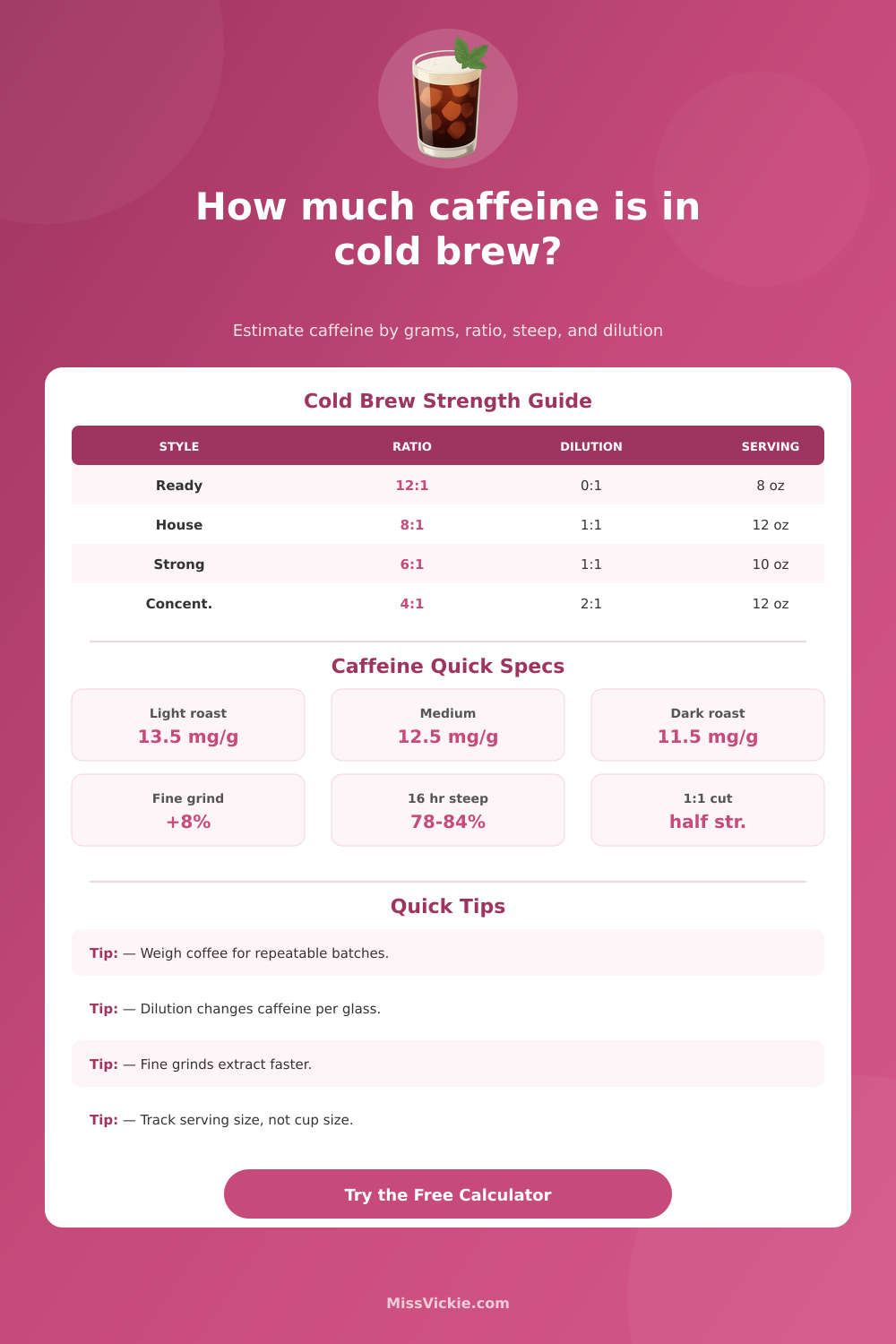
| Light roast arabica | About 13.5 mg per gram | Slightly slower extraction, bright cup | Use for dense beans and longer steeps |
| Medium roast arabica | About 12.5 mg per gram | Baseline cold brew estimate | Good default for most bags |
| Dark roast arabica | About 11.5 mg per gram | Extracts readily, lower bean density | Useful for chocolatey cold brew |
| Arabica with robusta | About 16.5 mg per gram | Higher caffeine before brewing | Choose when the bag lists robusta |
| Decaf coffee | About 0.35 mg per gram | Very low caffeine remains | Use for evening cold brew planning |
| Water to Coffee Ratio | Style | Typical Dilution | Caffeine Pattern |
|---|---|---|---|
| 4:1 to 5:1 | Heavy concentrate | 1:1 to 1:3 | Very high mg per ounce before dilution |
| 6:1 to 7:1 | Strong concentrate | 1:1 to 1:2 | High strength, useful for milk drinks |
| 8:1 to 10:1 | House concentrate | 0.5:1 to 1:1 | Moderate to high serving caffeine |
| 11:1 to 14:1 | Ready to drink | None or light ice | Lower density but larger cups can add up |
| 15:1 and above | Light cold coffee | Usually none | Lower extraction pressure and lighter body |
| Variable | Lower End | Middle Range | Higher End |
|---|---|---|---|
| Steep time | 8 to 10 hours: lighter | 14 to 18 hours: balanced | 20 to 24 hours: stronger |
| Grind size | Extra coarse: slower | Coarse: standard | Medium/fine: faster |
| Temperature | Fridge: cleaner, slower | Cool room: standard | Room temp: faster extraction |
| Filter method | Paper holds more liquid | Mesh is average | Pressing raises yield |
| Dilution Choice | Concentrate in Glass | Best For | Caffeine Effect |
|---|---|---|---|
| No dilution | 100 percent concentrate | Ready-to-drink cold brew | Full batch strength per ounce |
| 1 part plus 0.5 part | 67 percent concentrate | Light milk or ice cut | About two-thirds strength |
| 1 part plus 1 part | 50 percent concentrate | Most house cold brew | Half the concentrate caffeine density |
| 1 part plus 2 parts | 33 percent concentrate | Strong concentrate over ice | One-third strength per finished ounce |
| 1 part plus 3 parts | 25 percent concentrate | Very dense base or large tumblers | One-quarter strength per finished ounce |
Cold brew coffee is often known for being smoothy when brewed. However, cold brew coffee do contain caffeine. The amount of caffeine in a glass of cold brew coffee depend on several factor.
These factors include the type of coffee bean used, the level of roast, the size of the grind, the length of time the grounds steep, and the dilution of the brews. Many people does not account for all these factors when preparing their cold brew coffee. Therefore, using a caffeine calculator will give people a more better idea of the caffeine content of their brew.
How Much Caffeine Is in Cold Brew Coffee
The caffeine calculator will mathematicaly determine the caffeine content in cold brew coffee based off the variables that the individual input. The variables required to be entered into the caffeine calculator include the weight of the coffee, the roast levels, the grind of the coffee, the length of time the coffee steeped, and the dilution ratio of the coffee. The roast levels contains an impact on the caffeine content of cold brew coffee.
A light roast coffee contains more caffeine than a dark roast coffee. This is because the more roasted the coffee beans are, the more caffeine are lost. Additionally, light roast coffee allow for the caffeine to dissolve into the water used to prepare the coffee.
If an individual switched from medium roast coffee to a light roast coffee, the caffeine content would increase even without changing any other factor in the brewing of coffee. Another factor that influence the caffeine content is the size of the ground coffee beans. However, it works in a different way than many people expect it to.
Fine ground coffee beans will release the caffeine into the coffee water more fast. Therefore, a finer grind will allow more caffeine to be extracted from the ground coffee beans. However, it will also extract the bitter compound from the ground coffee beans.
People usually use a coarse grind for cold brew coffee so that it will have a cleaner flavor. However, using a finer ground coffee will increase the extraction percentage of the caffeine in the coffee. Steep time will impact the caffeine content in brewed coffee.
However, it dont follow the same rate as the other variables. During the first eight hours of steeping, coffee will extract a significant amount of caffeine. The following eight to ten hours will continue to release the caffeine at a slower rate.
After twenty hours of steeping, the body will no longer extract caffeine from the coffee grounds. The temperature at which the coffee steeped will also impact this factor. Cold brew coffee steeped at room temperature will steep faster than coffee steeped in the refrigerator.
If the coffee is steeped at room temperature, the steep time has to be reduced to avoid brewing coffee with too much caffeine. Another factor that will impact the caffeine content is dilution. Cold brew coffee concentrate contain alot of caffeine.
However, when water or milk is added to it, the caffeine concentration will drop. The caffeine calculator takes into account the amount of water that is added during dilution. Additionally, any water that melts from ice that is added to the coffee is also take into account.
Ready-to-drink cold brew coffee has a higher water-to-coffee ratio than cold brew coffee concentrate. Therefore, it will contain less caffeine per ounce than cold brew coffee concentrate. Counting the number of cups of coffee that one drinks does not provide an accurate measurement of caffeine intake.
Coffee come in different sizes and dilutions. To accurately follow the caffeine content that the body can take, individuals should measure the amount of caffeine in milligrams. If an individual increases the size of the coffee from twelve ounces to sixteen ounces, they will consume more caffeine.
The caffeine calculator allows an individual to determine how many milligrams of caffeine one cup of coffee contains. Additionally, the calculator can determine how many cups of coffee one can have during the day. Adding ingredients to cold brew coffee will impact the caffeine concentration.
For instance, if milk is added to cold brew coffee, the volume of the liquid that is consumed increases. However, the amount of caffeine does not. This is why a latte made from cold brew coffee contains less caffeine per ounce than plain cold brew coffee.
Using the caffeine calculator, one can calculate the amount of caffeine that each type of drink contain. The type of filter that is used in brewing cold brew coffee can alter the amount of cold brew coffee that one produces. Paper coffee filters will absorb more liquid than mesh filter or the screens in a French press.
The amount of liquid that is absorbed by the paper coffee filter will reduce the total yield of cold brew coffee that the filter produce. Changing the type of filter will alter the total amount of caffeine that is produced per serving of cold brew coffee. Therefore, the type of coffee filter will have to be accounted for in measuring the results of the cold brew coffee that is prepared.
These reference tables will provide an individual with the typical ratios and dilutions for cold brew coffee. These tables is not exact, as each type of coffee reacts differently to the factors mentioned above. There is no exact strength of cold brew coffee that is best for everyone.
Some may want a concentrate that can be used to make milk drink, while others may want to drink ready-to-drink cold brew coffee. The caffeine calculator will allow individuals to prepare their coffee in a manner that will allow the caffeine content to remain the same. Cold brew coffee can be prepared in a manner that provide an individual with the amount of caffeine that they need.
Many individuals use scoops to measure the amount of coffee that is needed to make cold brew coffee. However, many of them should measure the amount of coffee that they use by weighing it. Using a scale to measure the coffee will allow for more consistent results.
Additionally, the caffeine calculator can help to log these settings so that each individual will recieve the same result each time that they brew their coffee. This caffeine calculator allows an individual to compare the brewing setups of two different individuals. One individual may use a light roast coffee that steeped for long periods.
Another individual may use a dark roast coffee that steeped for shorter periods of time. The caffeine content of both brews can be made equal to each other by adjusting the dilution or the serving size of the cold brew coffee. Using the caffeine calculator regularly will allow individuals to understand the effect that each variable has on the caffeine content of their cold brew coffee.
With time, they will be able to make changes to the flavor of their cold brew coffee without affecting the caffeine content. The caffeine calculator will also allow them to avoid having to perform the arithmetic calculations for cold brew coffee themselves.