☕ Coffee TDS Calculator
Calculate brew strength, extraction yield, and get dialing-in recommendations
| Brew Method | Ideal TDS % | Extraction Yield % | Typical Brew Ratio |
|---|---|---|---|
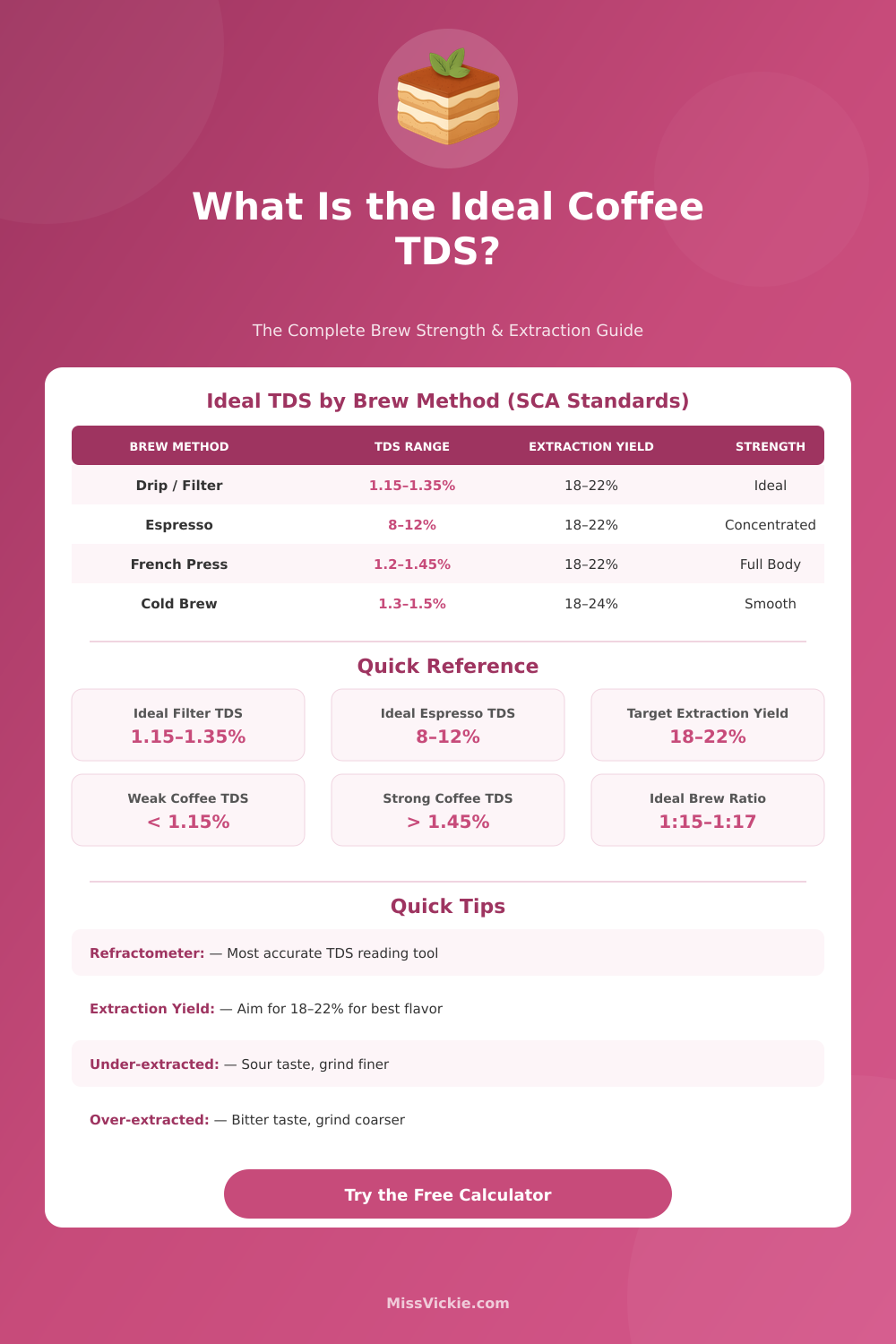
| Drip / Filter | 1.15–1.35% | 18–22% | 1:15–1:17 |
| Pour Over | 1.20–1.40% | 18–22% | 1:15–1:17 |
| French Press | 1.20–1.45% | 18–22% | 1:12–1:15 |
| AeroPress | 1.20–1.45% | 18–22% | 1:6–1:15 |
| Espresso | 8.00–12.00% | 18–22% | 1:2–1:2.5 |
| Cold Brew (Conc.) | 1.30–1.50% | 18–24% | 1:4–1:8 |
| Moka Pot | 2.50–4.50% | 18–22% | 1:5–1:8 |
| Chemex | 1.15–1.35% | 18–22% | 1:15–1:17 |
| Hario V60 | 1.20–1.40% | 18–22% | 1:15–1:17 |
| Siphon / Vacuum | 1.20–1.40% | 18–22% | 1:12–1:15 |
| TDS Range (Filter) | Strength | Flavor Profile | Adjustment |
|---|---|---|---|
| Below 1.15% | Weak / Thin | Watery, lacks body | Add more coffee or reduce water |
| 1.15–1.35% | Ideal (SCA) | Balanced, clean, sweet | No change needed |
| 1.35–1.45% | Strong | Bold, full-bodied | Slightly reduce coffee or add water |
| Above 1.45% | Very Strong | Intense, heavy, muddy | Reduce coffee dose or increase water |
| Extraction Yield | Flavor | Cause | Fix |
|---|---|---|---|
| Below 18% | Under-extracted | Sour, grassy, sharp | Grind finer, brew hotter, brew longer |
| 18–22% | Ideal | Sweet, balanced, complex | Keep your current recipe! |
| Above 22% | Over-extracted | Bitter, dry, harsh | Grind coarser, brew cooler, brew shorter |
Total Dissolved Solids (TDS) are a measurement of the strength of your coffee. The TDS value measure the amount of coffee solubles that has dissolved into the water. Coffee solubles include various elements such as acids, sugars, bitters, and oil.
By measuring the TDS of your brew, you can determine the percentage of coffee solids in your final liquid beverage. This is a separate value from how much water you have added to your grounds to brew your coffee. In order to determine the TDS of your brewed coffee, many coffee enthusiasts uses a device called a refractometer.
How Coffee Strength and Extraction Affect Taste
This device reads a cooled drop of brewed coffee as it passes through a prism. If you dont have access to a refractometer, you can still estimate the strength of your coffee through another value: the coffee dose and coffee yield. Coffee strength and the coffee to water ratio are closely related.
The extraction yield for coffee measures the percentage of the coffee mass that was extracted through the brewing process. If you find that the extraction yield for your coffee is too low, your coffee may taste sourly. If the extraction yield is too high, your brew may taste bitter.
An extraction yield between 18 and 22 percent is considered to be ideal when brewing coffee. The strength of coffee from different brewing methods can vary. For instance, different methods will require different target strengths.
Methods that utilize paper filters, like filter drip coffee methods, will typically require a TDS that is within a narrow range. This is due to the fact that paper filters will catch some of the fine particles that is brewed with the coffee grounds. Immersion methods, like a French press, allow for more of the coffee solids to be extracted with the brewed water, and can be prepared to feature a slightly higher strength of coffee.
Espresso methods require much higher concentrations of coffee solids than other brew methods. Cold brew coffee extracts its flavor with time instead of heat. Cold brew coffee typically features a smoother flavor profile due to the long steeping process require to brew the coffee.
To understand how to adjust your brewing parameters to control the strength of the coffee that you brew, consider the following scenario: if you use 15 gram of coffee and 250 grams of water, your brewed coffee should have a TDS of 1.25 percent to be considered balanced. If the TDS of your brewed coffee is below 1.15 percent, add more coffee to your brew to increase the strength. If the TDS is above 1.45 percent, brew coffee with added water to reduce the coffees strength.
Additionally, you can use a calculator to determine where your brewed coffee’s TDS and extraction yield values lie in comparison to ideal for each brewing method. Not only that, but if your coffee tastes sour, the issue might not be with the coffee-to-water ratio. If your coffee features an under-extraction yield, you should grind the coffee beans to be more finely in size.
However, if the sourness results from a lack of brewing strength, simply add more coffee beans to the brew. Many people rely on the taste of their brewed coffee to adjust their brewing methods. However, taste is not the most reliable determinant of coffee strength.
This is due to the adaptation of human taste buds to specific flavor. Additionally, coffees contain different amounts of density and porosity in their beans, which can impact the rate at which they extract with water. Finally, the quality of the water used to brew coffee can play a major role in the outcome of brewed coffee; water hardness will chemically interact with the coffee solids when brewing.
TDS is an objective measurement of coffee strength; taste is not. Professionals that brew coffee for others use this measurement to ensure that their coffee shots taste the same on any machine in the coffee shop. Beyond understanding that TDS and extraction have different meanings in the brewing of coffee, it is also essential to consider the relationship between dose, yield, and extraction.
For instance, if you use 20 grams of coffee and 300 grams of water, the ratio of brew variables may be set up to produce an ideal cup of coffee. Yet, if the coffee tastes grassy or sharp, it may be due to an extraction yield that hovers around 17 percent. A refractometer could highlight that the extraction process has failed to extract the majority of the coffee solids from the ground coffee beans.
Depending on the brewing method, yield issues can impact brewing parameters. For instance, if espresso shots undershoot extraction targets for light roast beans, changing the water temperature or agitation variables can help. Conversely, dark roast espresso methods may require a coarser grind to balance extraction strength.
Brew ratio is the weight of the coffee divided by the weight of the final beverage. You must account for the amount of water that is lost during brewing through evaporation and absorption. For instance, when utilizing a pour-over brew method, you may lose 10 percent of the water to the brew vessel.
This means that the amount of water that you start brewing with will be less than the amount of water that you yield from your brew. For instance, espresso methods use a brew ratio of 1:2. At this ratio, espresso has a TDS of 8 to 12 percent if prepared correctly.
Moka pots produce brews that are stronger than espresso methods and can feature a TDS between 2.5 and 4.5 percent. Cold brew coffee methods concentrate to a TDS between 1.3 and 1.5 percent. Various factors can impact brewing consistency.
For instance, buildup of scale within your kettle can impact the temperature of the water that is dispensed from your kettle. Changes in the water temperature will impact the brewing process. Coffee that is not as fresh as it once was will extract more weakly when brewed.
The level of roast applied to coffee beans will impact how much extraction is required from coffee to achieve an ideal taste. TDS accounts for these variable, as it is a measurement of the outcome of the brewing process. Under-extraction of coffee results in the brew tasting sour.
Under-extraction happens if the yield is below 18 percent of the coffee mass. In order to fix under-extraction, grind the coffee to increase the surface area of the coffee particles, brew with hotter water to increase the solubility of the coffee, or brew the coffee for a longer amount of time. Over-extraction of coffee features flavor characteristics of astringency and dryness in the mouth.
Over-extraction occurs when the coffee brew’s extraction yield is above 22 percent. Change brewing variables to fix over-extraction by changing the grind size to be more coarse, reduce the brewing temperature of the water, or reduce the amount of time required for brewing to take place. Finally, recognize that coffee strength and extraction are two different values.
To diagnose brewed coffee for strength or sourness, use a layered diagnosis to determine whether to change the grind size of the coffee beans or the coffee-to-water ratio. Despite the variety of brewing methods, the importance of the brew ratio, TDS measurements, and the extraction process can be seen in determining the flavor of brewed coffee. Additionally, understanding how to fix common brewing problems, such as under or over-extraction, ensures that your coffee maintains an ideal flavor profile.
Recognizing the differences between strength and extraction allows you to properly diagnose the cause of flavor inconsistency.