
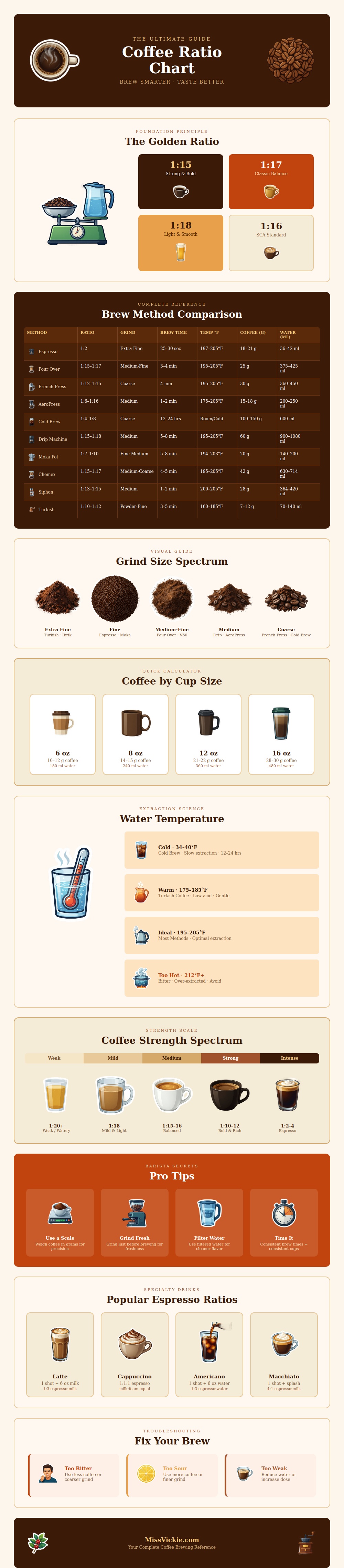
Whether you’re using a French press or a drip machine, most of us start our day following a ritual rooted in chance, not science. Scoop some grounds into a filter; pour water over it; hope for something decent. What result is typically inconsistent: sometimes bitter, sometimes watery, never quite what you’d hoped for.
But this variance almost always stems from one thing: neglecting to pay attention to the ratio. Brewing coffee isn’t like creating a painting (there’s no room for intuition here). Chemistry experiments demand exact measurements, and coffee is a chemical extraction process. While ratio is your biggest lever for better taste, other things like grind size, temperature, and water quality also matter. If you can get those two in perfect harmony, you’ve got the greatest leverage to produce a tastier cup.
How to Make Better Coffee
This translates into easy-to-understand terms on the chart above, where we can see that there’s no magic number that works best for all beans and all tasters alike; some want their coffee super-intense (approaching a 15:1 ratio of water to coffee), while others want theirs lighter (closer to 18-20:1). As a general guideline, the Specialty Coffee Association suggest starting at about 16, since it falls somewhere in the middle that will accommodate most roasts and most palates. You do not have to follow it, though it is a good place to start.
Is it under-extracted? Your coffee tastes sour, add some coffee, grind a little finer. Is it over-extracted? Your coffee tastes harsh/bitter, reduce the amount of coffee/try a slightly coarser grind. These ratios work hand in hand with grind size. Powder made for your french press won’t be suitable for your espresso machine. That’s made clear in the infograph above. In an espresso machine, water travels through grounds fast and at high pressure. This calls for a fine grind.
In contrast, cold brew steeps for hours without any heat, so we need a coarse (gravel like) grind. The issue arises when using the incorrect grind size; the mechanics don’t match the intent. If you pair the grind with the intended method, you control the rate of water coming into contact with coffee solids. The amount of contact time will determine if flavors open up or go muddy.
There’s also an element of water temp to this. Many home brewers think “hotter is better,” but boiling your coffee will both scorch delicate compounds and pull bitter, burnt-wood-like tannins into your brew. That two-hundred-degree Fahrenheit range is generally considered the sweet spot: Hot enough to extract sugars and acids but not so hot as to drag out bitterness. It’s a small detail, but one that makes a huge difference in clarity.
Then there’s the issue of water. Because coffee is about ninety-eight percent water, you’ll reap the dividend by using filtered or clean-tasting tap water. Water that tastes like chlorine make coffee taste chlorinated. Know the variables, it makes troubleshooting simple. Tasting thin coffee from a pour over? Check your grind (it’s probably too coarse) before topping up with additional beans. Check your grind (it’s probably too fine) before topping up with more bean. French press tasting weak even after plenty of grounds? You might be grinding too coarse for the steep time you allowed. It could of being because you’re grinding too coarse and only giving it enough steep time.
These small tweaks compound. You don’t have to become a chemist, but when you treat brewing like a series of connected choices (instead of a guessing game) it changes everything. A simple scale that weights in grams is incredibly helpful. Heaping scoops vary wildly in density; weighing takes away this difference. And all that really means is consistency. You’re looking for that cup you know will be there when you wake up (or at the very least, you’ll have a clear reason why it didn’t come out as expected).
Think of the chart as the map; think of your taste buds as the destination. Begin with the baseline ratios, and adjust each variable in turn until you achieve the cup of your remembered ideal. When you get it right, when you drink a truly well-balanced cup of coffee. It’s not a chore, so much as a reward.