
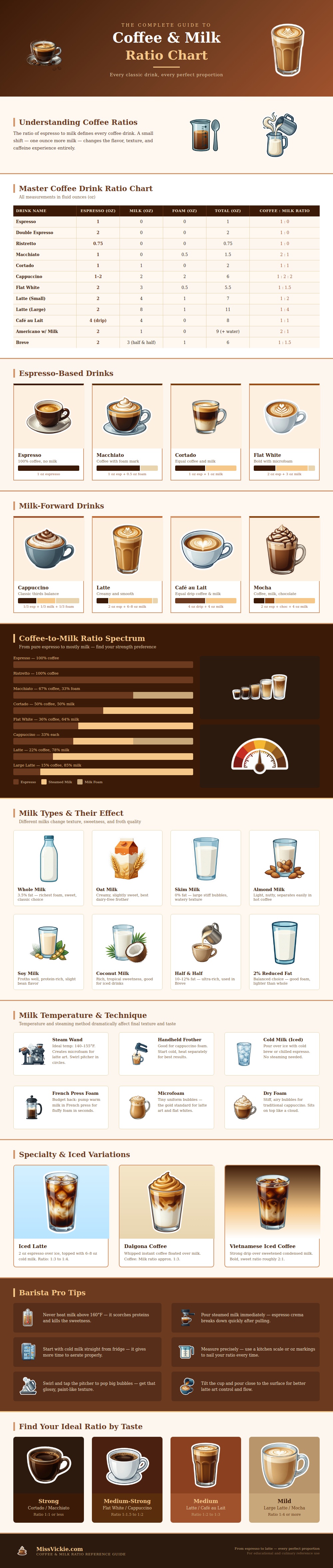
Coffee ordering at a cafe produces its own unique brand of confusion. You say “latte” and find yourself holding glass of warm milk with a dash of caffeine. You say “espresso macchiato” and what arrives is a thimble-sized shot of concentrated bitterness that scorch your taste buds. It’s not the barista’s fault.
It’s the ratio. How much milk meets how much coffee alter everything about what you’re drinking in the morning. This is well shown in the chart above which shows precisely what’s happening to your drink as it travels along the range from straight-up espresso at one end to primarily milk at the other. Depending on your cup size, a typical latte will be made off roughly two-ounces of espresso balanced with four- or even eight-ounces of steamed milk making it creamy and mild. Flip that equation altogether with equal measures of milk and coffee for a cortado, which provides strength without the burn.
How Coffee and Milk Ratios Change Your Drink
The point here is that ratio doesn’t only determine flavor but also texture. If you’re looking for a bold kick, head towards the stronger ratios closer to top of any comparative table. Everyone thinks all milk are equal. They are not. Skim milk contains zero fat so it foams up quickly and holds stiff peaks but has no body. Whole milk has high-fat content that produce beautiful microfoam because the fat stabilizes the bubbles (that’s what pros mean by “glossy” froth). Therefore, these is not interchangeable.
Of course, for those who prefer their coffee without dairy, oat milk has become the popular choice for a few reasons: it tastes naturaly sweet and works much like full-fat dairy. Barista grade almond milk won’t separate if you heat it; regular almond milk will. And while beans make an impact on a coffee’s mouthfeel, more often than not choosing your milk first will affects that outcome different than the beans themselves.
There’s also another invisible variable that kills good coffee: temperature. Heating your milk over 160 degrees Fahrenheit scorch the proteins. You obliterate its inherent sweetness and end up with a flat, cooked flavor. Using cold milk right out of your fridge will buy you extra time to add air correctly before you cross the thermal line. Once steamed, swirling the milk in the pitcher will help pop large bubbles and produce that “paint” like sheen required for good texture. It may seem like a small detail but it’s what sets an amateur pour apart from a pro.
But ice is its own beast. Unlike gravity pulling milk downward, it also melts rapidly, making for quicker-than-normal dilution. Because it’s cold, it also dulls your taste buds a bit (just enough to blunt the bitter). The result is that an iced latte might require less milk or maybe even a little more espresso to achieve balance. Vietnamese iced coffee rely heavily on sweetened condensed milk to offset the strength of those dark-roast droplets. Sweet-and-intense, it couldn’t be further away from a traditional Americano.
In the end, what’s best for you depends primarily on how intense you want your beverage. Prefer something stronger? Stick with flat whites or cortados, more coffee, less milk (though they retain some creaminess). Prefer a gentler beginning? You’re probably better off with a mocha or big latte in which milk and chocolate overpower the taste of coffee. It’s not that one’s right or wrong, it’s just a matter of matching expectations with delivery.
You should of looked at the ratio first. So in the end, it’s all about understanding what it is that you’re drinking (whether ordering from a shop or making coffee at home) and then making smarter decisions when you do so. Seeing these ratios stacked side by side takes the confusion out of the menu. Then you can choose based off exactly how strong or mild you want your morning to be. And this clarity transforms a routine habit into a small pleasure every day that’s worth making better.