☕ Coffee Half Life Calculator
Find out how much caffeine remains in your system and when it is safe to sleep
| Beverage | Serving | Caffeine (mg) | Notes |
|---|---|---|---|
| Drip / Filter Coffee | 8 fl oz | 95 mg | Standard brewed |
| Espresso | 1 shot (1 oz) | 63 mg | Concentrated |
| Double Espresso | 2 shots (2 oz) | 126 mg | Common latte base |
| Cold Brew Coffee | 8 fl oz | 155 mg | Higher extraction |
| Instant Coffee | 8 fl oz | 62 mg | Lower than drip |
| Green Tea | 8 fl oz | 47 mg | L-theanine softens effect |
| Black Tea | 8 fl oz | 47 mg | Similar to green tea |
| Energy Drink (8oz) | 8 fl oz | 80 mg | Check label — varies |
| Energy Drink (16oz) | 16 fl oz | 160 mg | Full can |
| Decaf Coffee | 8 fl oz | 7 mg | Not truly caffeine-free |
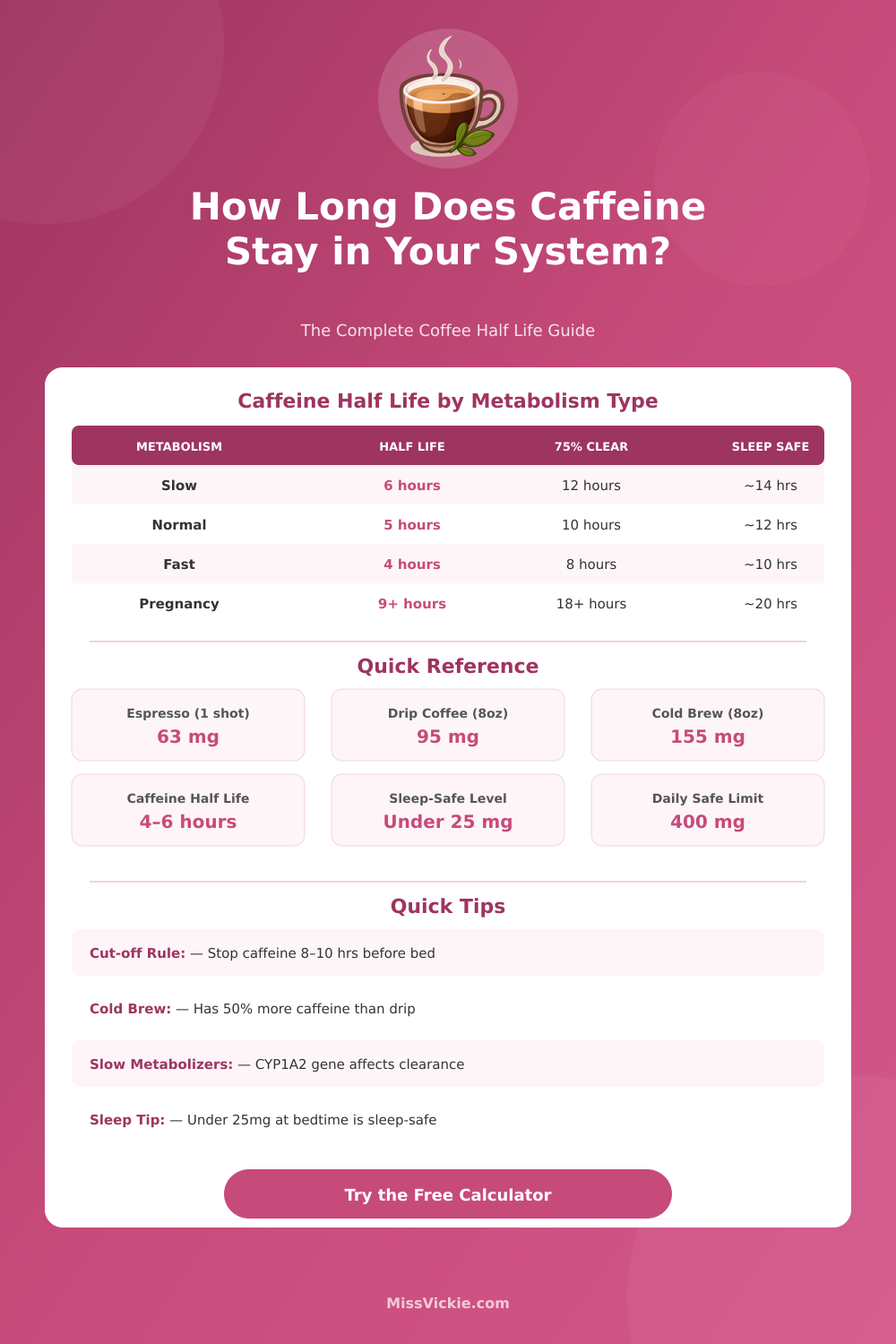
| Metabolism | Half Life | 50% Cleared | To Sleep-Safe (<25mg from 200mg) |
|---|---|---|---|
| Fast (CYP1A2 fast) | 4 hours | 4 hours | ~12 hours |
| Normal (average) | 5 hours | 5 hours | ~15 hours |
| Slow (CYP1A2 slow) | 6 hours | 6 hours | ~18 hours |
| Pregnancy | 9+ hours | 9+ hours | ~27+ hours |
| Liver conditions | Up to 96 hrs | Varies | Consult a doctor |
| Hours Elapsed | Fast (4hr HL) | Normal (5hr HL) | Slow (6hr HL) |
|---|---|---|---|
| 2 hours | 71% remains | 76% remains | 79% remains |
| 4 hours | 50% remains | 57% remains | 63% remains |
| 6 hours | 35% remains | 43% remains | 50% remains |
| 8 hours | 25% remains | 33% remains | 40% remains |
| 10 hours | 18% remains | 25% remains | 31% remains |
| 12 hours | 13% remains | 19% remains | 25% remains |
| 16 hours | 6% remains | 11% remains | 16% remains |
| 20 hours | 3% remains | 6% remains | 10% remains |
Coffee is a drink made from roasted and ground coffee beans. It has a black color, bitter taste and a bit of acid. The stimulating effect of coffee comes mostly from the caffeine, although decaffeinated versions also exist For those that want something different, many coffee substitutes are available.
Botanically coffee has only two main kinds: arabica and robusta. The robusta has more caffeine and commonly has a rubbery, bitter taste.
Coffee Basics
The serving sizes of coffee can confuse. The industry standard for a cup is six ounces, but people usually want at least sixteen ounces. Typical cups are small at eight ounces, medium at twelve ounces and big at sixteen ounces, according to local custom and kinds of drinks.
One cup from a coffee maker is usually five ounces. Makers define a cup as five to six ounces, so that they can advertise more cups for one brew. A machine with a sixty-ounce water tank can promise ten cups, instead of only seven and a half according to the standard eight-ounce cup.
One galon of coffee serves about sixteen eight-ounce cups, so it serves big groups well.
Adding more coffee for a stronger drink seems like a good idea during sleepy mornings. More ground coffee may bring out more taste, but not necessarily more caffeine, and the result is often a too bitter drink.
Instant coffee powder is made of dehydrated crystals soluble in water. Just add water, best hot, but not boiling; to get a fast cup. It is cheaper and easier than whole beans or pods, but the bad fame of instant coffee comes from its taste.
Coffee liqueurs like Kahlúa mix well with ice, milk, cream or almond milk. They work as after-dinner or evening drinks. The caffeine in those liqueurs is almost nothing.
Brewing methods for coffee are many. The French press is popular for home users. Pour-over styles like Melitta and Chemex also have fans.
Some like electric moka pots more than the classical stovetop version, because of better taste and safety. Quality of beans and water matters more than other things for a good result. Good beans going in give good coffee coming out.
Middle East style coffee and coffee with a cloth filter both are true arts. The ground coffee is first only a bit wet, so that it swells before you continue.
Coffee is used in baking too. Used coffee grounds mix into sourdough bread, and there are recipes with coffee and spices like mint, cocoa and cinnamon for a delicious mix.