Coffee Grounds Per Cup Calculator
Calculate coffee grounds for drip coffee, pour over, French press, espresso-style moka pot, AeroPress, and cold brew using cup size, strength, grind, and scoop size.
☕ Coffee Measuring Presets
Choose a common brewing situation, then adjust cups, cup size, method, roast, strength, grind, and scoop size to match your kitchen.
⚖ Brew Details
Coffee grounds estimate
Enter your brew details to calculate grounds, water, tablespoons, and scoops.
Measurement Breakdown
Water And Yield
- Use a scale when possible for repeatable coffee.
- Measure water before brewing if your carafe marks are unclear.
📏 Serving Size Grid
📋 Coffee Grounds Reference Tables
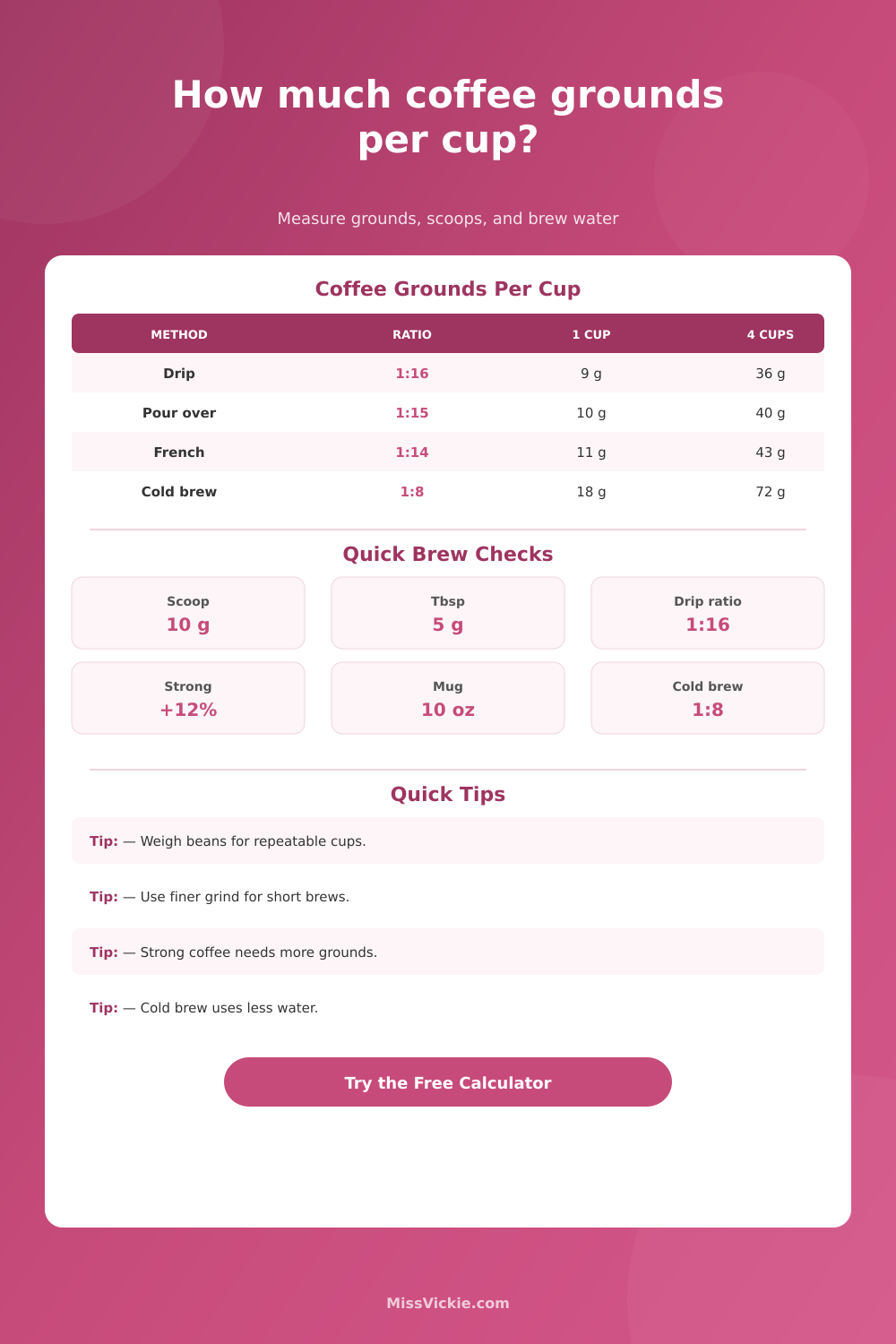
| Brew Method | Baseline Ratio | Grind Size | Typical Cup Size | Practical Note |
|---|---|---|---|---|
| Drip coffee maker | 1 g coffee to 16 g water | Medium | 5 to 6 fl oz brewer cups | A classic starting point is about 9 to 11 g grounds per 6 oz cup. |
| Pour over cone | 1 g coffee to 15 g water | Medium-fine to medium | 8 to 12 fl oz mugs | Use slightly more grounds for clarity and body in single-cup brewing. |
| French press | 1 g coffee to 14 g water | Coarse | 8 oz mugs or carafe cups | Coarse grounds are lighter by tablespoon, so scoops can look larger. |
| Cold brew concentrate | 1 g coffee to 8 g water | Extra coarse | Batch jar or pitcher | This makes concentrate; dilute with water, milk, or ice after steeping. |
| AeroPress style brewer | 1 g coffee to 13 g water | Fine to medium | 6 to 8 fl oz cups | Short steep time works well with a stronger ratio and finer grind. |
| Moka pot | 1 g coffee to 10 g water | Fine, not powdery | 2 to 3 fl oz demitasse cups | Fill the basket level without tamping for a strong stovetop brew. |
| Finished Coffee | Drip 1:16 | Pour Over 1:15 | French Press 1:14 | Cold Brew 1:8 |
|---|---|---|---|---|
| 1 cup, 6 fl oz | 11 g, about 2.2 tbsp | 12 g, about 2.4 tbsp | 13 g, about 2.6 tbsp | 22 g, about 4.4 tbsp |
| 2 cups, 12 fl oz | 22 g, about 4.3 tbsp | 24 g, about 4.7 tbsp | 25 g, about 5 tbsp | 44 g, about 8.8 tbsp |
| 4 cups, 24 fl oz | 44 g, about 8.6 tbsp | 47 g, about 9.5 tbsp | 51 g, about 10.2 tbsp | 89 g, about 17.8 tbsp |
| 8 cups, 48 fl oz | 89 g, about 17.8 tbsp | 95 g, about 19 tbsp | 101 g, about 20.3 tbsp | 177 g, about 35.5 tbsp |
| 10 cups, 60 fl oz | 111 g, about 22.2 tbsp | 118 g, about 23.7 tbsp | 127 g, about 25.4 tbsp | 222 g, about 44.4 tbsp |
| 12 cups, 72 fl oz | 133 g, about 26.6 tbsp | 142 g, about 28.4 tbsp | 152 g, about 30.4 tbsp | 266 g, about 53.3 tbsp |
| Measurement | Medium Grounds | Coarse Grounds | Fine Grounds | Kitchen Use |
|---|---|---|---|---|
| 1 level tablespoon | About 5 g | About 4.5 g | About 5.5 g | Good for small changes when you do not have a scale. |
| 1 standard scoop | About 10 g | About 9 g | About 11 g | Most coffee scoops hold 2 tablespoons when leveled. |
| 1 US cup of grounds | About 80 g | About 72 g | About 88 g | Useful for large cold brew batches or meal-prep style brewing. |
| 1 ounce by weight | 28.35 g | 28.35 g | 28.35 g | Weight does not change by grind size; volume estimates do. |
| 100 g water | 100 ml | About 3.4 fl oz | About 0.42 cup | Coffee ratios use water weight because it is easy to scale. |
🌱 Coffee Strength And Yield Notes
Milder cup, lower body, useful for dark roasts or sensitive palates.
Reliable everyday drip starting point for most medium roasts.
More body and bitterness risk; adjust grind if extraction tastes harsh.
Designed for dilution, ice, milk, or cold brew serving.
💡 Measuring Tips
Coffee ratios are starting points. Taste, grinder consistency, water temperature, and brew time can all change the final cup.
Everyone has their own morning routine. But no one knows what they’re doing. Measure out some beans, pour in some water, and hope for the best. Even though the process is identical, it always tastes different from day to day. And that’s because the math are wrong. It is not the coffee; it is the math.
Guessing at your ratio means brewing blind. Water and grounds is the single most critical variables of all. They determine everything about how you experience your cup. They affect the body and acidity, and whether you like drinking it or not.
Stop Guessing Your Coffee Recipe
All you have to do is plug in your serving size and brew method, and the calculator above does all of the math for you. You won’t have to fumble with grams and ounce when you’re barely awake, and you won’t have to remember formulas by heart. You will no longer have a fuzzy sense of how strong something was. Instead, it’s a specific recipe.
But what exactly are those numbers? Why does switching from a drip machine to a French press result in a different number? For a well-balanced cup, a typical drip machine operate on a 1:16 ratio. In other words, for each gram of coffee you’ll want to add sixteen grams of water.
When you switch to a French press, however, you’ll need to narrow that down to a 1:14. Because the extraction method is different (it’s an immersion method), you require more coffee than water to get the same rich taste. Go with the drip ratio in the press and you’ll end up with a cup of watery, under-extracted goop that tastes like hot bean water.
And I know that sounds crazy. But they do. Most people often measure by volume but taste by weight. They don’t consider how the volume changes as the grind size change. They don’t consider the change in volume as the bean’s particle size changes. And the particle size does make a difference, which is why a level tablespoon of drip grind is heavier than French press grind.
Why? Because a tablespoon of coarse grounds fills a scooper differently then a tablespoon of fine grounds. The coarser the ground, the larger scoop and the lower weight. The tool compensates for this weight shift without even thinking about it. When we forget to compensate for this shift, we’ll end up under-dosing our coffee. We’ll believe that we’ve added the correct amount of coffee, when in reality we’ve added less mass because there are air gaps between the coarse grounds.
It’s the one thing that many home brewer overlook. They taste based off weight, but they measure based on volume. The other thing the calculator does is personalize itself for your strength preference. Do you like a strong, diner style cup? It will tweak its ratio toward more coffee in the mix. Do you like something closer to tea? Then it will pull back.
And this isn’t simply about preference; it’s about how efficiently it extracts. When you make a recipe with less water but add more coffee, you’ll increase the concentration of dissolved solids. Your cup gets thicker and more intense. Get carried away, though, and you’ll run into the bitter side of the wall.
To avoid wasting beans on an undrinkable beverage, the calculator provide a comfort zone for experimentation. Brewing cold coffee is a whole other kettle of fish (er, coffee?). Because it’s meant to be brewed as a concentrate, it calls for a much higher ratio, typically 1 to 8.
What does that mean? That you’re not going to take a sip from the jar. Instead, you’ll add some ice or milk later on when you drink it. Brew cold coffee at your typical drip coffee ratio and what you have will taste more like rainwater then anything else. Fortunately, the calculator doesn’t let you mess it up (and waste all those precious coffee beans).
It actually tells you exactly how much water to add to account for how much the filter paper and coffee grounds soak up. Water loss is a quiet thief of quality. Paper filters absorbs an impressive quantity of water. French press keeps a portion of the water at the bottom of the sludge. It returns it to your overall water volume; that’s why you end up with a different sized cup than what you thought you’d be getting.
For maximum performance, you’ll want to use a kitchen scale. Volumetric measurements are convenient, but by their nature, they’re inconsistent. A level scoop isn’t the same thing as a heaping scoop. A fluffy scoop isn’t the same thing as a compacted one. By weighing out your beans, all the guesswork goes away.
Start with the balanced setting for your chosen method. Whatever you’re using, set it to balanced. Try it out. Too bitter? Subtract a gram. Not strong enough? Add a gram. Don’t adjust anything else, don’t heat up more water and don’t change how fine you’re grinding it yet. That’s the base. That’s what matters.
From there you’ll nail down exactly what you like and that’s when you lock it in. No more concern over an imperfect cup. It’s consistent. It becomes a ritual. And a good ritual is a great beginning to your morning.