☕ Coffee Grind Size Calculator
Find the perfect grind size for your brew method and fix extraction issues instantly
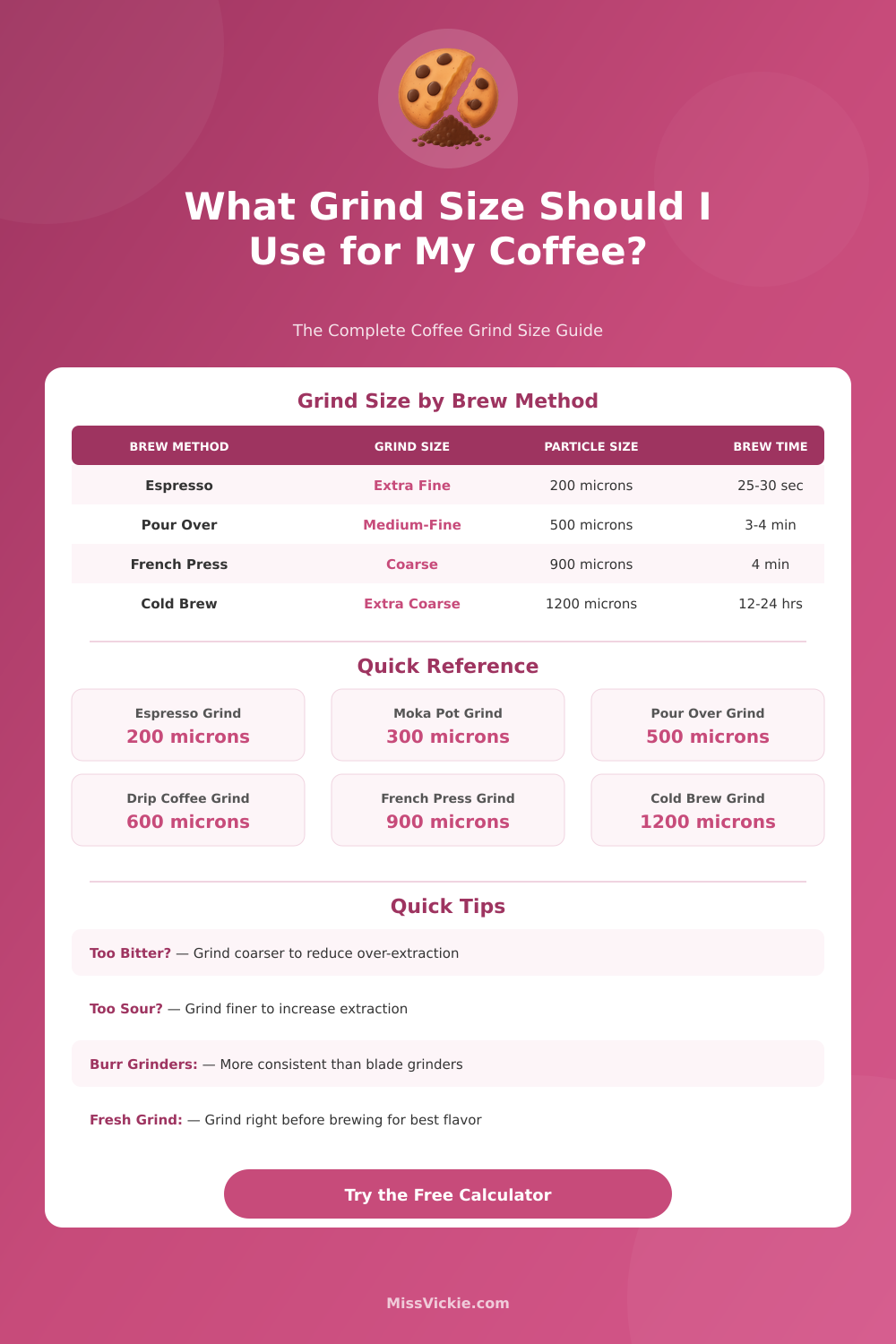
| Brew Method | Grind Size | Particle Size | Brew Time | Grinder Setting* |
|---|---|---|---|---|
| Turkish Coffee | Extra Fine (powder) | 100–200 microns | 3–5 min | 1–3 |
| Espresso | Fine | 200–300 microns | 25–30 sec | 3–6 |
| Moka Pot | Fine-Medium | 300–400 microns | 5–7 min | 5–8 |
| AeroPress (espresso style) | Fine-Medium | 300–500 microns | 1–2 min | 5–10 |
| Pour Over (V60, Chemex) | Medium-Fine | 400–600 microns | 3–4 min | 8–14 |
| Drip / Auto Drip | Medium | 500–700 microns | 5–8 min | 10–16 |
| AeroPress (standard) | Medium | 500–700 microns | 2–3 min | 10–15 |
| French Press | Coarse | 800–1000 microns | 4 min | 18–24 |
| Cold Brew | Extra Coarse | 1000–1400 microns | 12–24 hrs | 22–28 |
*Setting ranges are approximate for a typical 40-step burr grinder. Consult your grinder's manual for exact settings.
| Symptom | Cause | Fix | Direction |
|---|---|---|---|
| Bitter, harsh taste | Over-extracted | Grind coarser | → Coarser |
| Sour, weak, watery | Under-extracted | Grind finer | → Finer |
| Astringent, dry finish | Too fine / too hot | Grind coarser, lower temp | → Coarser |
| Flat, no flavor | Stale beans or too coarse | Grind finer, fresher beans | → Finer |
| Espresso runs too fast | Grind too coarse | Grind finer by 1–2 clicks | → Finer |
| Espresso runs too slow | Grind too fine | Grind coarser by 1–2 clicks | → Coarser |
| French press is muddy | Grind too fine | Grind coarser, steep less | → Coarser |
| Pour over drains too fast | Grind too coarse | Grind finer by 1 step | → Finer |
| Grind Category | Microns | Visual Texture | Best For |
|---|---|---|---|
| Extra Fine (powder) | 100–200 µm | Finer than flour | Turkish coffee |
| Fine | 200–400 µm | Like table salt | Espresso, Moka pot |
| Medium-Fine | 400–600 µm | Like fine sand | Pour over, AeroPress |
| Medium | 500–700 µm | Like coarse sand | Drip, flat bottom |
| Medium-Coarse | 700–900 µm | Like rough sand | Chemex, Clever Dripper |
| Coarse | 800–1000 µm | Like coarse sea salt | French press |
| Extra Coarse | 1000–1400 µm | Like peppercorns | Cold brew, cowboy coffee |
Grind size is one of those things that makes or breaks your coffee. It simply shows how big or small are the grind particles and it matters much more than many folks know. Fine grind beans show more surface for water which helps to quickly extract the taste.
Coarse sizes slow the process. Hence espresso machines require a fine grind, water flows through it under extremely high pressure and must grab everything fast
Why Coffee Grind Size Matters
Grind whole beans simply to break them into small bits so that water can reach the good stuff inside. Think about that as how cake batter mix works. You cannot simply mix random bits and expect the same result.
There are several grind sizes that are good to know. Coarse sizes look roughly like kosher salt or ground peppers. Medium size looks like granulated sugar and works well for drip coffee.
Then comes medium-coarse size, that looks like rough sand and works well with Chemex or flat filter. Espresso requires much finer. Turkish coffee?
Here you use powder size that sinks down and forms a thick sediment deposit.
Espresso has a truly narrow window. Because the machine pushes water through the grounds in such high pressure, even a little change in size can cause over or under extraction more quickly than other methods. Low-pressure modes, as French press, benefit from coarse sizes and longer contact.
Light roasts well tolerate more fine grind, while dark roasts favor coarse size.
When buying grinders, you have two main types. Blade grinders are the cheap; fast and small. Problem is, that they cut beans unevenly, what gives different particles and inconsistent results.
Burr grinders work carefully, passing beans through the mechanism to give uniform sizes always. You adjust the size according to need, coarse for immersion methods, fine for espresso. Pace also matters: low paces avoid warming, what helps to preserve the freshnes of the grind.
Freshness truly cannot be ignored. In the moment when you open the package of beans, oxidation starts. Grind and brew together as soon as possible makes a big difference in the taste.
Pre-ground coffee commonly cause problems depending on the method. In French press it can lead to over extraction and bitter taste. However immersion methods are a bit more forgiving regarding grind-consistency and particle expansion.