How Much Coconut Oil to Melt Chocolate Calculator
Estimate the coconut oil needed for melted chocolate based on chocolate weight, chocolate style, dipping goal, room temperature, and how glossy or snappy you want the finish.
Pick a common kitchen use to load a practical starting ratio. You can still adjust every field before calculating.
Full Breakdown
| Chocolate Use | Starting Oil Ratio | Per 100 g Chocolate | Best Texture Target |
|---|---|---|---|
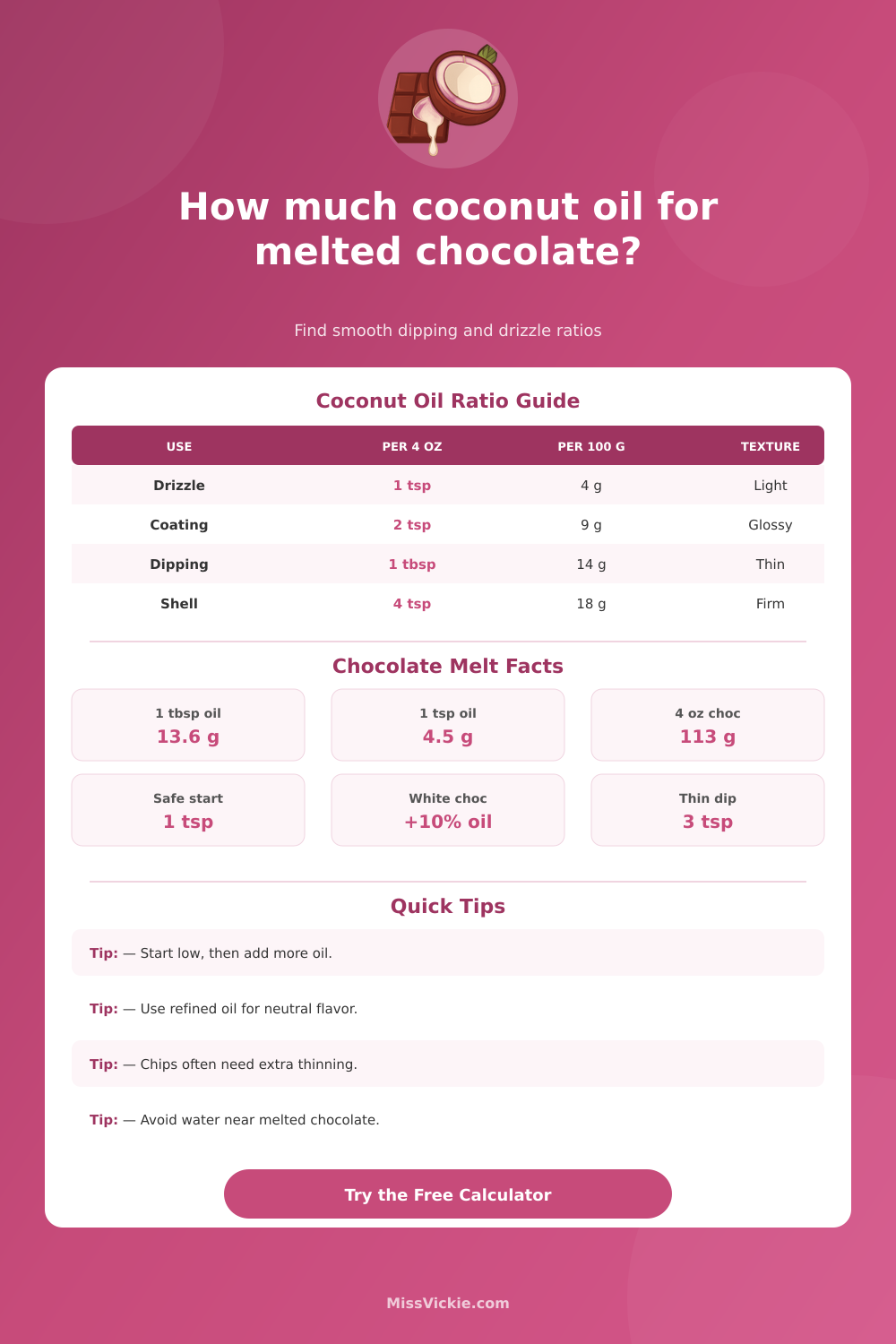
| Fine drizzle over cookies or fruit | 1 teaspoon per 4 ounces chocolate | About 4 g coconut oil | Fluid enough for lines, still sets fairly firm |
| Glossy coating for pretzels or clusters | 2 teaspoons per 4 ounces chocolate | About 8 g coconut oil | Smooth coating with moderate snap |
| Dip for strawberries, cookies, or bananas | 1 tablespoon per 4 ounces chocolate | About 12 g coconut oil | Thin, even dip that covers quickly |
| Ice cream shell or very thin coating | 4 teaspoons per 4 ounces chocolate | About 16 g coconut oil | Fast-setting shell when chilled |
| Bark base with nuts or dried fruit | 1 to 2 teaspoons per 4 ounces chocolate | About 4 to 8 g coconut oil | Spreadable base that still breaks cleanly |
| Chocolate Type | Oil Adjustment | Why It Changes | Best First Move |
|---|---|---|---|
| Dark baking bar | Baseline | Usually melts cleanly because it has fewer stabilizers | Add oil slowly after the chocolate is mostly melted |
| Semisweet baking bar | Baseline to 5% less | Cocoa butter balance is often smooth enough for coating | Start with the calculator result, then thin only if needed |
| Milk chocolate | 5% less oil | Milk solids soften the set and the melt usually flows easily | Use the conservative rounding style for firmer pieces |
| White chocolate | 10% more oil | It thickens easily and is sensitive to overheating | Melt gently, then stir in oil off the heat |
| Chocolate chips | 10% to 18% more oil | Chips are made to hold shape and can stay thick | Use short heat bursts and stir longer before adding extra |
| Candy melts or wafers | 15% less oil | They are already built for smooth coating | Use only enough oil to loosen the dip |
| Coconut Oil Measure | Approx Grams | Approx Milliliters | Kitchen Use |
|---|---|---|---|
| 1/2 teaspoon | 2.3 g | 2.5 ml | Small adjustment for glossy drizzle |
| 1 teaspoon | 4.5 g | 4.9 ml | Good first addition for 4 ounces chocolate |
| 2 teaspoons | 9.1 g | 9.9 ml | Balanced coating for pretzels or clusters |
| 1 tablespoon | 13.6 g | 14.8 ml | Thin dipping chocolate for fruit |
| 2 tablespoons | 27.2 g | 29.6 ml | Large batch shell or very fluid coating |
| Chocolate Amount | Drizzle Start | Coating Start | Dipping Start |
|---|---|---|---|
| 2 oz / 57 g | 1/2 tsp | 1 tsp | 1 1/2 tsp |
| 4 oz / 113 g | 1 tsp | 2 tsp | 1 tbsp |
| 8 oz / 227 g | 2 tsp | 1 tbsp plus 1 tsp | 2 tbsp |
| 12 oz / 340 g | 1 tbsp | 2 tbsp | 3 tbsp |
| 1 lb / 454 g | 4 tsp | 2 tbsp plus 2 tsp | 4 tbsp |
Use the lowest oil ratio when you want lines that firm up and do not feel slick at room temperature.
A middle ratio gives pretzels, clusters, and bark enough gloss without making the chocolate too soft.
Fruit and cookies coat more evenly with a thinner mix, especially when the chocolate is in a deep narrow cup.
More coconut oil makes a fluid shell that sets quickly on cold desserts but softens faster in warm rooms.
Chocolate tends to become thick and difficult to use when attempting to melt the chocolate. The structure of the cocoa butter within chocolate make it stiff when melted. Adding coconut oil to chocolate melts more smoothly.
The coconut oil add fat to the chocolate that loosens the structure of the cocoa butter. If there is not enough coconut oil, the chocolate will remain thick. However, if there is too much coconut oil, the chocolate will become greasy and fail to set.
How to Use Coconut Oil to Melt Chocolate
The amount of coconut oil that you add to chocolate depend on the use of that chocolate. If you will use the chocolate to drizzle thin lines over cookies, there needs to be very little coconut oil. If you will use the chocolate to coat desserts like strawberries or pretzels, there will need to be more coconut oil.
If the chocolate will be used in ice cream shells, there will need to be the most coconut oil because the chocolate shells need to remain fluid until they hit something cold. These different amounts of coconut oil is needed because the amount of coconut oil determine the flow of the chocolate once melted and how firmly it will set once cooled. The type of chocolate that is used will impact how much coconut oil is used in melting the chocolate.
Dark baking chocolate melts very cleanly so it will require the least amount of coconut oil. Milk chocolate contains some of the milk solids that make the chocolate softer, so a smaller amount of coconut oil will be needed. White chocolate tends to thicken quickly when too warm so a modest amount of coconut oil will be stirred in once melted.
Chocolate chips contain stabilizers that help the chips maintain their shape so they will require more coconut oil and more patience in stirring them up. The temperature of the kitchen will impact chocolate once coconut oil is added. In a cool kitchen, the chocolate will set faster and feel firmer with a moderate amount of coconut oil.
In a warm room, the chocolate will remain softer for a longer period of time. A warm kitchen may be desirable when dipping desserts in chocolate but frustrating when attempting to make a drizzle of chocolate that sets to create clean lines. Using a calculator will allow you to calculate the correct amount of coconut oil for any recipe that uses melted chocolate.
Many people use coconut oil to fix chocolate that has seized. Seized chocolate is chocolate that has thickened to the point of being difficult to use. Adding a small amount of coconut oil can fix this problem.
The added fat will loosen the structure of the cocoa butter that has seized. Adding liquid will make the chocolate seize, so adding coconut oil instead is a helpful technique. This technique is useful for fixing older chocolates or chocolates stored in a humid environment.
While the fat will not fix every chocolate problem, adding coconut oil will help fix the texture problem of seized chocolate. Whether you are doing a single-dip or a double-dip project, you will need to alter the amount of coconut oil based off the number of dips you will do. For a double-dip project, you will need to increase the amount of coconut oil because the chocolate will contain more oil after two dips than it would of otherwise.
This is the same for cake pops or chocolate clusters because these treats are double-dipped in chocolate. Coconut oil changes the way the chocolate will behave when served. Chocolate that is drizzled over cookies needs to be firm enough to hold its shape.
However, ice cream shells dont need to be as firm because the ice cream will be consumed while it is cold. Therefore, the decision of how the chocolate will be served will help inform the amount of coconut oil to use in the melted chocolate. A reference table will help you understand how much coconut oil to add to what kind of chocolate for different served forms of chocolate.
A small amount of coconut oil will help change the behavior of melted chocolate. Adding one or two teaspoons of coconut oil to four ounces of chocolate will change the behavior of the chocolate. This amount of coconut oil will create a melted chocolate that melts in the mouth but will not become a soft ganache.
Using the calculator will allow you to avoid adding too much coconut oil to the chocolate. Coconut oil has a melting point that is lower than that of cocoa butter. If you add the coconut oil too soon, the chocolate may become too loose before all of the chocolate has melted.
If you melt the chocolate first and then add the coconut oil, the ratio of chocolate to coconut oil will be easier to judge. This method also will prevent you from overheating the chocolate. Overheating the chocolate will result in dull chocolate streaks.
Depending on what kind of coconut oil you use will change the flavor of the chocolate. If you use refined coconut oil, it will not change the flavor of the chocolate. However, if you use virgin coconut oil, it will add a light flavor of coconut to the chocolate that may or may not suit all desserts.
Lastly, if you use liquid coconut oil, it will mix in easily with the chocolate but may make the chocolate too soft once it sets. Other fats can be used in place of coconut oil. However, the butter will change the flavor and the setting of the chocolate.
Using vegetable oil will also make the chocolate too soft. Coconut oil melts quickly in the mouth and remains solid at cool room temperatures, making it the perfect fat to use for melting chocolate. Additionally, because coconut oil melts quickly in the mouth, it preserves the snap of the chocolate.
Using the correct ratio of coconut oil to chocolate makes working with chocolate easier. You will have more control over dipping, drizzling, or spreading the chocolate on desserts. Understanding why each of the mentioned inputs impact chocolate will aid you in understanding similar projects in the future.