Cocoa Powder for Ice Cream Calculator
Estimate cocoa powder for an ice cream base by balancing dairy volume, fat percentage, sugar, cocoa type, bloom liquid, chocolate intensity, churn loss, stabilizer, and freezer texture.
Pick a base style, then adjust cocoa strength, sugar, bloom liquid, churn loss, and stabilizer for your own machine and freezer.
Batch Breakdown
| Cocoa Type | Typical Fat | Ice Cream Effect | Best Sugar Cue |
|---|---|---|---|
| Natural cocoa | 10% to 12% | Sharp, fruity, lighter color | Add 0.5% to 1% sugar if very bitter |
| Dutch-process cocoa | 10% to 12% | Rounder chocolate, darker base | Classic sugar works well |
| High-fat cocoa | 20% to 24% | Smoother mouthfeel, less dry finish | Can hold darker intensity |
| Black cocoa | 8% to 10% | Deep cookie color, low chocolate aroma | Use with extra sugar or vanilla |
| Raw cacao powder | 12% to 14% | Fruity, tannic, slightly gritty if unbloomed | Needs careful blooming |
| Alkalized blend | 10% to 14% | Dark color with rounded bitterness | Works at 5% to 6% |
| Base Style | Fat Range | Sugar Range | Cocoa Range |
|---|---|---|---|
| Philadelphia ice cream | 9% to 14% | 14% to 17% | 3.5% to 5.5% |
| Custard ice cream | 10% to 16% | 15% to 18% | 4% to 6% |
| Gelato style | 4% to 8% | 17% to 20% | 4.5% to 6.5% |
| Protein ice cream | 1% to 6% | 6% to 14% | 2.5% to 4.5% |
| Coconut milk base | 9% to 17% | 14% to 18% | 4% to 6% |
| Soft serve mix | 4% to 8% | 15% to 18% | 3% to 4.5% |
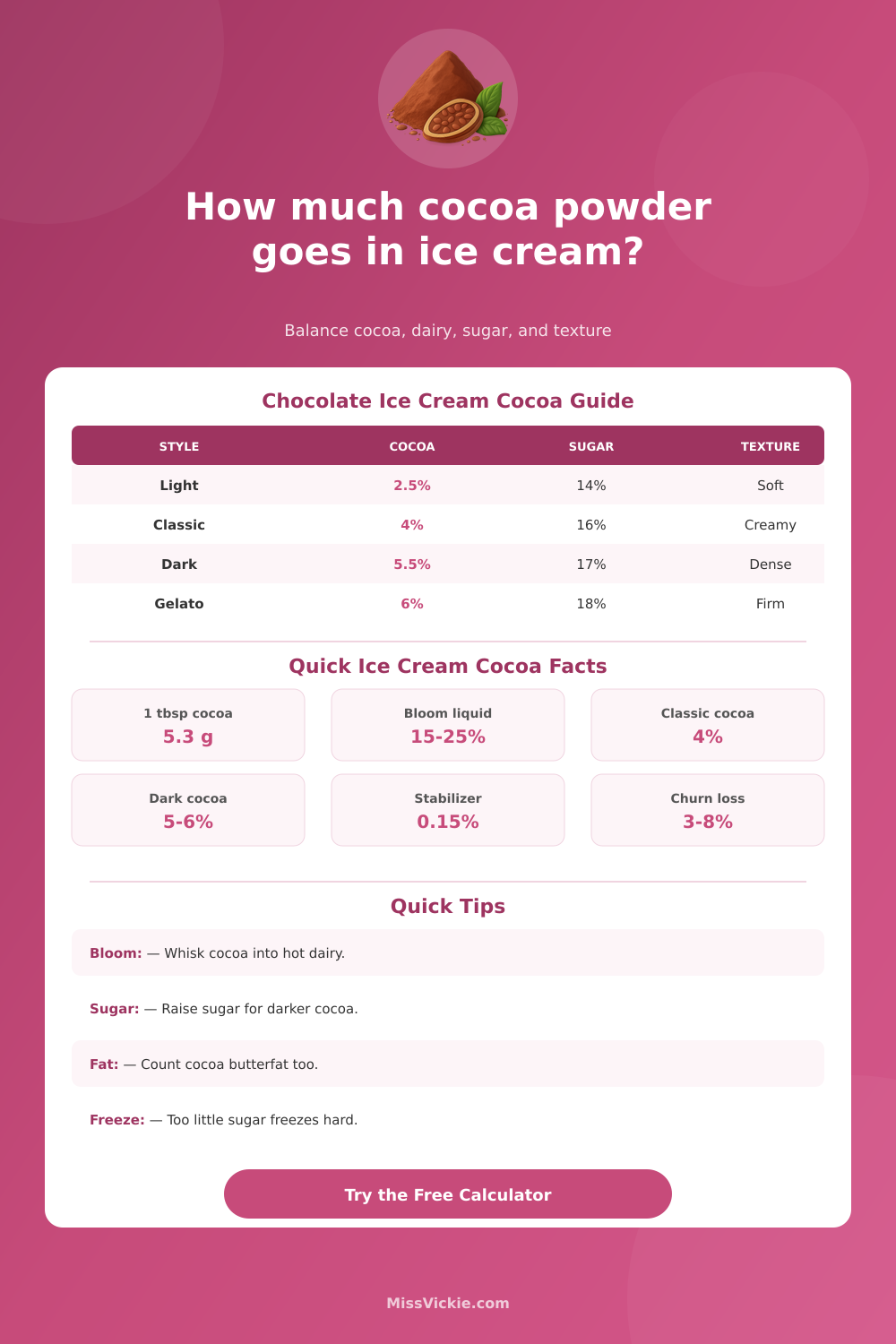
Classic 4% cocoa, about 3.6 tablespoons.
Classic 4% cocoa, bloom in about 190 ml hot dairy.
Classic 4% cocoa with 160 g to 170 g sugar.
Classic 4% cocoa before churn loss and transfer loss.
Making chocolate ice cream require an understanding of how cocoa powder interacts with fat, sugar, and water in the ice cream base. Cocoa powder is more than just a source of flavor in chocolate ice cream. Cocoa powder is a dry matter that absorbs the liquid and add fat to the mix.
The type and amount of cocoa powder that you use will change the freezing of the base. Therefore, you must control the amount of cocoa powders that you use in your chocolate ice cream to achieve the proper texture. Many recipes contains guesses as to the amount of cocoa powder that should be used in the base.
How cocoa powder affects chocolate ice cream
Using too much or too little cocoa powder can lead to poor texture and flavor. You must determine the amount of cocoa powder that your dairy base can take before you must add more sugar or raise the serving temperature of your ice cream to balance the flavor. The cocoa powder will absorb some of the liquid in the chocolate ice cream mixture.
Therefore, how you add the cocoa powder to the mixture will change the texture of your chocolate ice cream. The chocolate ice cream calculator allows you to enter the volume, fat level, sugar target, and cocoa powder type at the calculator to determine the proper amount of each ingredient. Each ingredient impact the final flavor of your chocolate ice cream.
High-fat ice cream bases can take more cocoa powder than low-fat bases because the fat will help keep the base from drying out. Additionally, the type of cocoa powder will change the flavor of your chocolate ice cream. Cocoa powder with high bitterness will require more sugar to balance the flavor.
The calculator will also show you the amount of hot liquid your base will require to bloom the cocoa powder, which will activate the cocoa powder so that you can mix it into your base. Blooming cocoa powder is necessary because dry cocoa powder will clump when drop into cold dairy products. The clumps of cocoa powder will not dissolve when mixed into the base and will create a dusty texture to your ice cream.
To bloom cocoa powder, heat some of the dairy and whisk in the cocoa powder until it is glossy. Allow this mixture to chill while you continue churning your base. This blooming process will produce a texture to your chocolate ice cream that is much more smoother and flavorful than if you bloomed it.
The calculator will estimate the amount of liquid for blooming so that you do not thin out your base too much and so that you do not take up too much room for other ingredients. The sugar content in your base will change the freezing point of your chocolate ice cream. A higher percentage of sugar will create a lower freezing point for your base.
This is critical with chocolate ice creams with a high amount of cocoa powder because cocoa powder will create hard ice cream. If you increase the amount of cocoa powder in your base without increasing the amount of sugar, the result will be a chocolate ice cream that is as hard as a brick when taken out of the freezer. The calculator will warn you of a high chance of setting your chocolate ice cream too hard and provide options to fix the problem.
The solids in your ice cream such as stabilizers, milk powder, and protein will thicken the base. However, if you use too much cocoa powder to your base, these solids can create a pasty texture to your chocolate ice cream. Using these solids in your chocolate ice cream base can be accounted for in the calculator to determine the proper amount of each solid for a realistic final product.
Additionally, when churning your base, some of the mixture will remain in your churn machine. The calculator accounts for this loss in the base, allowing it to accurately calculate the amount of chocolate ice cream you will finally produce. Depending on the temperature of your freezer, the chocolate ice cream may freeze to a particular texture.
If your freezer is very cold, the ice cream will become firm. Because chocolate ice cream contains a form of cocoa powder, it is quite sensitive to the freezing temperatures. You must enter the serving temperature of your chocolate ice cream into the calculator so that the warning regarding texture will accurately reflect the conditions of your specific freezer.
Once you have used the calculator to determine the proper amount of each ingredient, you can begin churning your chocolate ice cream base. Before churning the base, taste it to determine if the bitterness of the cocoa powder is to your liking. If not, add more salt or vanilla flavoring to your base.
Additionally, make sure the base is thoroughly chilled before churning. The first scoops of chocolate ice cream will be the softest when scooped from the freezers, but the ice cream will continue to set. Therefore, plan to serve your chocolate ice cream at a higher temperature than vanilla ice cream.
Following these steps will result in a batch of chocolate ice cream that has a creamy texture with a rounded flavor.