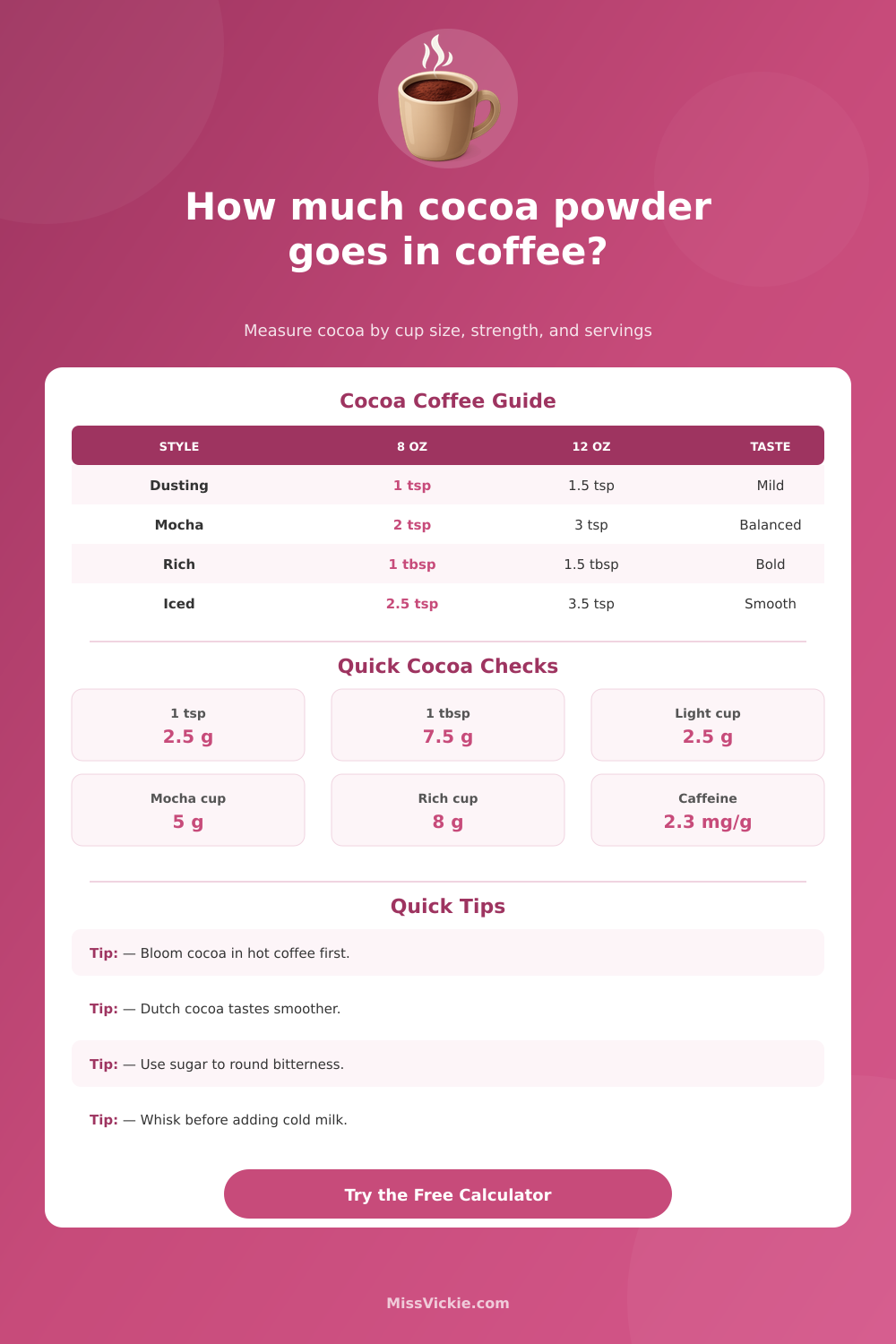
Cup size, cocoa type, spoon density, mocha strength, servings, milk, sweetness, and cocoa solids
How Much Cocoa Powder in Coffee Calculator
Calculate cocoa powder for coffee by grams, teaspoons, tablespoons, cocoa style, drink size, cup count, milk balance, and desired chocolate intensity.
Choose a starting style, then fine tune cup size, cocoa type, spoon measure, milk, sweetness, and serving count.
Full Cocoa Coffee Breakdown
About one level teaspoon; bright chocolate, noticeable bitterness, easy to mix when bloomed.
Slightly lighter per teaspoon; smoother flavor, good for low-sugar mocha coffee.
Fruitier and sharper; often tastes stronger than the same gram weight of Dutch cocoa.
Heavier per teaspoon because sugar and milk solids are included; less pure cocoa per spoon.
| Chocolate Goal | Grams Per 8 fl oz | Teaspoons Natural Cocoa | Best Coffee Use |
|---|---|---|---|
| Light dusting | 2 to 3 g | About 1 tsp | Black coffee, drip coffee, subtle cocoa aroma |
| Gentle cocoa coffee | 3.5 to 4 g | About 1.5 tsp | Small milk splash, lower sweetness, everyday cup |
| Balanced mocha | 5 to 6 g | About 2 tsp | Most 8 to 12 oz coffee drinks with milk |
| Rich chocolate coffee | 7 to 8.5 g | About 1 tbsp | Lattes, cold brew, strong espresso-based drinks |
| Dessert-style mocha | 10 to 12 g | About 1.5 tbsp | Sweetened large drinks, blended drinks, whipped toppings |
| Cocoa Type | 1 Level Teaspoon | 1 Level Tablespoon | Notes For Coffee |
|---|---|---|---|
| Natural unsweetened cocoa | 2.5 g | 7.5 g | Standard conversion for most recipes and mocha math |
| Dutch-process cocoa | 2.3 g | 6.9 g | Smoother taste; slightly less dense in many kitchens |
| Black cocoa powder | 2.2 g | 6.6 g | Very intense color; use less unless sweetened well |
| Raw cacao powder | 2.4 g | 7.2 g | Sharper flavor; works well with milk and syrup |
| Sweetened hot cocoa mix | 4.0 g | 12.0 g | Contains sugar; cocoa solids are much lower per spoon |
| Batch | Light Cocoa | Balanced Mocha | Rich Cocoa Coffee |
|---|---|---|---|
| 1 cup, 8 fl oz | 2.5 g, 1 tsp | 5 g, 2 tsp | 7.5 g, 1 tbsp |
| 2 cups, 8 fl oz each | 5 g, 2 tsp | 10 g, 4 tsp | 15 g, 2 tbsp |
| 4 cups, 8 fl oz each | 10 g, 4 tsp | 20 g, 8 tsp | 30 g, 4 tbsp |
| 8 cups, 8 fl oz each | 20 g, 8 tsp | 40 g, 16 tsp | 60 g, 8 tbsp |
| 12 cups, 8 fl oz each | 30 g, 12 tsp | 60 g, 24 tsp | 90 g, 12 tbsp |
| Measure | Calories | Fiber | Caffeine And Theobromine |
|---|---|---|---|
| 1 tsp natural cocoa, 2.5 g | 6 cal | 0.8 g | 6 mg caffeine, 51 mg theobromine |
| 2 tsp natural cocoa, 5 g | 11 cal | 1.7 g | 12 mg caffeine, 103 mg theobromine |
| 1 tbsp natural cocoa, 7.5 g | 17 cal | 2.5 g | 17 mg caffeine, 154 mg theobromine |
| 2 tbsp natural cocoa, 15 g | 34 cal | 5.0 g | 35 mg caffeine, 309 mg theobromine |
| Hot cocoa mix, 12 g | 45 cal | 0.8 g | Lower cocoa, higher sugar contribution |
When your mug of steaming dark liquid sit on the counter waiting for you to stir in some cocoa powder, and you’re asking yourself, “Is it going to be a real mocha? Or is it just going to look a little bit brown, but still be mostly coffee?” More often than we let on, that doubt exists. Unlike hot cocoa mixes or even chocolate syrup, which can be adjusted for consistency, cocoa powder act differently; every sip after adding milk reveals its differences.
Learning how much of each ingredient matters isnt so much about nailing perfection as it is understanding exactly what effect it has on the finished beverage. Of course, it’s not just about the cocoa. It’s also about the relationship between the cocoa and the coffee volume, your choice of milk, and what you hope to achieve: Is this going to be a drink you consume during your daily commute?
How much cocoa to add to your coffee
Will it be as sweet and thick as a sundae? Or is it something more like a latte, light enough to get you through a hectic day but not so mild as to leave you feeling unfulfilled? When cocoa is processed, its density varies.
Naturaly processed cocoa tends to be brighter (more acidic) in taste, meaning it needs a bit of added sweetness or milk to balance out. The acidity of dutch-process cocoa has already been lowered, so for the same amount of cocoa mass, it’s smoother tasting and can take slightly more as a whole without getting bitter. Raw cacao falls somewhere in the middle, with an often fruitier edge that some people love but others finds sharper in a hot beverage.
But it’s not just about flavor. It does influence how much you can get away with adding without making the drink seem dry and medicinal. Milk does something to the equation all at once: it both softens out the bitterness and helps thin out the coffee itself, meaning you may have to add more cocoa than your simple black coffee calculation might predict.
But because we take into account how much milk you’ve added, by making an adjustment to the actual amount of cocoa needed, the calculator knows that when you’re a heavy cream-in-your-mocha kind of gal, you’ll need to bump up the cocoa a bit from where your basic black coffee calculations would have led you. The way sweetness is used is similar. Adding just enough sugar smooths out any sharpness and makes a higher concentration of cocoa feel like it’s intended, as opposed to overpowering.
With too little sugar and too much cocoa, the drink can feel medicinal. Too much sugar and not enough cocoa, and you’ll end up with something closer to a milkshake than a coffee drink. Simply turning the sweetness knob on the tool ups or downs what would otherwise be an effective cocoa load based on how sweet you plan to finalize the cup.
Another factor: Batch size. You’re tempted to scale-up from one serving to a few cups; this works OK for smaller batches, but when making 8-10 cups, the tiny rounding errors can add up. A.5 teaspoon difference per cup adds up to a couple of teaspoons over a pot, which will show up in the first cup just as much as the last.
The calculator allows you to input number of cups served, with the total taking into account batch size, as opposed to having to do your own multiplication. How you measure cocoa matters more than you think it does. Because cocoa is light and fluffy, you’ll notice the difference between a leveled teaspoon and a heaped one when you’re doing multiple servings of the same thing.
And whether you want to weigh things out or scoop, some people just like the idea of knowing exactly what’s going into their coffee: If you’re making the same drink every day, weighing it out consistently might be preferable. But others simply think scooping with a spoon works well enough and saves time; the tool allows you to do whichever way you’d like while also showing you both the amount in grams and how much it is in spoon, so you can figure out which one makes sense to you in your own kitchen. But there’s one thing the numbers cant quite quantify: How you’re working the cocoa into the coffee.
If you just pour hot water over dry cocoa, you’ll end up with dry clumps here and there that won’t ever really break down, blooming it instead (adding a bit of your hot coffee to wet the cocoa until glossy, then pouring in the rest) will smooth things out using the same amount of powder. And some folks like mixing their cocoa with a bit of syrup or sugar prior to adding any liquid, speeding its integration further. These small tweaks don’t affect how much cocoa goes in the beverage, but they do impact how that cocoa comes across in the final product.
It’s there for those who track their tolerance to bitterness, theobromine (an ingredient in chocolate), or simply how much fiber they can take before their stomach hurt. Chocolate contains both caffeine and theobromine in significant quantities; some folks start feeling its effects at higher levels than others. It’s an option, not required.
But rather than try to judge whether this batch is too much or just right, it offers an easy way to see if your limits are being crossed today. The thing that counts isnt what other people prefers; it’s whether or not you’re happy with the way things taste for yourself. Use the calculator as more of an easy reference to help you dial in what works best for you, rather than something you use to make decisions.
The inputs are no longer variables, but instead become a personal recipe. It’s when this happens that the entire process turns from guessing to something you can do again without even giving it a second thought.