🍸 Cocktail Dilution Calculator
Calculate dilution %, final ABV, and water added for stirred, shaken, or batched cocktails
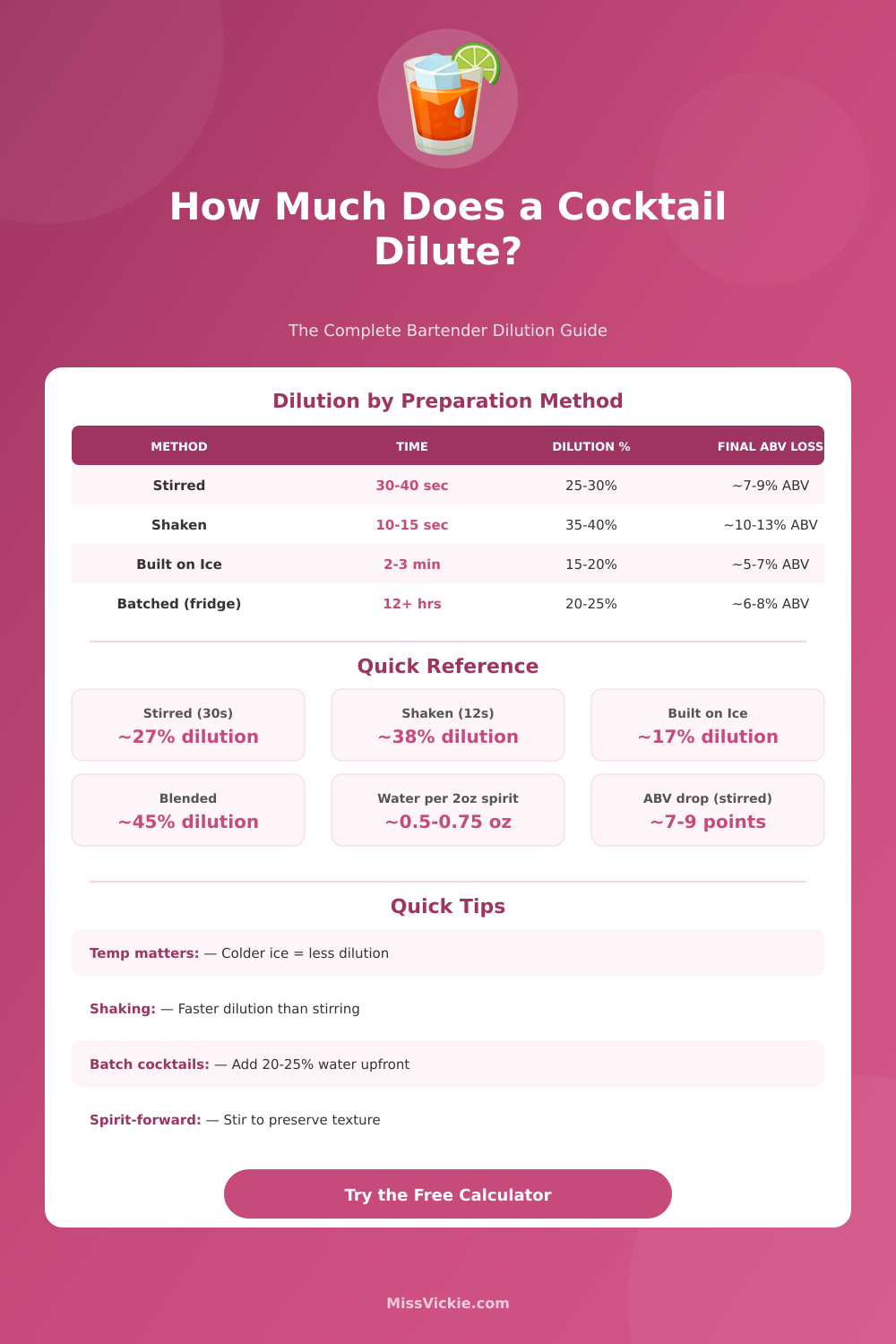
| Method | Typical Time | Dilution % | Notes |
|---|---|---|---|
| Stirred (cubed ice) | 30-40 sec | 25-30% | Smooth, silky texture |
| Stirred (large ice) | 40-50 sec | 20-25% | Slower melt, less dilution |
| Shaken (cubed ice) | 10-15 sec | 35-40% | Aerated, colder result |
| Shaken (crushed ice) | 8-12 sec | 40-50% | Very fast dilution |
| Built on ice | 2-3 min | 15-20% | Gradual, guest-controlled |
| Blended / Frozen | 20-30 sec | 40-50% | High dilution from ice |
| Batched (pre-diluted) | N/A | 20-25% | Add water before chilling |
| Rolled / Thrown | 15-25 sec | 28-34% | Between stir and shake |
| Dilution % | Water Added | Final Volume | Final ABV |
|---|---|---|---|
| 15% | 0.35 oz (10 ml) | 2.35 oz (70 ml) | ~34% |
| 20% | 0.5 oz (15 ml) | 2.5 oz (74 ml) | ~32% |
| 25% | 0.67 oz (20 ml) | 2.67 oz (79 ml) | ~30% |
| 30% | 0.86 oz (25 ml) | 2.86 oz (85 ml) | ~28% |
| 35% | 1.08 oz (32 ml) | 3.08 oz (91 ml) | ~26% |
| 40% | 1.33 oz (39 ml) | 3.33 oz (99 ml) | ~24% |
| 45% | 1.64 oz (48 ml) | 3.64 oz (108 ml) | ~22% |
| 50% | 2.0 oz (59 ml) | 4.0 oz (118 ml) | ~20% |
| Ice Type | Surface Area | Dilution Rate | Best For |
|---|---|---|---|
| Standard Cubed (1") | Medium | Moderate | Most cocktails |
| Large Format / Block (2"+) | Low | Slow | Spirit-forward stirs |
| Crushed Ice | Very High | Very Fast | Juleps, swizzles |
| Ice Sphere (2.5") | Lowest | Slowest | Whiskey on the rocks |
| Pebble / Nugget Ice | High | Fast | Highballs, tropical |
Dilution occur in the process of adding water to a cocktail through the melting of ice. Dilution is a necessary component of cocktail preparations because dilution help to balance the alcohol content of the cocktail. When you prepare a cocktail with ice, that ice will melt and add water to the cocktail.
This water change the volume and the alcohol by volume of the cocktail. If there isnt enough dilution of the cocktail, the cocktail will contain too much alcohol for the flavors of the cocktail. However, if there is too much dilution of the cocktail, the cocktail will taste watery.
How Ice Melting Changes a Cocktail
The method in which a person prepares a cocktail will impact the amount of dilution that occur in the cocktail. If you stir a cocktail with ice for approximately 30 seconds, the ice melt at a relatively slow rate, and the bartender will stir the cocktail to provide a smooth texture to the cocktail. If a cocktail is shaken with ice, however, the shaking will occur at a faster rate then stirring.
Additionally, shaking break the ice into smaller pieces. Smaller pieces have more surface area, which allow for more dilution to occur. Additionally, shaking cocktails also introduces air into the cocktail, which form foam.
However, the increased amount of surface area of the ice during shaking causes the dilution to often reach 35 percent of total volume of the cocktail. The type of ice that is used to prepare a cocktail will also impact the amount of dilution of the cocktail. Ice in standard sizes has a relatively even rate of melting and contributes to the dilution of the cocktail at a moderate rate.
Large ice cubes and ice spheres melt at a slower rate, which allow for the cocktail to retain some of the strength of the spirit. Crushed ice have a high surface area relative to the size of the ice, which allow for the crushed ice to melt rapidy. Thus, crushed ice produces a high amount of dilution for cocktails with crushed ice.
Additionally, the type of ice that is to be used will dictate the amount of water that will enter the cocktail during the preparation of the cocktail. The alcohol by volume (ABV) for cocktails is a measurement of the strength of the cocktail. Most spirit contain 40 percent ABV.
However, cocktails will have a lower ABV than spirits due to the dilution from the melting of ice. The optimal ABV for cocktails is between 25 and 30 percent. An ABV that is too low will produce a cocktail that contain too much water.
An ABV that is too high will overwhelm the flavors of the cocktail. Batching cocktails requires a different preparation than cocktails that are stirred or shaken with ice. When you prepare batch cocktails, no alcohol is stirred or shaken with ice.
Therefore, water must be added to mimic the flavor of melting ice. You should add water to the batch cocktails to an amount of 20 to 25 percent of the volume of the spirits to be used in the batch cocktail. Additionally, the water should be filtered water and refrigerated prior to the batch cocktail preparation.
The temperature of the ingredients and the cocktail will impact the dilution of the cocktail. Ice melt at a faster rate if it is warmer than if it is colder. Additionally, using warm glassware for serving cocktails will raise the temperature of the cocktail.
Therefore, chilling ingredients and glassware prior to preparation or serving of cocktails is recommended. A calculation tool can be used to calculate the exact amount of dilution to be used in preparing cocktails. The calculation tool will ask for the initial volume of the spirits to be used, the ABV of the spirits, and the type of ice that is to be used in the cocktail.
The tool will calculate the final volume and ABV that will result from the cocktail. This information is helpful in determining the impact that preparation methods will have on the cocktail. For instance, if there are 500 ml (half a liter) of 40 percent ABV liquor and crushed ice is used in the preparation, the resulting ABV will be approximately 30 percent.
Additionally, if calculations are performed in advance of the preparation of cocktails, host bartenders could of avoided any mistake in preparation.