Cinnamon Roll Calculator
Scale cinnamon rolls by finished roll count, pan size, dough weight, sheet dimensions, butter-sugar-cinnamon filling ratio, spiral thickness, proof time, bake temperature, icing amount, and expected yield loss.
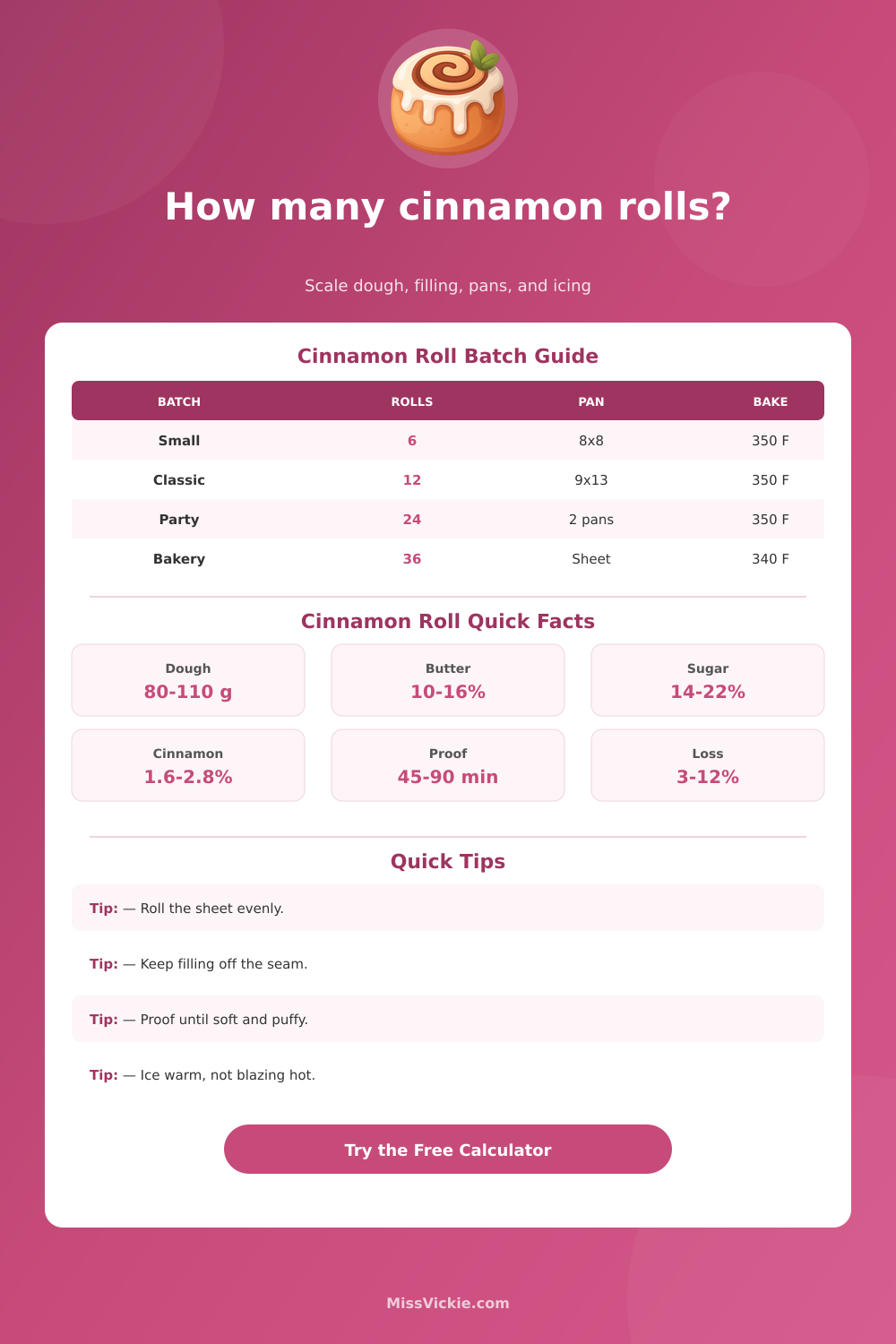
Choose a real bake plan to load roll count, pan size, dough weight, sheet dimensions, filling style, proof timing, bake temperature, icing amount, and yield loss.
Batch Breakdown
| Roll Style | Dough Per Roll | Typical Pan | Cut Thickness | Bake Cue |
|---|---|---|---|---|
| Mini brunch rolls | 45 to 60 g dough each | 12 to 18 in a 9 x 13 pan | 0.9 to 1.1 in | Centers set, edges lightly golden |
| Classic home rolls | 80 to 100 g dough each | 9 to 12 in a 9 x 13 pan | 1.25 to 1.6 in | Soft sides, golden tops |
| Large bakery rolls | 120 to 160 g dough each | 6 to 8 in a 9 x 13 pan | 1.75 to 2.3 in | Deep golden edges, tender middle |
| Pull-apart pan rolls | 70 to 95 g dough each | Close spacing with 0.4 to 0.8 in gaps | 1.2 to 1.5 in | Touching sides after proof |
| Style | Butter | Sugar | Cinnamon | Best Use |
|---|---|---|---|---|
| Light swirl | 10% of dough weight | 14% of dough weight | 1.6% of dough weight | Less sweet breakfast rolls |
| Classic | 13% of dough weight | 18% of dough weight | 2.2% of dough weight | Balanced home-style rolls |
| Bold cinnamon | 14% of dough weight | 20% of dough weight | 2.8% of dough weight | Dark, spicy spirals |
| Sticky bakery | 16% of dough weight | 22% of dough weight | 2.4% of dough weight | Rich rolls with syrupy bottoms |
| Condition | Proof Range | Bake Temp | Time Adjustment | Note |
|---|---|---|---|---|
| Warm kitchen, 78 to 82 F | 45 to 70 min | 345 to 355 F | Standard bake time | Check when rolls look puffy and relaxed |
| Cool kitchen, 68 to 72 F | 70 to 105 min | 350 to 360 F | Add 2 to 5 min if dense | Use visual proofing more than the clock |
| Overnight cold proof | 45 to 90 min after chilling | 350 F | Add 3 to 6 min if cold | Let centers lose the chill before baking |
| Large bakery rolls | 60 to 95 min | 335 to 345 F | Add 5 to 10 min | Lower heat protects the centers |
Making cinnamon rolls is a balancing act: there’s the timing (how long does it take dough to rise?), there’s the composition (what are your filling ingredients?) and then there’s the execution (will they all fit in my pan?). If you change any of those variable, everything else shift to match. A calculator will let you juggle these choices with accuracy, ensuring that your ratios stays balanced as you work on taste and consistency once baked. By taking care of all calculations along the chain for you, the tool take some arithmetic off your plate.
First big item: how much dough should be in each roll? Less dough bakes more quick and remains softer inside; more requires longer proofing and slightly lower baking temperatures to prevent a doughy interior. Next thing: the scale figures out how large your total batch will be (based off your selected goal) and resizes sheet accordingly to maintain same thickness for all slices. Depending on which ratio of width vs. Length you use, each resulting roll will have similar appearance and flavor.
How the Calculator Helps Your Baking
Ratios matter almost as much than weight. Too much filling and the layers won’t stick together; too little will make cinnamon undetectable. Those numbers is always in relation to your dough weight, so if you’re making more dough, there’s no need to guess; just adjust amount of filling accordingly. Ditto with icing: A light glaze is fine on warm rolls, but cream cheese icing needs a few minutes of cooling or it turn into a puddle. And all those variables don’t need to be remembered all at once. The calculator has your back.
It’s not just what goes into the pan but also how much and how it fit. Heavier rolls need lower heat and extra proofing so they don’t end up with doughy centers. Space them well (the plan even includes suggested pan sizes). Raw rolls that just fit will melt together as butter melts and the dough soften. Leaving a little breathing room helps the edges brown evenly instead of steaming against there neighbors.
Tables at bottom of page indicate approximate weight and cut thickness for various types of doughs. Pick your size based off the occasion, from tiny, brunch-sized rolls to something more like what you find in a bakery case. And you won’t need to test again. The second consideration is the type of dough: what you’re making also affects how to use the proofing and baking times. For example, if you make a tangzhong batch, it will go up faster than a richer brioche dough that has higher fat content, so it can handles slightly cooler temperatures. If your calculated proof time falls below or above safe range for the inputted temperature, the calculator alerts you to avoid problems such as collapsed tops or centers that don’t gets fully developed.
Until you’re cutting the end off a log and noticing rolls vanishing before your eyes, it’s hard to realize how easily yield can be lost. By including that allowance in the tool, the final tally you request is what you’ll receive. That means a more realistic ingredient list, not an optimistic one. There are so many little choices that make a big difference. You might add a touch of sugar, swap an ingredient for more thickness, or find more space on your counter to spread out pans. All of these things change the overall texture much more then a single tweak does alone. Do it once, and you’ll remember; do it every time, and you’ve made those decisions consciously, instead of accidently.
Because at the end of the day, that’s what separates the rolls that are gone by noon from the ones that still has plenty left by midafternoon. You should of used this before!