🍹 Back Sweetening Cider Calculator
Calculate exactly how much sugar, honey, or juice to add to your homemade cider
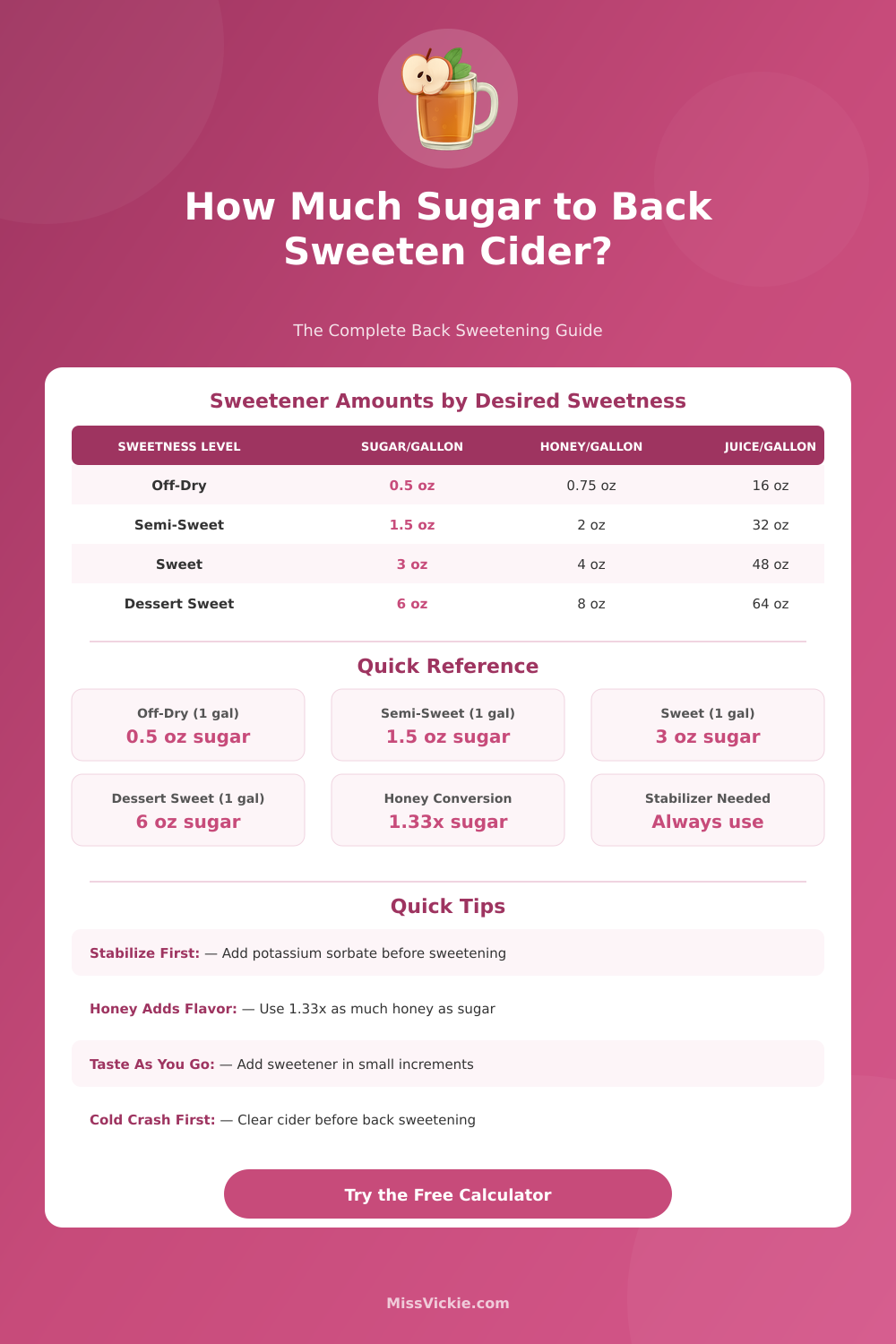
| Sweetness Level | White Sugar | Honey | Brown Sugar | Apple Juice Conc. |
|---|---|---|---|---|
| Off-Dry | 0.5 oz / 14g | 0.65 oz / 18g | 0.5 oz / 14g | 2 fl oz |
| Semi-Sweet | 1.5 oz / 43g | 2 oz / 57g | 1.5 oz / 43g | 4 fl oz |
| Sweet | 3 oz / 85g | 4 oz / 113g | 3 oz / 85g | 8 fl oz |
| Dessert Sweet | 6 oz / 170g | 8 oz / 227g | 6 oz / 170g | 16 fl oz |
| Sweetener | Relative Sweetness | Multiplier vs Sugar | Notes |
|---|---|---|---|
| White Cane Sugar | Baseline | 1.00x | Most common, neutral flavor |
| Honey | Sweeter | 1.33x | Adds floral flavor notes |
| Brown Sugar | Same | 1.00x | Adds slight molasses character |
| Apple Juice Conc. | Less sweet | ~4x volume | Reinforces apple flavor |
| Maple Syrup | Similar | 1.25x | Adds distinct maple flavor |
| Xylitol | Similar | 1.00x | Non-fermentable, safe for keg |
| Step | Action | Why It Matters |
|---|---|---|
| 1 | Cold crash or fine the cider | Removes yeast before sweetening |
| 2 | Add potassium sorbate | Stops yeast from re-fermenting the sugar |
| 3 | Wait 24 hours | Ensures sorbate fully disperses |
| 4 | Dissolve sweetener in a small amount of cider | Prevents clumping or layering |
| 5 | Add in small increments, taste as you go | Reach exact sweetness without over-sweetening |
| 6 | Bottle or keg immediately | Prevents any residual yeast activity |
You likely heard about cider if you visited United Kingdom or Ireland. It is fermented apple juice that became famous here, especially in the West Country. The statistics show that clearly: United Kingdom is world leader in the amount of cider drunk per person and here you produce most of the world cider.
Even so, the main thing is that cider is not beer, although folks occasionally mix them. Beer comes from grains like oats, wheat, rye, rice, corn and barley. Cider?
What Is Cider
It is fermented fruit juice, usually from apples, but also from peaches or other fruits
Indeed, cider is more like wine than beer. When it surpasses a certain alcohol level, United Kingdom classifies it officially as wine. In a pub you take a cool pint of fruity, refreshing and pure drink on the palate.
That is totally differnet from the experience with authentic South Devon scrumpy cider. That has a totally other character and style.
Here is what commonly surprises folks: the difference between cider and apple juice. Cider you make from whole apples with seeds, so it stays thick and pureed. Apple juice on the other hand is filtered until it becomes crystal clear.
Simple test: can you see through the bottle to what is behind it? Yes? So it is juice.
No, if it is opaque and thick, then it is cider. CAMRA, that deeply cares about that, define real cider as fermentation from freshly pressed whole apple juice or pear juice, without concentrates or chaptalisation.
Consider Virtue Cider, that follows old schools. They use only natural ingredients, no sugar added, hand-pressed apples and solar fermentation on their farm in Fennville, Michigan. Their ciders come out crisp and complex, naturally without gluten.
Similar work do other craft producers, that prepare dry barrel-aged ciders or port-style desserts from certified organic gardens.
Recall the main point: real orchard ciders do not intend to replace beer, and they have too strong taste for standard beer-size. Because they commonly reach eight percent ABV, serve less than one pint, around six to eight ounces. For lighter, session cider in the 4.5 to 6 percent range, you can pour more freely.
Standard ration of around 125 grams give approximately 70 calories, which is not a lot different from a cup of pure apple juice with around 117 calories.
Except simply drinking, cider shines also in the kitchen. It works well for pulled pork or poured over sauerkraut with pork chops on top. For warm spicy winter drink mix a gallon of cider with orange juice concentrate and cinnamon sticks.
For longer cook, put apples, oranges, cinnamon sticks and whole nutmeg in a slow cooker with cider (and you have a perfect party drink). Apple cider vinegar improves the toolkit, but use it moderately and carefully.